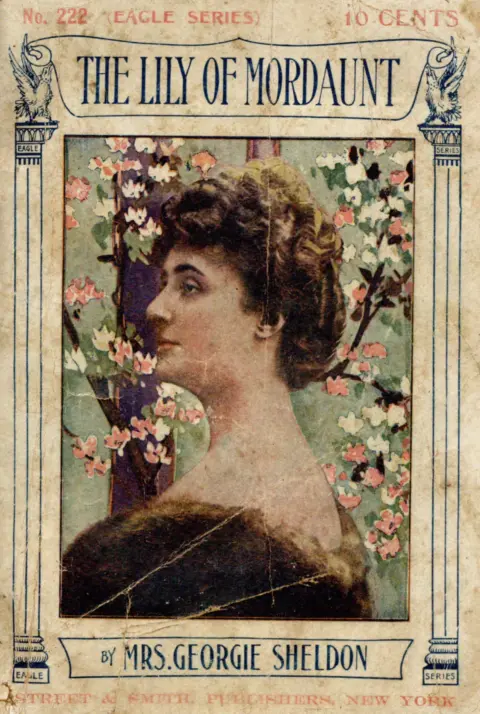
The lily of Mordaunt
Georgie, Mrs. Sheldon
THE CLASSIC COLLECTION · 1880
"Earle Wayne's Nobility" by Mrs. Georgie Sheldon is a novel written in the late 19th century. The story revolves around Earle Wayne, a young man wrongfully convicted of a crime he did not commit, and the struggles he faces as he navigates the trials of prison life and seeks to clear his name. The narrative also highlights Editha Dalton, a devoted friend who believes in his innocence and stands by him, grappling with her own emotions and societal pressures throughout the unfolding drama. At the start of the book, a tense courtroom scene sets the stage for Earle Wayne's conviction, with his solemn declaration of innocence echoing amidst the crowd’s murmurs of sympathy. The chapter introduces Editha Dalton, who passionately pleads for his acquittal, revealing her deep feelings for Earle and her commitment to helping him prove his innocence. As Earle is sentenced to three years of hard labor, the story follows both characters' emotional turmoil, the complexity of their relationship, and the societal constraints they must navigate as the plot unfolds around the themes of nobility, honor, and redemption.
Introduction adapted from the source catalogue; source summaries may be automatically generated.
Free to read · English · 147,272 words · No account needed
MAKE TIME FOR A GOOD BOOK
On by default. Untick to stop anonymous reading totals. Each page counts after 10 seconds in view. How this works.
Anonymous counting is on unless you have switched it off.
A stormy interview between father and daughter had followed, Mr. Dalton declaring that she should marry the rich Englishman, and Editha as firmly asserting that she should not do so.
The disappointed lover, however, followed them to Newport, where he continually haunted every scene of pleasure where the fair girl was to be found; and, to Editha’s shame, she was at last forced to believe that her father was still bidding him hope against hope.
It might be thought that Paul Tressalia was lacking in either pride for himself or proper respect for the woman he professed to love, by being so persistent but it was the one passion of his life, although he was thirty years of age, and he could not easily yield to her gentle though firm refusal, particularly when Mr. Dalton told him he must eventually overcome her objections if he was patient.
He was not presuming in his attentions; he never forced his society upon her; yet, with a patience and faithfulness that deserved a better return, he waited and hoped.
“If you would but give me the least ray of hope that I may eventually win your love, Miss Editha; my life will be ruined without the crown of your love,” he had ventured to urge once more, in a sorrowful kind of way, on the last evening of her stay at Newport.
He had heard she was going on the morrow and he could not bear it; he must put his fate to the test once more and for the last time.
“Mr. Tressalia,” she entreated, in a pained voice, “what shall I tell you to make you understand that it cannot be?”
“There could be only one thing that you could tell me that would destroy every gleam of hope.”
“And that?” she interrupted, with a quick breath and a fluttering of her
white lids.
“That your love is given to another,” he said, passionately, and searching, with sudden foreboding, the beautiful face he loved so well.
The rich blood surged instantly over cheek brow, and neck.
Could she confess that she loved another, when that love was as yet
unspoken even to its object?
And yet she must not go away and leave him to feed on a hopeless
passion.
Would it be maidenly? Would it be proper?
“Editha, have I been deceived all this while? Have I been persecuting you with my attentions, while you loved another?” he cried, in consternation, as he marked that startled flush, and intuitively knew its cause.
She looked up into his white, pained face, and pitied him from the
depths of her tender heart.
Your reading position is saved on this browser. Take it to another device with a library code. Reading pages adapt to text, rather than matching a printed edition.
Georgie, Mrs. Sheldon
Georgie, Mrs. Sheldon
Georgie, Mrs. Sheldon
Georgie, Mrs. Sheldon
BEHIND THE BOOK
This eBook is for the use of anyone anywhere in the United States and most other parts of the world at no cost and with almost no restrictions whatsoever. You may copy it, give it away or re-use it under the terms of the Project Gutenberg License included with this eBook or online at www.gutenberg.org. If you are not located in the United States, you will have to check the laws of the country where you are located before using this eBook. Read the source licence.
The original source file, including credits and licence, is retained by this library. Request an original-format copy at no charge. Please include the book title and Project Gutenberg identifier #70862.
KEEP YOUR CURIOSITY GOING
Coulson Kernahan

Maurice Baring
Frances Wright
Cécile Tormay

Frederic Jesup Stimson

W. H. P. (William Henry Pope) Jarvis