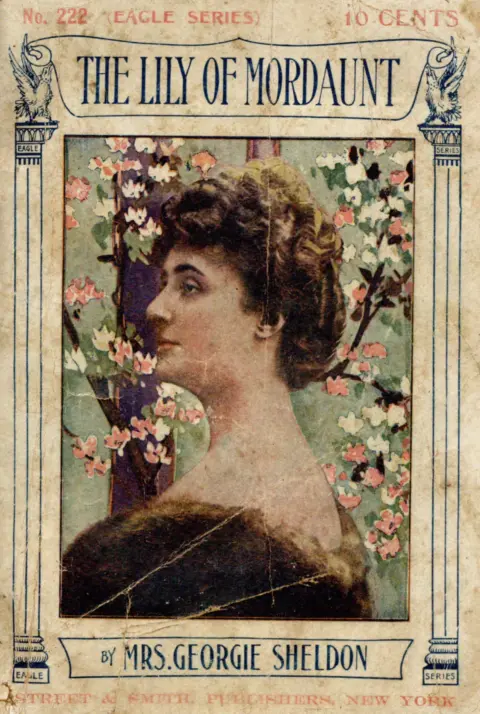
The lily of Mordaunt
Georgie, Mrs. Sheldon
THE CLASSIC COLLECTION · 1880
"Earle Wayne's Nobility" by Mrs. Georgie Sheldon is a novel written in the late 19th century. The story revolves around Earle Wayne, a young man wrongfully convicted of a crime he did not commit, and the struggles he faces as he navigates the trials of prison life and seeks to clear his name. The narrative also highlights Editha Dalton, a devoted friend who believes in his innocence and stands by him, grappling with her own emotions and societal pressures throughout the unfolding drama. At the start of the book, a tense courtroom scene sets the stage for Earle Wayne's conviction, with his solemn declaration of innocence echoing amidst the crowd’s murmurs of sympathy. The chapter introduces Editha Dalton, who passionately pleads for his acquittal, revealing her deep feelings for Earle and her commitment to helping him prove his innocence. As Earle is sentenced to three years of hard labor, the story follows both characters' emotional turmoil, the complexity of their relationship, and the societal constraints they must navigate as the plot unfolds around the themes of nobility, honor, and redemption.
Introduction adapted from the source catalogue; source summaries may be automatically generated.
Free to read · English · 147,272 words · No account needed
MAKE TIME FOR A GOOD BOOK
On by default. Untick to stop anonymous reading totals. Each page counts after 10 seconds in view. How this works.
Anonymous counting is on unless you have switched it off.
Everybody who knows anything about Newport—the Brighton of America—knows that the season there is one long scene of gayety, pleasure, and splendor.
And this year bade fair to eclipse all previous years owing to the unusual brilliancy and elegance of its entertainments, its incessant round of pleasure, the presence of numberless beautiful women, with their magnificent toilets, and the great number of distinguished guests from abroad.
Among these latter one in particular seemed to attract great attention, on account of his noble personal attractions, the report of his great wealth, and, more than all, because of his being unmarried, handsome, and—thirty.
He was an F. R. C. S., had graduated with high honors, and the reputation of his skill was in everybody’s mouth, while it was stated upon the best authority that he was heir prospective to large estates in both England and France, though where they were situated, and of their extent, no one seemed to know.
“Mr. Tressalia, allow me to present to you my daughter, Miss Dalton.”
Such was the introduction of Paul Tressalia, the distinguished stranger, to Edith Dalton, as performed by Mr. Dalton, one golden summer evening, as Editha sat by herself upon the broad piazza of their hotel, musing rather pensively upon the events of the past two years.
Editha lifted her large blue eyes, which filled with instant admiration as they rested upon the handsome stranger, and she gracefully saluted him, realizing at once that she was in the presence of a man of power—one of superior intellect, and yet with a velvet hand withal, as the mild dark eyes and the gentle expression of his mouth asserted.
Mr. Tressalia, on his part, was evidently powerfully attracted by those same large and expressive eyes, which were reading his face with such a comprehensive glance.
His gaze rested admiringly on the slender figure, with its mien of blended grace, reserve, and dignity, attired, so simply yet artistically, in its force of spotless embroidered muslin; on the small head, with its silken aureate crown; on the sweet face, so full of expression and the impress of latent character.
Her small hands seemed to him like “symmetrical snowflakes,” her feet like little mice peeping from beneath the flowing robe, and all her movements full of “sweet, attractive grace.”
Mr. Tressalia noted all this during the ceremony of introduction, and realized at once that he had “met his fate” in this being “fair as Venus,” whose
“Face and figure wove a spell
While her bright eyes were beaming.”
Your reading position is saved on this browser. Take it to another device with a library code. Reading pages adapt to text, rather than matching a printed edition.
Georgie, Mrs. Sheldon
Georgie, Mrs. Sheldon
Georgie, Mrs. Sheldon
Georgie, Mrs. Sheldon
BEHIND THE BOOK
This eBook is for the use of anyone anywhere in the United States and most other parts of the world at no cost and with almost no restrictions whatsoever. You may copy it, give it away or re-use it under the terms of the Project Gutenberg License included with this eBook or online at www.gutenberg.org. If you are not located in the United States, you will have to check the laws of the country where you are located before using this eBook. Read the source licence.
The original source file, including credits and licence, is retained by this library. Request an original-format copy at no charge. Please include the book title and Project Gutenberg identifier #70862.
KEEP YOUR CURIOSITY GOING
Coulson Kernahan

Maurice Baring
Frances Wright
Cécile Tormay

Frederic Jesup Stimson

W. H. P. (William Henry Pope) Jarvis