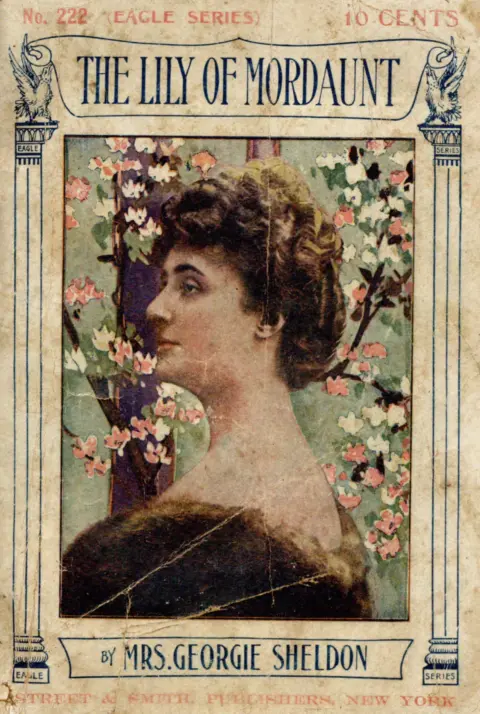
The lily of Mordaunt
Georgie, Mrs. Sheldon
THE CLASSIC COLLECTION · 1879
"Brownie's Triumph" by Mrs. Georgie Sheldon is a fiction novel written in the late 19th century. The story centers around the character of Brownie Douglas, a young heiress whose life takes a dramatic turn after the death of her wealthy aunt, leaving her without the fortune she expected. The novel explores themes of resilience, societal expectations, and the journey of a young woman as she confronts the realities of life in a world that suddenly feels far less secure. The opening of "Brownie's Triumph" introduces readers to a lively scene set during the World’s Centennial Exposition in Philadelphia. Brownie Douglas, a petite and spirited young woman, has just encountered her elegant friend Aspasia Huntington, who is struggling with her extravagant attire. The narrative unfolds with comedic moments involving a clumsy countryman, showcasing the contrast between the two young ladies. As the girls navigate through the exposition, they attract the attention of two young men, setting the stage for potential romantic developments amidst Brownie's transition from wealth to self-sufficiency after her aunt's passing. This initial glimpse of both frivolity and deeper themes offers a captivating start to Brownie’s journey.
Introduction adapted from the source catalogue; source summaries may be automatically generated.
Free to read · English · 100,316 words · No account needed
MAKE TIME FOR A GOOD BOOK
On by default. Untick to stop anonymous reading totals. Each page counts after 10 seconds in view. How this works.
Anonymous counting is on unless you have switched it off.
One tall, fair, and languid, and dressed in the height of fashion; covered with jewels, laces, flowers, and furbelows, not to mention a three-quarters of a yard train, which, with the other fixings referred to, demanded so much of her attention that she could enjoy nothing of the wonders and beauties around her.
The other, petite and dainty; her glossy brown hair simply coiled at the back of her small head, which was crowned with a hat of dark straw, trimmed with a wreath of scarlet berries and shining dark green leaves. Her half-fitting linen ulster protected, while it did not wholly conceal her rich though simple dress of black silk, which just cleared the floor, and did not hide the “two mites of feet,” incased in their tiny French boots. A pair of gray silk gloves covered her little hands, and a simple linen collar was fastened at her delicate throat by a richly carved spray of coral, her only visible ornament.
“Are you ready to go on now?” she asked her friend, as she saw the frown upon her brow fade out, at being once more set in moving order.
“Yes, but— There! Oh, dear!”
Miss Douglas, who was about moving on, turned again at this cry of woe, and immediately a ripple of musical, irrepressible laughter broke from her scarlet lips.
There stood her friend in the act of gathering up her voluminous train, while directly behind her stood an unmistakable countryman, with one huge foot planted firmly upon the ruffles and plaitings of the beautiful skirt, securely pinning it to the floor, and making it optional with Miss Aspasia, either to go on and leave behind her that (to her) very important appendage, or wait until that herculean member should be removed.
The luckless, though innocent cause of this uncomfortable state of affairs, was gazing with wide eyes, and open mouth, at the figure of an Indian upon the trail opposite him, and wholly unconscious of the strong attachment which bound him to the fashionable belle.
“I beg your pardon,” said Miss Douglas, hastening to the rescue, “but will you please lift your foot?”
“Eh? What? Oh, ya-as,” ejaculated the clumsy, but good-natured fellow. “I declare, miss, I never saw so many wimmen a losin’ their clo’s off before. I hain’t ben nowhere to-day but somebody’s dress has ben tumblin’ off on ’em, and I’ve stepped on’t. I sh’d hev a fit if ’twar me, and I’m tarnal glad I wur born to a pair o’ breeches.”
Miss Huntington colored angrily, and murmured something about “such insufferable insolence,” whereupon the irrepressible countryman offered a piece of friendly advice.
Your reading position is saved on this browser. Take it to another device with a library code. Reading pages adapt to text, rather than matching a printed edition.
Georgie, Mrs. Sheldon
Georgie, Mrs. Sheldon
Georgie, Mrs. Sheldon
Georgie, Mrs. Sheldon
BEHIND THE BOOK
This eBook is for the use of anyone anywhere in the United States and most other parts of the world at no cost and with almost no restrictions whatsoever. You may copy it, give it away or re-use it under the terms of the Project Gutenberg License included with this eBook or online at www.gutenberg.org. If you are not located in the United States, you will have to check the laws of the country where you are located before using this eBook. Read the source licence.
The original source file, including credits and licence, is retained by this library. Request an original-format copy at no charge. Please include the book title and Project Gutenberg identifier #71118.
KEEP YOUR CURIOSITY GOING
Coulson Kernahan

Maurice Baring
Frances Wright
Cécile Tormay

Frederic Jesup Stimson

W. H. P. (William Henry Pope) Jarvis