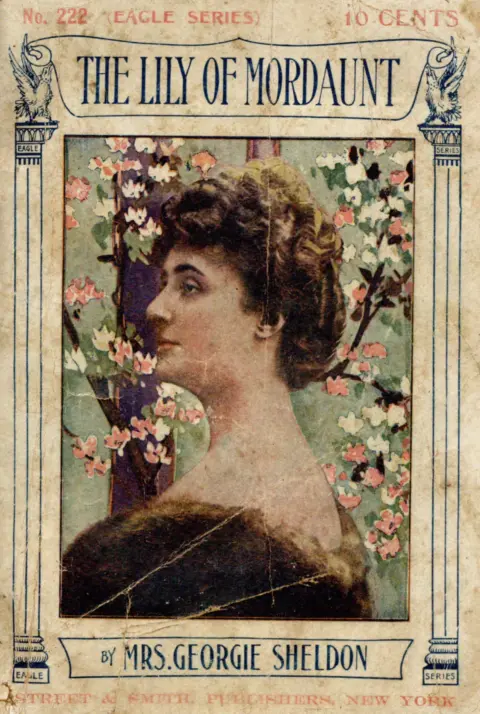
The lily of Mordaunt
Georgie, Mrs. Sheldon
THE CLASSIC COLLECTION · 1880
"Earle Wayne's Nobility" by Mrs. Georgie Sheldon is a novel written in the late 19th century. The story revolves around Earle Wayne, a young man wrongfully convicted of a crime he did not commit, and the struggles he faces as he navigates the trials of prison life and seeks to clear his name. The narrative also highlights Editha Dalton, a devoted friend who believes in his innocence and stands by him, grappling with her own emotions and societal pressures throughout the unfolding drama. At the start of the book, a tense courtroom scene sets the stage for Earle Wayne's conviction, with his solemn declaration of innocence echoing amidst the crowd’s murmurs of sympathy. The chapter introduces Editha Dalton, who passionately pleads for his acquittal, revealing her deep feelings for Earle and her commitment to helping him prove his innocence. As Earle is sentenced to three years of hard labor, the story follows both characters' emotional turmoil, the complexity of their relationship, and the societal constraints they must navigate as the plot unfolds around the themes of nobility, honor, and redemption.
Introduction adapted from the source catalogue; source summaries may be automatically generated.
Free to read · English · 147,272 words · No account needed
MAKE TIME FOR A GOOD BOOK
On by default. Untick to stop anonymous reading totals. Each page counts after 10 seconds in view. How this works.
Anonymous counting is on unless you have switched it off.
The servant who answered the ring at Mr. Dalton’s door found standing there a tall, dignified young man, with the unmistakable stamp of the gentleman upon him.
To his inquiry if Miss Dalton was at home, he replied that she was, and ushered him into a small reception-room opposite the drawing-room.
“Take this, if you please, to her,” Earle Wayne said, handing the man a blank, unsealed envelope.
The servant took it with a bow and withdrew, wondering what that spotless envelope contained, and who the gentleman was who sent no card—unless, perhaps, it might be in the envelope, and was intended for Edith’s eyes alone.
The fair girl arose with apparent calmness at his rap, and, taking the missive from his hand, opened it, and found within her own note, that she had written bidding Earle come to her as soon as he should be free.
At that moment she realized how very short and formal it was, and a feeling of remorse stole into her heart that she had not written more freely and kindly, in spite of her sensitiveness at her father’s sneers and insinuations.
Waiting a moment or two to cool the hot color in her cheeks, and to still the fierce beating of her heart, she then went slowly and trembling down to meet the brave hero, whom she had not seen for nearly three years.
Would he be much changed? Would he be pale, haggard, and miserable in appearance? Would he look the same, and speak the same, as he had done on that sad day when she had bidden him farewell and left him to go to his dreary fate within those four gloomy walls, or would he be broken and disheartened, and feel that the future held nothing but scorn and contempt for him?
She had read of men, noble, spirited, and energetic, who, having been imprisoned for a term of years, were ruined by it, and who had settled down into an existence of profound melancholy and inaction upon regaining their freedom.
Would Earle be like this?
These were some of the anxious questions which flitted through her mind on the way from her chamber to the reception-room, where Earle, with equal agitation, was awaiting her coming.
She opened the door softly and went in.
He did not hear her—he was standing at a window, his back toward her,
and absorbed in thought.
As if shod with velvet, Editha crossed the room and stood at his side.
Her eyes had lighted wondrously as they rested upon the proud, handsome figure before her, and the rich color coming and going in her cheeks made her marvelously beautiful.
Your reading position is saved on this browser. Take it to another device with a library code. Reading pages adapt to text, rather than matching a printed edition.
Georgie, Mrs. Sheldon
Georgie, Mrs. Sheldon
Georgie, Mrs. Sheldon
Georgie, Mrs. Sheldon
BEHIND THE BOOK
This eBook is for the use of anyone anywhere in the United States and most other parts of the world at no cost and with almost no restrictions whatsoever. You may copy it, give it away or re-use it under the terms of the Project Gutenberg License included with this eBook or online at www.gutenberg.org. If you are not located in the United States, you will have to check the laws of the country where you are located before using this eBook. Read the source licence.
The original source file, including credits and licence, is retained by this library. Request an original-format copy at no charge. Please include the book title and Project Gutenberg identifier #70862.
KEEP YOUR CURIOSITY GOING
Coulson Kernahan

Maurice Baring
Frances Wright
Cécile Tormay

Frederic Jesup Stimson

W. H. P. (William Henry Pope) Jarvis