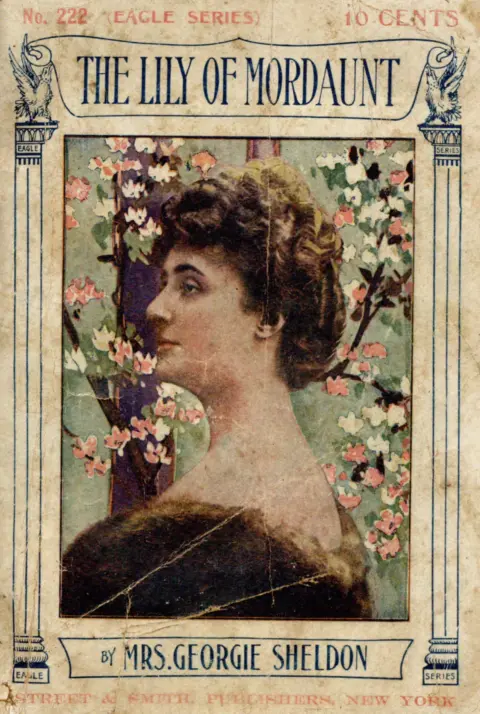
The lily of Mordaunt
Georgie, Mrs. Sheldon
THE CLASSIC COLLECTION · 1880
"Earle Wayne's Nobility" by Mrs. Georgie Sheldon is a novel written in the late 19th century. The story revolves around Earle Wayne, a young man wrongfully convicted of a crime he did not commit, and the struggles he faces as he navigates the trials of prison life and seeks to clear his name. The narrative also highlights Editha Dalton, a devoted friend who believes in his innocence and stands by him, grappling with her own emotions and societal pressures throughout the unfolding drama. At the start of the book, a tense courtroom scene sets the stage for Earle Wayne's conviction, with his solemn declaration of innocence echoing amidst the crowd’s murmurs of sympathy. The chapter introduces Editha Dalton, who passionately pleads for his acquittal, revealing her deep feelings for Earle and her commitment to helping him prove his innocence. As Earle is sentenced to three years of hard labor, the story follows both characters' emotional turmoil, the complexity of their relationship, and the societal constraints they must navigate as the plot unfolds around the themes of nobility, honor, and redemption.
Introduction adapted from the source catalogue; source summaries may be automatically generated.
Free to read · English · 147,272 words · No account needed
MAKE TIME FOR A GOOD BOOK
On by default. Untick to stop anonymous reading totals. Each page counts after 10 seconds in view. How this works.
Anonymous counting is on unless you have switched it off.
“My baby—Editha we had named her—was only three months of age, when one day, as my husband and I were watching her as she lay crowing and laughing in her cradle, the door behind us opened and some one entered the room. We both turned, and saw a form gaunt and trembling, a face pale and wasted, but dearer than life to me. It was Louis Villemain, my lost lover, whom I believed lying cold in death at the bottom of the sea.
“I was young, impulsive, and not yet strong after the birth of my child, and the shock was more than I could bear. With one wild cry of joy, I sprang forward and threw myself upon his bosom, forgetting that I was already a wife and a mother, forgetful of my husband’s presence—of everything save that Louis was alive and had returned. I murmured fond, wild words of love and delight, words which a wife has no right to speak save in the ear of her husband, and mine, sitting there, listened horror-struck, and learned the whole. It was only when, exhausted with my joy, I lay weeping on Louis’s bosom that I was at last aroused to a consciousness of what I had done, by my husband’s stern sarcasm.
“‘What may be the meaning of this exceedingly affecting scene, allow me to ask?’ he said, hissing the words between his teeth; and then with a shriek I realized our relative positions, and fell fainting to the floor.
“I need not dwell upon what followed,” madam said, with a sigh, “when I came to myself, Louis was gone, and my husband, angry and wretched at discovering how he had been deceived, was very unreasonable, and poured forth such a storm of jealous wrath upon me that I was nearly crushed. I confessed everything to him then, I pleaded my sorrow and weakness, and implored his forgiveness and mercy, but he denounced me as an unfaithful wife, at least at heart, and vowed that from that day we should live as strangers, and yet, for our child’s sake, every outward propriety must be observed. I was more wretched than I can express, and very unwisely poured forth my troubles into Louis’s ear, when he came the next day and sought me alone. I could not deny that the old love was stronger than the new, and the future looked like darkest gloom to me—my husband’s respect and confidence gone—my lover returned to look reproach upon me from sad and hollow eyes, and my conscience constantly upbraiding me for having married a good and noble man when I had no heart to give him. I felt like a forsaken thing, and, always morbidly sensitive, I was tenfold more so then in my weakened, nervous state. I do not pretend to excuse my sin—I can only tell it just as it happened. Louis, as wretched as myself, comforted me with the old, tender words that he used to speak, and, bemoaning my sad fate in being linked to such a cruel husband, urged me to fly with him on a new vessel that he was to command, and be happy in our own way. The vessel was to sail in a few days, and with passionate eloquence he pictured the delight of the free, beautiful, roving life we would lead. I consented, and one day, when my husband was absent for a few hours, I took my baby and fled. Louis had gone on before me, and was to meet me at the seaport town from which the vessel was to sail. Not being able to leave home until afternoon, I was obliged to stop over night at a small town about half way from the port. I was more lonely than I can tell you, as alone and unprotected I retired and lay with my baby in my arms, thinking of what I had done. I thought of my dead mother and her early teachings—of the words she used to love and repeat from the sacred book, and the earnestness with which she used to impress their meaning upon me, and the horror and guilt of the step I was contemplating overwhelmed me. My baby awoke at midnight, and would not be coaxed to sleep again; so, lighting the candle, I lay there and watched her play, and talk, and coo in her charming little way. Every now and then she would stop, look around the room as if she knew she was in a strange place, and then glance up at me with great serious eyes that seemed to question my conduct and reproach my rashness. I thought of my husband, who, though he had been hasty and somewhat cruel in his reproaches, was yet a good, true man. I pictured the despair he would feel when he should return and find his wife and child gone, his home desolate, his name dishonored, and all the horror of my rash act rushed with overwhelming force upon me. I threw myself upon my knees beside my bed and wept out my repentance there, resolving that early morning should find me returning like the prodigal to my home. I acted upon that resolve, first dispatching a note to Louis telling him of my resolution, and entreating him not to come to me again, nor seek to hold any communication with me.
Your reading position is saved on this browser. Take it to another device with a library code. Reading pages adapt to text, rather than matching a printed edition.
Georgie, Mrs. Sheldon
Georgie, Mrs. Sheldon
Georgie, Mrs. Sheldon
Georgie, Mrs. Sheldon
BEHIND THE BOOK
This eBook is for the use of anyone anywhere in the United States and most other parts of the world at no cost and with almost no restrictions whatsoever. You may copy it, give it away or re-use it under the terms of the Project Gutenberg License included with this eBook or online at www.gutenberg.org. If you are not located in the United States, you will have to check the laws of the country where you are located before using this eBook. Read the source licence.
The original source file, including credits and licence, is retained by this library. Request an original-format copy at no charge. Please include the book title and Project Gutenberg identifier #70862.
KEEP YOUR CURIOSITY GOING
Coulson Kernahan

Maurice Baring
Frances Wright
Cécile Tormay

Frederic Jesup Stimson

W. H. P. (William Henry Pope) Jarvis