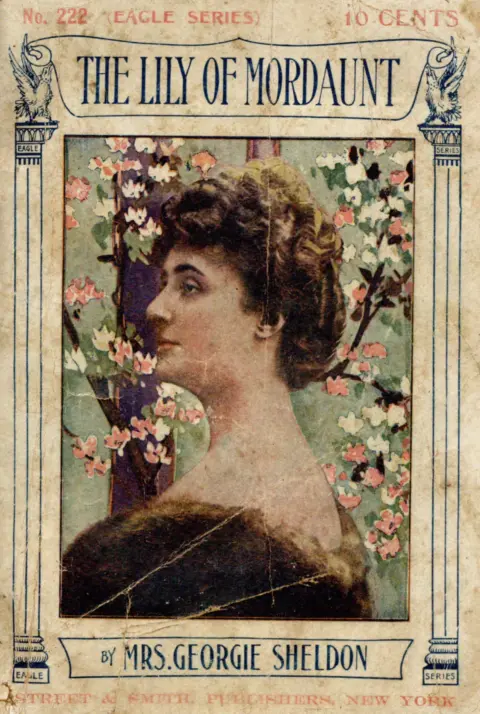
The lily of Mordaunt
Georgie, Mrs. Sheldon
THE CLASSIC COLLECTION · 1879
"Brownie's Triumph" by Mrs. Georgie Sheldon is a fiction novel written in the late 19th century. The story centers around the character of Brownie Douglas, a young heiress whose life takes a dramatic turn after the death of her wealthy aunt, leaving her without the fortune she expected. The novel explores themes of resilience, societal expectations, and the journey of a young woman as she confronts the realities of life in a world that suddenly feels far less secure. The opening of "Brownie's Triumph" introduces readers to a lively scene set during the World’s Centennial Exposition in Philadelphia. Brownie Douglas, a petite and spirited young woman, has just encountered her elegant friend Aspasia Huntington, who is struggling with her extravagant attire. The narrative unfolds with comedic moments involving a clumsy countryman, showcasing the contrast between the two young ladies. As the girls navigate through the exposition, they attract the attention of two young men, setting the stage for potential romantic developments amidst Brownie's transition from wealth to self-sufficiency after her aunt's passing. This initial glimpse of both frivolity and deeper themes offers a captivating start to Brownie’s journey.
Introduction adapted from the source catalogue; source summaries may be automatically generated.
Free to read · English · 100,316 words · No account needed
MAKE TIME FOR A GOOD BOOK
On by default. Untick to stop anonymous reading totals. Each page counts after 10 seconds in view. How this works.
Anonymous counting is on unless you have switched it off.
“Thank you, Viola; but you are altogether too enthusiastic in your compliments,” Brownie returned, with a smile.
Yet as she glanced into the mirror, she grew suddenly conscious, and blushed with a sense of her own beauty.
Her hair was drawn away from her broad, low forehead, and knotted gracefully at the back of her small head.
Her beautiful neck gleamed through the misty fichu, and her rounded arms were only half concealed by the fall of delicate lace from her sleeves.
She wore a finely wrought chain of gold about her neck, from which was suspended the beautiful coral cross, set with brilliants, which her aunt had given her at the same time she gave her the other contents of the casket.
The butterfly hair ornament to match she had fastened in her glossy hair, and it sparkled and gleamed with her every movement.
She surely was lovely, as Viola said:
“I’m afraid your mamma will think me too fine,” she said, half regretfully, and struck by the young girl’s words.
“But,” she added, “this is the simplest thing I have, unless I wear white, and your mamma said Alma was to dress in white.”
“Miss Douglas, who—what are you?” Viola asked, an expression of perplexity on her young face.
“My dear, must I repeat my dreadful name? I am Mehetabel Douglas, and a poor governess,” Brownie said, gayly.
“I know that, of course; but haven’t you been a fine lady at some time in your life?” demanded the young girl, impatiently.
“That depends altogether upon what you mean by the term ‘fine lady,’
Viola.”
“Why, one who has everything rich and elegant, and who goes among
fashionable people.”
Brownie smiled at this definition of the term, but she replied, gravely,
and a little sadly:
“My dear, you have been so kind to me, I will gratify you in this, only please remember that I do not care to have it spoken of again. A year ago—yes, and much less—my prospects in life were as bright as your own are now. But death and misfortune took everything from me, and I was obliged to do something for my own support.”
“Did you live in an elegant house, and have servants, horses, and
carriages?”
“Yes.”
“Have you always had these things until now?”
“Yes, dear.”
“Then you are every bit as good as we are, and it’s a shame that you are not treated as an equal,” burst from Viola’s lips, indignantly, as she remembered all Isabel’s sneers about “the governess,” and her mother’s scathing remarks regarding “that person, Miss Douglas.”
Your reading position is saved on this browser. Take it to another device with a library code. Reading pages adapt to text, rather than matching a printed edition.
Georgie, Mrs. Sheldon
Georgie, Mrs. Sheldon
Georgie, Mrs. Sheldon
Georgie, Mrs. Sheldon
BEHIND THE BOOK
This eBook is for the use of anyone anywhere in the United States and most other parts of the world at no cost and with almost no restrictions whatsoever. You may copy it, give it away or re-use it under the terms of the Project Gutenberg License included with this eBook or online at www.gutenberg.org. If you are not located in the United States, you will have to check the laws of the country where you are located before using this eBook. Read the source licence.
The original source file, including credits and licence, is retained by this library. Request an original-format copy at no charge. Please include the book title and Project Gutenberg identifier #71118.
KEEP YOUR CURIOSITY GOING
Coulson Kernahan

Maurice Baring
Frances Wright
Cécile Tormay

Frederic Jesup Stimson

W. H. P. (William Henry Pope) Jarvis