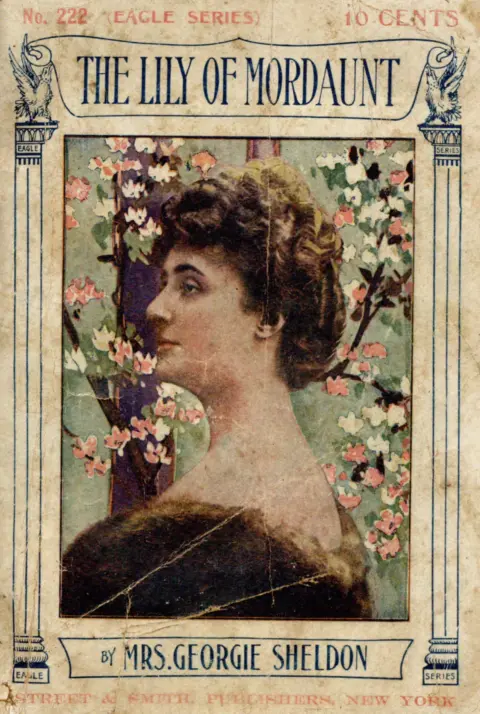
The lily of Mordaunt
Georgie, Mrs. Sheldon
THE CLASSIC COLLECTION · 1879
"Brownie's Triumph" by Mrs. Georgie Sheldon is a fiction novel written in the late 19th century. The story centers around the character of Brownie Douglas, a young heiress whose life takes a dramatic turn after the death of her wealthy aunt, leaving her without the fortune she expected. The novel explores themes of resilience, societal expectations, and the journey of a young woman as she confronts the realities of life in a world that suddenly feels far less secure. The opening of "Brownie's Triumph" introduces readers to a lively scene set during the World’s Centennial Exposition in Philadelphia. Brownie Douglas, a petite and spirited young woman, has just encountered her elegant friend Aspasia Huntington, who is struggling with her extravagant attire. The narrative unfolds with comedic moments involving a clumsy countryman, showcasing the contrast between the two young ladies. As the girls navigate through the exposition, they attract the attention of two young men, setting the stage for potential romantic developments amidst Brownie's transition from wealth to self-sufficiency after her aunt's passing. This initial glimpse of both frivolity and deeper themes offers a captivating start to Brownie’s journey.
Introduction adapted from the source catalogue; source summaries may be automatically generated.
Free to read · English · 100,316 words · No account needed
MAKE TIME FOR A GOOD BOOK
On by default. Untick to stop anonymous reading totals. Each page counts after 10 seconds in view. How this works.
Anonymous counting is on unless you have switched it off.
That night Miss Mehetabel died suddenly of heart disease.
How the next few days passed Brownie never knew, but it was all over at
last.
There were no near relatives, only some distant cousins, and these, knowing they had no claim upon the old lady’s money, did not deem it worth their while to come to the funeral. So Brownie and Aspasia, who had proved herself a real comfort in these days of trial, sat alone, excepting the servants and a few intimate acquaintances, in those great somber rooms, while those last sad words were spoken above the dead.
And then they carried her forth to her last long home, and laid her beside those other dear ones, who had been gone so many years.
It seemed to Brownie as if she were almost the only one living—as if all the world had died and were buried, when she returned to that great house in all its lonely splendor.
“Oh, Aspasia,” she cried, throwing herself into Miss Huntington’s arms, with her first wild burst of tears, “What shall I do? I have nobody in the world now to love me.”
“Don’t talk so, darling,” she said, her own tears flowing in sympathy. “I love you better than any one else in the world, and I will never forsake you.”
She little knew how soon her words would be put to the test.
“I know you love me, dear, but you cannot stay with me; you will soon go home, where you have a fond father and mother, brothers and sisters, while I have no one. I have no object in life, Aspasia, now that auntie is gone,” and again the torrent of grief rushed forth.
Miss Huntington made her lie down, and soothed her as she would a child. With her own dainty hands she removed her boots, brought a soft pair of slippers and put them on, then bathed her head, and worked over her until she grew calm again.
Their conversation was interrupted by a servant coming to tell them that Miss Douglas’ presence was required in the library to listen to the reading of the will. The summons made the poor girl’s grief burst forth afresh.
“Oh, auntie, auntie!” she sobbed, “your money will be nothing to me without you—gold without love is worthless.”
“You will go down with me, Aspasia,” she said, holding out her hand to her friend as she arose to obey the request.
“Certainly, dear, if you wish,” was the kind reply, and the two friends descended to the library, to find Miss Mehetabel’s lawyer, the family doctor, and clergyman awaiting their appearance.
Your reading position is saved on this browser. Take it to another device with a library code. Reading pages adapt to text, rather than matching a printed edition.
Georgie, Mrs. Sheldon
Georgie, Mrs. Sheldon
Georgie, Mrs. Sheldon
Georgie, Mrs. Sheldon
BEHIND THE BOOK
This eBook is for the use of anyone anywhere in the United States and most other parts of the world at no cost and with almost no restrictions whatsoever. You may copy it, give it away or re-use it under the terms of the Project Gutenberg License included with this eBook or online at www.gutenberg.org. If you are not located in the United States, you will have to check the laws of the country where you are located before using this eBook. Read the source licence.
The original source file, including credits and licence, is retained by this library. Request an original-format copy at no charge. Please include the book title and Project Gutenberg identifier #71118.
KEEP YOUR CURIOSITY GOING
Coulson Kernahan

Maurice Baring
Frances Wright
Cécile Tormay

Frederic Jesup Stimson

W. H. P. (William Henry Pope) Jarvis