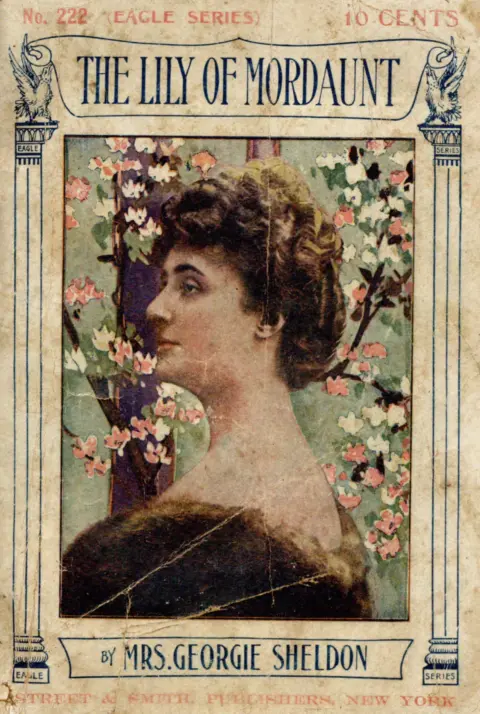
The lily of Mordaunt
Georgie, Mrs. Sheldon
THE CLASSIC COLLECTION · 1879
"Brownie's Triumph" by Mrs. Georgie Sheldon is a fiction novel written in the late 19th century. The story centers around the character of Brownie Douglas, a young heiress whose life takes a dramatic turn after the death of her wealthy aunt, leaving her without the fortune she expected. The novel explores themes of resilience, societal expectations, and the journey of a young woman as she confronts the realities of life in a world that suddenly feels far less secure. The opening of "Brownie's Triumph" introduces readers to a lively scene set during the World’s Centennial Exposition in Philadelphia. Brownie Douglas, a petite and spirited young woman, has just encountered her elegant friend Aspasia Huntington, who is struggling with her extravagant attire. The narrative unfolds with comedic moments involving a clumsy countryman, showcasing the contrast between the two young ladies. As the girls navigate through the exposition, they attract the attention of two young men, setting the stage for potential romantic developments amidst Brownie's transition from wealth to self-sufficiency after her aunt's passing. This initial glimpse of both frivolity and deeper themes offers a captivating start to Brownie’s journey.
Introduction adapted from the source catalogue; source summaries may be automatically generated.
Free to read · English · 100,316 words · No account needed
MAKE TIME FOR A GOOD BOOK
On by default. Untick to stop anonymous reading totals. Each page counts after 10 seconds in view. How this works.
Anonymous counting is on unless you have switched it off.
Meanwhile the day for Lady Peasewell’s drawing-room dawned.
Isabel Coolidge spared no pains or expense to make herself captivating for the occasion, and she succeeded admirably.
Her father’s unexpected return, and his anger at her own and her mother’s treatment of Miss Douglas, had threatened to upset all her plans, however.
He demanded that the jewels be brought to him, and another exciting
scene ensued over them.
It must be confessed that he was somewhat confounded himself when he beheld them, and a feeling of doubt entered his mind regarding Brownie’s honesty; but he would not confess it to his family, and censured them in no light terms for the dishonorable way in which they had become possessed of the rare stones.
It all ended in angry tears on the mother’s and daughter’s part, and in his taking charge of those unfortunate trinkets which had caused so much trouble, and locking them securely in his safe.
Isabel dawdled away the morning in a state of fretful unhappiness, and declared to herself, over and over again, that her appearance would be ruined without the governess’s jewels.
After dinner, however, her father complained of a raging headache; two hours later he was in a high fever, and all thoughts of his attending the evening’s festivities were relinquished.
From that moment Isabel’s spirits rose, the clouds vanished from her brow, and she was even heard humming a gay opera air.
“Wilbur can act as our escort, mamma; so we shall be all right,” she said, when her mother complained of the circumstance as spoiling all their pleasure.
“I have no heart for it, and would not go myself, were it not on your account,” she replied, wearily.
Her husband’s displeasure, and the fate of the missing governess, still weighed heavily on her conscience.
A few hours later she and Wilbur were waiting in the drawing-room for Isabel to make her appearance.
“Does my amiable sister contemplate a brilliant conquest to-night, that she is so long making her toilet?” sneered the young man, who had been pressed into the service, and was impatient of the delay.
“Do speak a little more kindly of Isabel, my son,” said Mrs. Coolidge, adding, with a heavy sigh: “In all probability she will marry some day, and it is desirable that she should make a good match.”
“Certainly; only there may be a difference of opinion as to what a ‘good match’ is,” he returned, sarcastically.
“I consider any one who occupies a good position in the world, and who has plenty of money, an eligible parti.”
“Regardless of either heart, brain, or principles,” interrupted Wilbur
cynically.
Your reading position is saved on this browser. Take it to another device with a library code. Reading pages adapt to text, rather than matching a printed edition.
Georgie, Mrs. Sheldon
Georgie, Mrs. Sheldon
Georgie, Mrs. Sheldon
Georgie, Mrs. Sheldon
BEHIND THE BOOK
This eBook is for the use of anyone anywhere in the United States and most other parts of the world at no cost and with almost no restrictions whatsoever. You may copy it, give it away or re-use it under the terms of the Project Gutenberg License included with this eBook or online at www.gutenberg.org. If you are not located in the United States, you will have to check the laws of the country where you are located before using this eBook. Read the source licence.
The original source file, including credits and licence, is retained by this library. Request an original-format copy at no charge. Please include the book title and Project Gutenberg identifier #71118.
KEEP YOUR CURIOSITY GOING
Coulson Kernahan

Maurice Baring
Frances Wright
Cécile Tormay

Frederic Jesup Stimson

W. H. P. (William Henry Pope) Jarvis