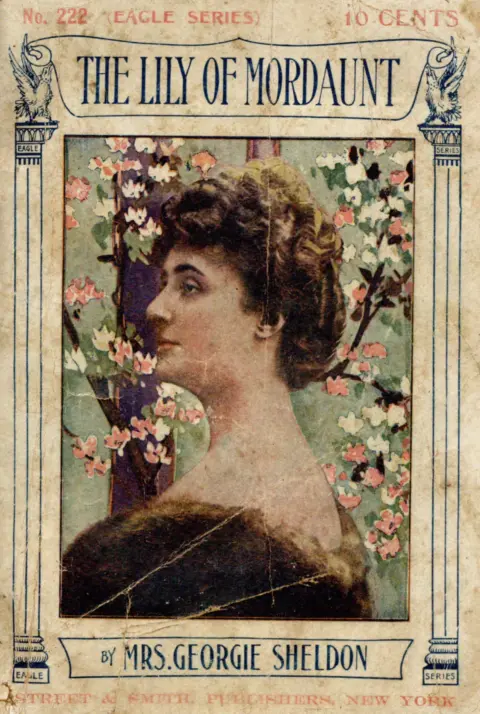
The lily of Mordaunt
Georgie, Mrs. Sheldon
THE CLASSIC COLLECTION · 1879
"Brownie's Triumph" by Mrs. Georgie Sheldon is a fiction novel written in the late 19th century. The story centers around the character of Brownie Douglas, a young heiress whose life takes a dramatic turn after the death of her wealthy aunt, leaving her without the fortune she expected. The novel explores themes of resilience, societal expectations, and the journey of a young woman as she confronts the realities of life in a world that suddenly feels far less secure. The opening of "Brownie's Triumph" introduces readers to a lively scene set during the World’s Centennial Exposition in Philadelphia. Brownie Douglas, a petite and spirited young woman, has just encountered her elegant friend Aspasia Huntington, who is struggling with her extravagant attire. The narrative unfolds with comedic moments involving a clumsy countryman, showcasing the contrast between the two young ladies. As the girls navigate through the exposition, they attract the attention of two young men, setting the stage for potential romantic developments amidst Brownie's transition from wealth to self-sufficiency after her aunt's passing. This initial glimpse of both frivolity and deeper themes offers a captivating start to Brownie’s journey.
Introduction adapted from the source catalogue; source summaries may be automatically generated.
Free to read · English · 100,316 words · No account needed
MAKE TIME FOR A GOOD BOOK
On by default. Untick to stop anonymous reading totals. Each page counts after 10 seconds in view. How this works.
Anonymous counting is on unless you have switched it off.
Her Majesty’s Opera, Drury Lane, was crowded to its utmost capacity when
our party arrived.
But having secured a private box, this circumstance did not
inconvenience them in the least.
Wilbur Coolidge took care, after his mother and Isabel were comfortably seated, that Miss Douglas should have a place where she could command a good view of the stage.
He was disgusted with their treatment of the lovely governess, and
strove by numerous little attentions to atone in part for their
rudeness.
A battery of lorgnettes was immediately leveled at this brilliant company, and there were numberless surmisings and questionings as to who the newcomers could be.
In a box not far from the Coolidge party there sat a royal-looking couple—an old gentleman, still hale and hearty, although upward of sixty-five, and a matron of perhaps a half-dozen years younger.
By the side of the latter, and assiduously attending to her wants, was a young man of about two-and-twenty.
It was no other than Adrian Dredmond!
He, too, had leveled his glass as the newcomers settled themselves in
their places.
After one sweeping glance, he half started from his chair, with a low
exclamation of pleasure.
“Whom do you see, Adrian?” asked the lady by his side.
“Some friends who came over in the same steamer with me, I believe,” he replied, taking another look, and a smile of pleasure curving his fine lips as his eye rested upon Brownie, who seemed to him in her elegant robes like some beautiful vision from another sphere.
“Americans?” demanded his companion, preparing to adjust her own glass.
“Yes, your ladyship,” was the quiet response.
“Ah!”
Her ladyship, as she uttered this with a slight accent of contempt, evidently did not deem them worthy the effort of a glance, and accordingly turned her glass toward the stage, the curtain having risen for the first act.
For a time the attention of all was attracted in the same direction.
Brownie sat as one entranced, forgetting the past, and living over again the exquisite delight which she had so often experienced in by-gone days.
“You are fond of the opera, Miss Douglas?” Wilbur whispered, when the curtain at length fell.
“Passionately,” she replied, turning her glowing face toward him; then added: “And, Mr. Coolidge, you have given me the first bit of unalloyed pleasure I have had since great misfortune came upon me.”
Her voice quivered, her eyes were dewy, and her breast heaved with the deliciousness of the hour.
“I would I could henceforth give you every joy of earth,” he murmured,
tenderly, in her ear.
Your reading position is saved on this browser. Take it to another device with a library code. Reading pages adapt to text, rather than matching a printed edition.
Georgie, Mrs. Sheldon
Georgie, Mrs. Sheldon
Georgie, Mrs. Sheldon
Georgie, Mrs. Sheldon
BEHIND THE BOOK
This eBook is for the use of anyone anywhere in the United States and most other parts of the world at no cost and with almost no restrictions whatsoever. You may copy it, give it away or re-use it under the terms of the Project Gutenberg License included with this eBook or online at www.gutenberg.org. If you are not located in the United States, you will have to check the laws of the country where you are located before using this eBook. Read the source licence.
The original source file, including credits and licence, is retained by this library. Request an original-format copy at no charge. Please include the book title and Project Gutenberg identifier #71118.
KEEP YOUR CURIOSITY GOING
Coulson Kernahan

Maurice Baring
Frances Wright
Cécile Tormay

Frederic Jesup Stimson

W. H. P. (William Henry Pope) Jarvis