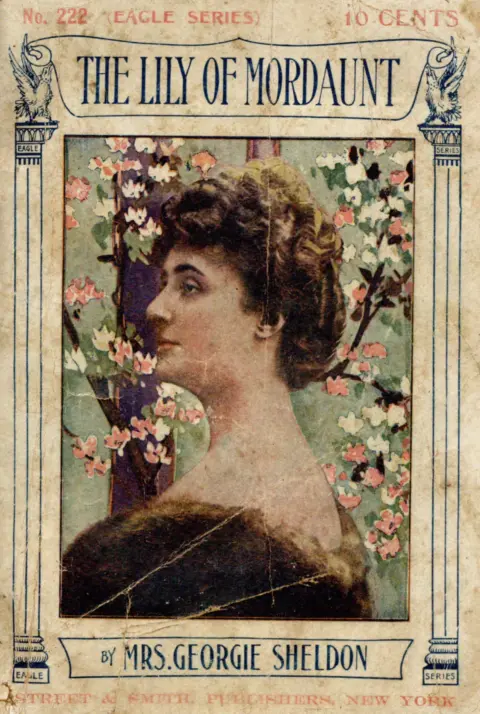
The lily of Mordaunt
Georgie, Mrs. Sheldon
THE CLASSIC COLLECTION · 1879
"Brownie's Triumph" by Mrs. Georgie Sheldon is a fiction novel written in the late 19th century. The story centers around the character of Brownie Douglas, a young heiress whose life takes a dramatic turn after the death of her wealthy aunt, leaving her without the fortune she expected. The novel explores themes of resilience, societal expectations, and the journey of a young woman as she confronts the realities of life in a world that suddenly feels far less secure. The opening of "Brownie's Triumph" introduces readers to a lively scene set during the World’s Centennial Exposition in Philadelphia. Brownie Douglas, a petite and spirited young woman, has just encountered her elegant friend Aspasia Huntington, who is struggling with her extravagant attire. The narrative unfolds with comedic moments involving a clumsy countryman, showcasing the contrast between the two young ladies. As the girls navigate through the exposition, they attract the attention of two young men, setting the stage for potential romantic developments amidst Brownie's transition from wealth to self-sufficiency after her aunt's passing. This initial glimpse of both frivolity and deeper themes offers a captivating start to Brownie’s journey.
Introduction adapted from the source catalogue; source summaries may be automatically generated.
Free to read · English · 100,316 words · No account needed
MAKE TIME FOR A GOOD BOOK
On by default. Untick to stop anonymous reading totals. Each page counts after 10 seconds in view. How this works.
Anonymous counting is on unless you have switched it off.
“And yet,” she said, thinking it over, “I know auntie would not wish me to deprive myself of the pleasure of attending the opera, and I know, also, she would not like me to appear in such a place in black.”
The other reason was the fear of displeasing Mrs. Coolidge if she made
any change.
But that matter was settled for her by that lady herself. She came to her room during the day, repeating the invitation which Wilbur had given her, and concluded by saying:
“Miss Douglas, have you not something a little more appropriate that you could wear? This black is hardly the thing.”
“I have several nice dresses which I used to wear upon such occasions, but I fear they are hardly suitable for my position now,” Brownie replied, with heightened color, for the first time alluding to the change in her circumstances.
“Ah!” said the matron, in surprise, and pleased with this evidence of the governess’ modesty; then she added, patronizingly: “You have seen better days, I presume?”
“Yes, madam.”
“Well, I leave the matter to your own judgment, only do not wear black, nor white, for Alma will wear that. Indeed,” she added, after a moment’s thought, “if you have a nice dress, Miss Douglas, wear it, for, as we are all going together, I do not care how nicely our party appears.”
An amused smile curled her lips at the expression, “if you have a nice dress,” and when the door closed after Mrs. Coolidge, she laughed outright.
Evidently she thought if the governess had seen better days, they could not have been very remarkable ones.
She crossed the room, and opened the trunk in which she had packed the richer portion of her clothing, and took out her evening dresses.
The decision was a difficult matter, and it was more than an hour before she could make up her mind which one of those beautiful garments it would do to wear.
She had no desire to outshine Miss Isabel.
But that young lady, with all her love for show and fashion, had nothing more elegant than Brownie’s own wardrobe contained.
She at length fixed upon a delicate maize-colored silk, trimmed with puffings of soft illusion, and ruffles of fine thread lace.
When the hour came for dressing, she arrayed herself with a throbbing
heart.
She had nearly completed her toilet, when Viola came sweeping in, lovely in blue silk and white tulle.
In her hands she carried a most exquisite bouquet of flowers.
She stood breathless on the threshold as she caught sight of Brownie.
“Miss Douglas,” she at length exclaimed, “how perfectly lovely you are!”
Your reading position is saved on this browser. Take it to another device with a library code. Reading pages adapt to text, rather than matching a printed edition.
Georgie, Mrs. Sheldon
Georgie, Mrs. Sheldon
Georgie, Mrs. Sheldon
Georgie, Mrs. Sheldon
BEHIND THE BOOK
This eBook is for the use of anyone anywhere in the United States and most other parts of the world at no cost and with almost no restrictions whatsoever. You may copy it, give it away or re-use it under the terms of the Project Gutenberg License included with this eBook or online at www.gutenberg.org. If you are not located in the United States, you will have to check the laws of the country where you are located before using this eBook. Read the source licence.
The original source file, including credits and licence, is retained by this library. Request an original-format copy at no charge. Please include the book title and Project Gutenberg identifier #71118.
KEEP YOUR CURIOSITY GOING
Coulson Kernahan

Maurice Baring
Frances Wright
Cécile Tormay

Frederic Jesup Stimson

W. H. P. (William Henry Pope) Jarvis