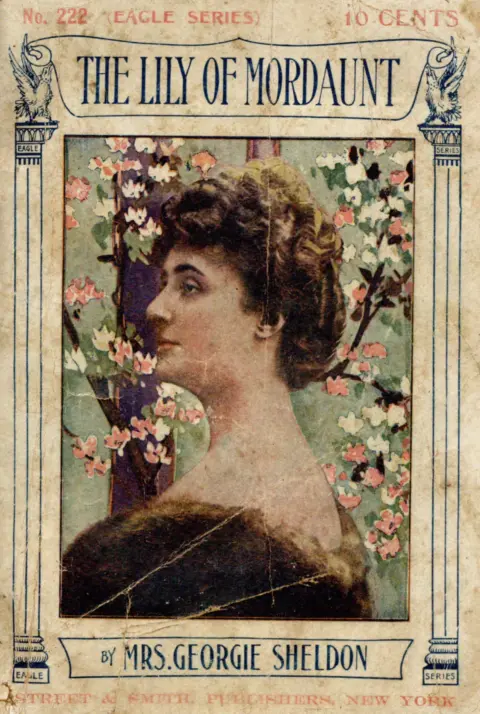
The lily of Mordaunt
Georgie, Mrs. Sheldon
THE CLASSIC COLLECTION · 1879
"Brownie's Triumph" by Mrs. Georgie Sheldon is a fiction novel written in the late 19th century. The story centers around the character of Brownie Douglas, a young heiress whose life takes a dramatic turn after the death of her wealthy aunt, leaving her without the fortune she expected. The novel explores themes of resilience, societal expectations, and the journey of a young woman as she confronts the realities of life in a world that suddenly feels far less secure. The opening of "Brownie's Triumph" introduces readers to a lively scene set during the World’s Centennial Exposition in Philadelphia. Brownie Douglas, a petite and spirited young woman, has just encountered her elegant friend Aspasia Huntington, who is struggling with her extravagant attire. The narrative unfolds with comedic moments involving a clumsy countryman, showcasing the contrast between the two young ladies. As the girls navigate through the exposition, they attract the attention of two young men, setting the stage for potential romantic developments amidst Brownie's transition from wealth to self-sufficiency after her aunt's passing. This initial glimpse of both frivolity and deeper themes offers a captivating start to Brownie’s journey.
Introduction adapted from the source catalogue; source summaries may be automatically generated.
Free to read · English · 100,316 words · No account needed
MAKE TIME FOR A GOOD BOOK
On by default. Untick to stop anonymous reading totals. Each page counts after 10 seconds in view. How this works.
Anonymous counting is on unless you have switched it off.
“Have you ever completed a regular course of study?” asked Mr. Alcott.
“Yes, sir; a thorough course. I graduated from the high school before I was sixteen, and I have since taken a two years’ classical course,” replied Brownie.
“You’ll do, then,” said the old man, with a contented nod of his head.
He was very much interested in the beautiful girl.
“My principal reason for hesitating is, that I have never had any experience in teaching, and could only follow the example of my own teachers, as far as I can remember it.”
“You are very truthful and frank, at all events,” remarked Mr. Coolidge,
smilingly.
“I should not presume to accept this position, sir, by placing myself in a false position,” replied Brownie, gravely.
“I think with my father-in-law, that you will do, and I feel confident that you will prove faithful to your trust. Shall we consider the bargain closed?” asked her employer, giving her a glance of admiration.
“Mr. Coolidge—I—really——” stammered the young girl.
She was astonished that he should desire to close the bargain, without making any inquiries regarding her character or antecedents, and yet she did not know how to broach the subject.
“Ah, I beg your pardon, Miss Douglas,” and the man of business looked utterly confused for a moment, “it was an oversight entirely that I did not mention what salary you would receive. Would four hundred a year and expenses meet your acceptance?”
“Make it five, William,” interrupted Mr. Alcott, adding: “With those harum-scarum girls it will be none too much; there will be plenty of little knickknacks that she will want to bring away from the old country, and an extra hundred will be none too much.”
“Well, call it five hundred and expenses, then,” said Mr. Coolidge.
“Excuse me, gentlemen, but I had not thought of the salary which I should receive. I was upon the point of saying that—you know nothing about me personally—whether I am, morally, one whom you would wish to receive into your family. I expected you would require references,” Brownie said, with dignity.
“Really, Miss Douglas,” said the former, “you have shown yourself wiser than I in this matter. That is a question which ought, according to the etiquette of the nineteenth century, to have been settled in the first place.”
“The very fact of her speaking of the matter herself is reference enough for me,” said Mr. Alcott, sotto voce.
“However,” continued her employer, “I suppose Mrs. Coolidge would be better pleased to have that matter satisfactorily settled. What reference can you give us, Miss Douglas?”
Your reading position is saved on this browser. Take it to another device with a library code. Reading pages adapt to text, rather than matching a printed edition.
Georgie, Mrs. Sheldon
Georgie, Mrs. Sheldon
Georgie, Mrs. Sheldon
Georgie, Mrs. Sheldon
BEHIND THE BOOK
This eBook is for the use of anyone anywhere in the United States and most other parts of the world at no cost and with almost no restrictions whatsoever. You may copy it, give it away or re-use it under the terms of the Project Gutenberg License included with this eBook or online at www.gutenberg.org. If you are not located in the United States, you will have to check the laws of the country where you are located before using this eBook. Read the source licence.
The original source file, including credits and licence, is retained by this library. Request an original-format copy at no charge. Please include the book title and Project Gutenberg identifier #71118.
KEEP YOUR CURIOSITY GOING
Coulson Kernahan

Maurice Baring
Frances Wright
Cécile Tormay

Frederic Jesup Stimson

W. H. P. (William Henry Pope) Jarvis