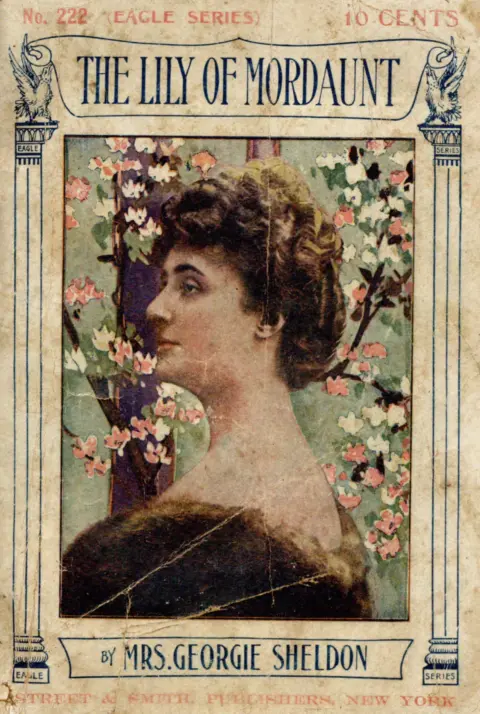
The lily of Mordaunt
Georgie, Mrs. Sheldon
THE CLASSIC COLLECTION · 1879
"Brownie's Triumph" by Mrs. Georgie Sheldon is a fiction novel written in the late 19th century. The story centers around the character of Brownie Douglas, a young heiress whose life takes a dramatic turn after the death of her wealthy aunt, leaving her without the fortune she expected. The novel explores themes of resilience, societal expectations, and the journey of a young woman as she confronts the realities of life in a world that suddenly feels far less secure. The opening of "Brownie's Triumph" introduces readers to a lively scene set during the World’s Centennial Exposition in Philadelphia. Brownie Douglas, a petite and spirited young woman, has just encountered her elegant friend Aspasia Huntington, who is struggling with her extravagant attire. The narrative unfolds with comedic moments involving a clumsy countryman, showcasing the contrast between the two young ladies. As the girls navigate through the exposition, they attract the attention of two young men, setting the stage for potential romantic developments amidst Brownie's transition from wealth to self-sufficiency after her aunt's passing. This initial glimpse of both frivolity and deeper themes offers a captivating start to Brownie’s journey.
Introduction adapted from the source catalogue; source summaries may be automatically generated.
Free to read · English · 100,316 words · No account needed
MAKE TIME FOR A GOOD BOOK
On by default. Untick to stop anonymous reading totals. Each page counts after 10 seconds in view. How this works.
Anonymous counting is on unless you have switched it off.
“A year, at least; probably longer, if the girls and their mother enjoy
it.”
“How old are your daughters, Mr. Coolidge?”
“Viola is sixteen, Alma is fourteen. I have another who is twenty, but I believe she considers her education completed, although I think she said something about studying the languages a little more while she is abroad.”
“Have the young ladies completed any course as yet?” Brownie asked, wishing to know something of their attainments before deciding.
“No; I regret to say, they have not. Their mother was unwilling they should attend any public institution, so they have had private teachers, and I am afraid they have not improved their advantages as they should have done.”
“Indeed, they have not!” exclaimed Mr. Alcott, excitedly. “They have behaved shamefully about it, and are a couple of ignoramuses.”
Brownie laughed as he said this, then asked:
“And do you think, sir, that I am capable of instructing them, if older and wiser teachers have failed?”
“Young lady, when you were reading French to me the other evening, I was not impressed wholly by your pronunciation. No; there was a ring of decision in your tones, there was a look of character and firmness in your face, that told me you would not fail to make a first-class teacher,” said the old gentleman, with emphasis.
“Your very youthfulness may help you to win where the others have failed. And, as I told you, it is not altogether an instructress that we want, but a refined and genial companion, and an interpreter also, for none of the family are able to converse fluently in foreign languages,” said Mr. Coolidge.
Sixteen and fourteen!
They were trying ages—just the time when girls loved fun and frolic better than anything else in the world.
Was she competent to take charge of them and direct their studies?
She longed to accept the position, she longed to go abroad and visit those old countries so fraught with interest, poetry, and romance, and where her aunt had lived and suffered so much. But the responsibility! Would it be right for her to assume it? Would she be able to influence these young girls aright?
“Mr. Coolidge,” she said, when she had thought of all these things, “I will tell you frankly that I would like this position which you are so kind to offer me, more than I can express, but I am only eighteen years of age myself, and I do not really feel like deciding whether I am competent to direct the education of your daughters or not. The other duties, I think, I could fulfill satisfactorily.”
Your reading position is saved on this browser. Take it to another device with a library code. Reading pages adapt to text, rather than matching a printed edition.
Georgie, Mrs. Sheldon
Georgie, Mrs. Sheldon
Georgie, Mrs. Sheldon
Georgie, Mrs. Sheldon
BEHIND THE BOOK
This eBook is for the use of anyone anywhere in the United States and most other parts of the world at no cost and with almost no restrictions whatsoever. You may copy it, give it away or re-use it under the terms of the Project Gutenberg License included with this eBook or online at www.gutenberg.org. If you are not located in the United States, you will have to check the laws of the country where you are located before using this eBook. Read the source licence.
The original source file, including credits and licence, is retained by this library. Request an original-format copy at no charge. Please include the book title and Project Gutenberg identifier #71118.
KEEP YOUR CURIOSITY GOING
Coulson Kernahan

Maurice Baring
Frances Wright
Cécile Tormay

Frederic Jesup Stimson

W. H. P. (William Henry Pope) Jarvis