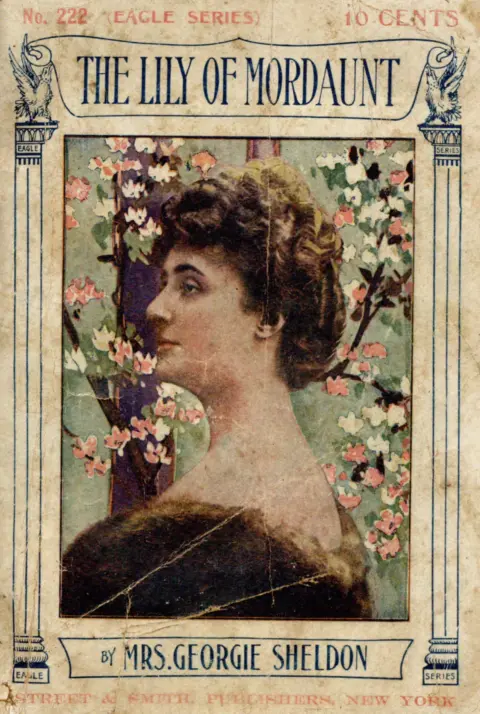
The lily of Mordaunt
Georgie, Mrs. Sheldon
THE CLASSIC COLLECTION · 1879
"Brownie's Triumph" by Mrs. Georgie Sheldon is a fiction novel written in the late 19th century. The story centers around the character of Brownie Douglas, a young heiress whose life takes a dramatic turn after the death of her wealthy aunt, leaving her without the fortune she expected. The novel explores themes of resilience, societal expectations, and the journey of a young woman as she confronts the realities of life in a world that suddenly feels far less secure. The opening of "Brownie's Triumph" introduces readers to a lively scene set during the World’s Centennial Exposition in Philadelphia. Brownie Douglas, a petite and spirited young woman, has just encountered her elegant friend Aspasia Huntington, who is struggling with her extravagant attire. The narrative unfolds with comedic moments involving a clumsy countryman, showcasing the contrast between the two young ladies. As the girls navigate through the exposition, they attract the attention of two young men, setting the stage for potential romantic developments amidst Brownie's transition from wealth to self-sufficiency after her aunt's passing. This initial glimpse of both frivolity and deeper themes offers a captivating start to Brownie’s journey.
Introduction adapted from the source catalogue; source summaries may be automatically generated.
Free to read · English · 100,316 words · No account needed
MAKE TIME FOR A GOOD BOOK
On by default. Untick to stop anonymous reading totals. Each page counts after 10 seconds in view. How this works.
Anonymous counting is on unless you have switched it off.
“Enough, sir! No person with any such record can ever become allied to my family!” burst forth Lord Dunforth, rising from his chair in wrath.
“But, sir, let me explain——”
“No, sir!” he thundered; “not another word! I am astonished and disappointed in you, Adrian, that you could so demean yourself as to desire to marry any one so far beneath you!”
“She is not beneath me,” began the indignant lover, hotly.
“Not another word, Adrian, if you please, on the subject, unless you wish to incur my stern displeasure. You, the future Earl of Dunforth, marry a person accused of theft! Never!” and he paced the floor, with angry strides.
Suddenly he wheeled upon his grandson, and demanded:
“May I ask, have you made proposals to this very estimable person?”
“I have, my lord.” The manly eyes blazed dangerously at this almost insulting question, while his hands worked nervously at the biting sarcasm of his grandfather’s words.
“Fool!”
“Sir!”
“You’re a fool, I say!”
The two men glared at each other furiously for a moment. Then Adrian, growing very pale, moved a step or two back, and said, in a quiet, though concentrated voice:
“Then I am to understand that you refuse your consent to my marrying?”
“I do, most emphatically refuse to allow you to marry any such doubtful person as Lady Ruxley’s companion appears to be. Shame upon you stooping so low!”
“Then, my Lord Dunforth, listen to me,” Adrian said, flushing angrily, and drawing his proud form to its fullest height. “I love this gentle girl with my whole heart; I have told her so, and I have asked her to be my wife. I am of age, and, sir, I shall marry her!”
Lord Dunforth suddenly wheeled about, and came forward with rapid
strides.
The two proud men stood looking steadfastly into each other’s eyes for a moment, and each read there a determination never to yield.
“Then you are no longer a child of mine!” whispered the irate lord, hoarsely, his whole frame shaking from anger, disappointment, and mortification.
“Grandfather,” returned Adrian, sadly, “you know I love you, and would gladly do anything in reason to please you; but the happiness of two lives is at stake, and in this matter I must choose for myself.”
There was a note of quiet determination in his voice, albeit it was so sad, which told the other that he meant every word he uttered.
“Then choose for yourself,” he cried, almost beside himself with grief and mortified pride, “and choose beggary with your wife, for not one shilling from the Dunforth coffers shall you ever touch!”
Your reading position is saved on this browser. Take it to another device with a library code. Reading pages adapt to text, rather than matching a printed edition.
Georgie, Mrs. Sheldon
Georgie, Mrs. Sheldon
Georgie, Mrs. Sheldon
Georgie, Mrs. Sheldon
BEHIND THE BOOK
This eBook is for the use of anyone anywhere in the United States and most other parts of the world at no cost and with almost no restrictions whatsoever. You may copy it, give it away or re-use it under the terms of the Project Gutenberg License included with this eBook or online at www.gutenberg.org. If you are not located in the United States, you will have to check the laws of the country where you are located before using this eBook. Read the source licence.
The original source file, including credits and licence, is retained by this library. Request an original-format copy at no charge. Please include the book title and Project Gutenberg identifier #71118.
KEEP YOUR CURIOSITY GOING
Coulson Kernahan

Maurice Baring
Frances Wright
Cécile Tormay

Frederic Jesup Stimson

W. H. P. (William Henry Pope) Jarvis