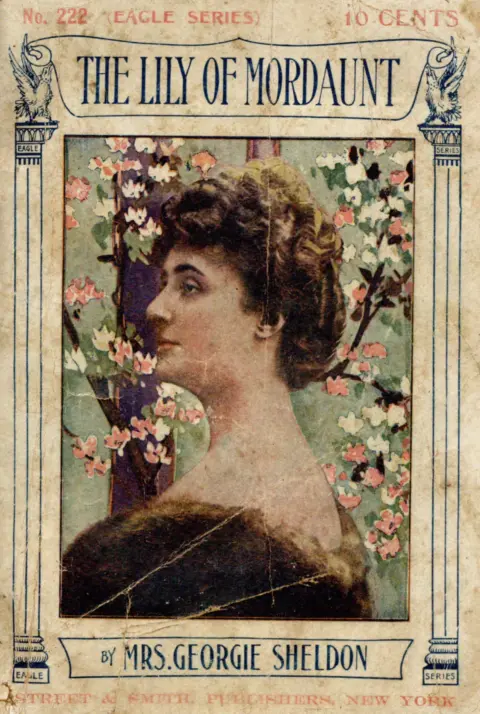
The lily of Mordaunt
Georgie, Mrs. Sheldon
THE CLASSIC COLLECTION · 1879
"Brownie's Triumph" by Mrs. Georgie Sheldon is a fiction novel written in the late 19th century. The story centers around the character of Brownie Douglas, a young heiress whose life takes a dramatic turn after the death of her wealthy aunt, leaving her without the fortune she expected. The novel explores themes of resilience, societal expectations, and the journey of a young woman as she confronts the realities of life in a world that suddenly feels far less secure. The opening of "Brownie's Triumph" introduces readers to a lively scene set during the World’s Centennial Exposition in Philadelphia. Brownie Douglas, a petite and spirited young woman, has just encountered her elegant friend Aspasia Huntington, who is struggling with her extravagant attire. The narrative unfolds with comedic moments involving a clumsy countryman, showcasing the contrast between the two young ladies. As the girls navigate through the exposition, they attract the attention of two young men, setting the stage for potential romantic developments amidst Brownie's transition from wealth to self-sufficiency after her aunt's passing. This initial glimpse of both frivolity and deeper themes offers a captivating start to Brownie’s journey.
Introduction adapted from the source catalogue; source summaries may be automatically generated.
Free to read · English · 100,316 words · No account needed
MAKE TIME FOR A GOOD BOOK
On by default. Untick to stop anonymous reading totals. Each page counts after 10 seconds in view. How this works.
Anonymous counting is on unless you have switched it off.
His lordship stared at his grandson in dismay.
“Miss Dundas, Adrian!” he exclaimed, aghast, his fine face flushing a
deep crimson.
“Miss Douglas, my lord,” corrected Adrian, somewhat proudly.
His lordship did not notice the correction. His head was bent in deep thought, his brow was knotted, his lips compressed. At length, looking up, he said, with emotion:
“My boy, your happiness is of the greatest importance to me, and has always been my first consideration. I know what it is to love deeply, and the anguish which follows the loss of a loved one”—his voice quivered painfully. “But,” he added, “it is better to give up an unworthy love than to marry beneath you, and then repent of it when it is too late.”
“Sir, the lady is not unworthy, and I shall never repent making her my wife,” Adrian said, indignantly; then continued, speaking rapidly: “I told you that she descended from a highly respectable family. They were English, too, and removed to America many years ago. They were very wealthy at that time, but a series of misfortunes deprived them of this. I learned this from my friend, Gordon, whom, you remember, I met two years ago in Germany. He vouched for her respectability, and told me he had seen the ‘family tree,’ and that they traced back their ancestry to the Scottish nobility.”
“But it must be very remote. Besides, she was born and reared in America, and has not a friend living, as you say, to prove her respectability, and all this would be very disagreeable to establish.”
“The fact that I have chosen her for my wife would be sufficient to establish her respectability without any questioning,” replied Adrian, proudly.
“But I want you to have an English wife, Adrian—one who will fill her position proudly and creditably.”
“I am as eager for that, my lord, as you can possibly be,” said the young man, with a quiet smile, as he thought how perfectly Brownie would reign in those grand old halls.
“How came she to be in England if she was so reduced in circumstances?”
“She came over as governess with a family, in the same steamer with
myself.”
“How does it happen that they did not retain her—that she left them to be companion to a woman like Lady Ruxley?” demanded his lordship, his face beginning to grow stern and set.
Adrian colored vividly. He knew it did not sound well, but he was truth
itself, and replied:
“She was ill-treated and insulted—in fact, was accused of taking that which did not belong to her.”
Your reading position is saved on this browser. Take it to another device with a library code. Reading pages adapt to text, rather than matching a printed edition.
Georgie, Mrs. Sheldon
Georgie, Mrs. Sheldon
Georgie, Mrs. Sheldon
Georgie, Mrs. Sheldon
BEHIND THE BOOK
This eBook is for the use of anyone anywhere in the United States and most other parts of the world at no cost and with almost no restrictions whatsoever. You may copy it, give it away or re-use it under the terms of the Project Gutenberg License included with this eBook or online at www.gutenberg.org. If you are not located in the United States, you will have to check the laws of the country where you are located before using this eBook. Read the source licence.
The original source file, including credits and licence, is retained by this library. Request an original-format copy at no charge. Please include the book title and Project Gutenberg identifier #71118.
KEEP YOUR CURIOSITY GOING
Coulson Kernahan

Maurice Baring
Frances Wright
Cécile Tormay

Frederic Jesup Stimson

W. H. P. (William Henry Pope) Jarvis