
Life of Edwin Forrest, the American Tragedian. Volume 2 (of 2)
William Rounseville Alger & Horatio, Jr. Alger
THE CLASSIC COLLECTION · 1888
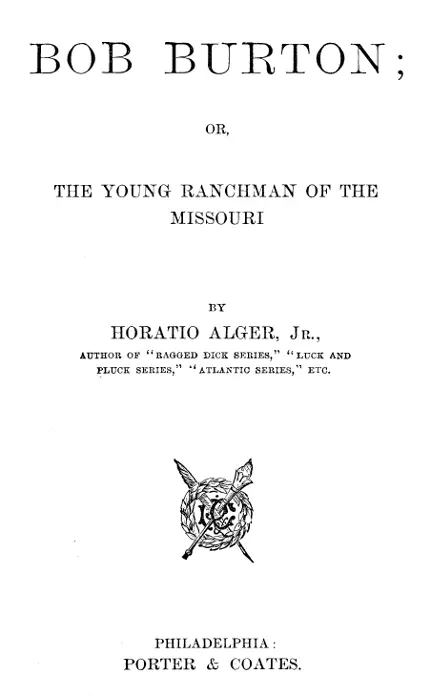
"Bob Burton; or, The Young Ranchman of the Missouri" by Horatio Alger, Jr. is a novel written in the late 19th century. The story centers around Bob Burton, a young ranchman navigating life on his family's ranch in Missouri. The opening chapters set the stage for a conflict involving Bob's father, Richard Burton, and Aaron Wolverton, the local moneylender, who harbors a hidden grudge against the family. At the start of the narrative, we are introduced to the Burton family as they prepare for Richard's trip to pay interest on a mortgage held by Wolverton. Tensions are hinted at in interactions between Richard and his wife, Mary, who expresses mistrust of Wolverton, recalling his past advances towards her. After Richard's tragic accident on the way home, where Wolverton is seen rifling through his pockets, a plot emerges involving accusations, deceit, and the desperate quest for justice. Bob, alongside his companion Clip, a young African American refugee, begins to confront the challenges threatening their livelihood while discovering the depths of Wolverton's malevolence.
Introduction adapted from the source catalogue; source summaries may be automatically generated.
Free to read · English · 49,874 words · No account needed
MAKE TIME FOR A GOOD BOOK
On by default. Untick to stop anonymous reading totals. Each page counts after 10 seconds in view. How this works.
Anonymous counting is on unless you have switched it off.
Fifteen minutes after Sam and Clip had left him Bob's attention was drawn to a man of somewhat flashy appearance, who, while leaning against a tree on the bank, seemed to be eying him and the boat with attention. He wore a Prince Albert coat which was no longer fit to appear in good society, a damaged hat, and a loud neck-tie. His eyes were roving from one point to another, as if he felt a great deal of interest in Bob or the boat. Our hero was not favorably impressed with this man's appearance.
"I wonder what he sees that interests him so much?" he thought.
"I say, young man, is this here boat yours?" he asked.
"Yes," answered Bob, coldly.
"What have you got on board?"
Bob felt under no obligation to answer, but reflecting that there was no good excuse for refusing, he said, briefly: "Wheat."
"Humph! How much have you got?"
This clearly was none of the questioner's business, and Bob replied by
another question:
"Do you want to buy?"
"I don't know," said the stranger. "What do you ask?"
"I can't say till I get to St. Louis."
"How much do you calc'late to get?"
"Two dollars and a quarter," answered Bob, naming a price beyond his
expectations.
"Ain't that a high figger?"
"Perhaps so."
"Come, young feller, you don't seem social. Can't you invite me aboard?"
"I don't think you would be paid for coming," said Bob, more and more
unfavorably impressed.
"Oh, I don't mind. My time ain't valuable. I guess I'll come."
The stranger stepped across the gang-plank, which Bob had laid from the boat to the shore, and entered without an invitation. Bob was tempted to order him off, but the intruder appeared much stronger than himself; and while he was alone it seemed politic to submit to the disagreeable necessity of entertaining his unwelcome visitor.
The latter walked from end to end of the boat, examining for himself without asking permission, or appearing to feel the need of any. He opened the bins and counted them, while Bob looked on uneasily.
"I say, young feller, you've got a smart lot of wheat here."
"Yes," said Bob, briefly.
"Got a thousand bushels, I reckon?"
"Perhaps so."
"And you expect to get two dollars and a quarter a bushel?"
"Perhaps I shall have to take less."
"At any rate, you must have two thousand dollars' worth on board."
"You can judge for yourself."
"I say, that's a pile of money--for a boy."
"The wheat doesn't belong to me."
"Who owns it, then."
"My mother."
"What's your mother's name?"
"I have answered all the questions I am going to," said Bob,
indignantly.
Your reading position is saved on this browser. Take it to another device with a library code. Reading pages adapt to text, rather than matching a printed edition.
William Rounseville Alger & Horatio, Jr. Alger

William Rounseville Alger & Horatio, Jr. Alger

Horatio, Jr. Alger

Horatio, Jr. Alger
BEHIND THE BOOK
This eBook is for the use of anyone anywhere in the United States and most other parts of the world at no cost and with almost no restrictions whatsoever. You may copy it, give it away or re-use it under the terms of the Project Gutenberg License included with this eBook or online at www.gutenberg.org. If you are not located in the United States, you will have to check the laws of the country where you are located before using this eBook. Read the source licence.
The original source file, including credits and licence, is retained by this library. Request an original-format copy at no charge. Please include the book title and Project Gutenberg identifier #52194.
KEEP YOUR CURIOSITY GOING
Coulson Kernahan

Maurice Baring
Frances Wright
Cécile Tormay

Frederic Jesup Stimson

W. H. P. (William Henry Pope) Jarvis