
Life of Edwin Forrest, the American Tragedian. Volume 2 (of 2)
William Rounseville Alger & Horatio, Jr. Alger
THE CLASSIC COLLECTION · 1888
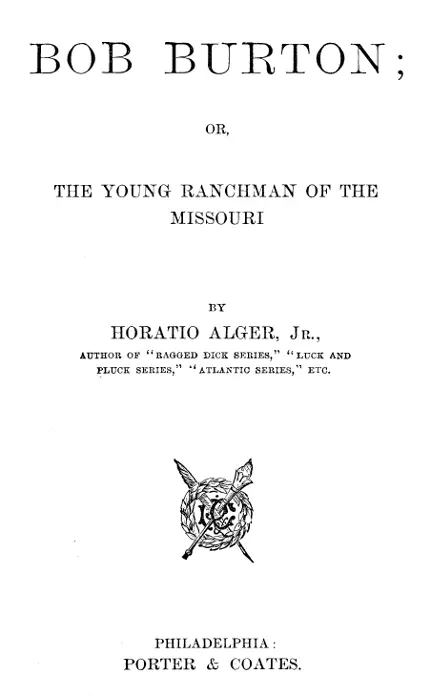
"Bob Burton; or, The Young Ranchman of the Missouri" by Horatio Alger, Jr. is a novel written in the late 19th century. The story centers around Bob Burton, a young ranchman navigating life on his family's ranch in Missouri. The opening chapters set the stage for a conflict involving Bob's father, Richard Burton, and Aaron Wolverton, the local moneylender, who harbors a hidden grudge against the family. At the start of the narrative, we are introduced to the Burton family as they prepare for Richard's trip to pay interest on a mortgage held by Wolverton. Tensions are hinted at in interactions between Richard and his wife, Mary, who expresses mistrust of Wolverton, recalling his past advances towards her. After Richard's tragic accident on the way home, where Wolverton is seen rifling through his pockets, a plot emerges involving accusations, deceit, and the desperate quest for justice. Bob, alongside his companion Clip, a young African American refugee, begins to confront the challenges threatening their livelihood while discovering the depths of Wolverton's malevolence.
Introduction adapted from the source catalogue; source summaries may be automatically generated.
Free to read · English · 49,874 words · No account needed
MAKE TIME FOR A GOOD BOOK
On by default. Untick to stop anonymous reading totals. Each page counts after 10 seconds in view. How this works.
Anonymous counting is on unless you have switched it off.
Many a man who had come unexpectedly into a fortune of a hundred thousand dollars would not have felt so rich as Sam with his silver dollar. It must be remembered that he had never before had so much money at one time in his life. The prospect of spending it opened up dazzling possibilities. There were so many things that he wanted, that it was hard to decide which to select.
Among other things, Sam wanted a fishing-pole. There was a supply at a variety store in the village. He had never inquired the price, because he had no money. Now that he was wealthy he determined to inquire.
So he went into the store and, pointing to the coveted article, asked
the price.
"Seventy-five cents," answered the old man, Gordon Locke, who kept the
store.
"Seventy-five cents!" repeated Sam, thoughtfully.
This would only leave him twenty-five cents, and there were so many
other things he wanted.
"Was you calc'latin' to buy, Sam?" asked Mr. Locke, pushing up his
iron-bound spectacles.
"I don't know," said Sam, slowly; "I didn't think I'd have to pay so
much."
"It's cheap, for the quality," said the store keeper. "This ain't no common fishing-pole. It comes all the way from York."
"Yes, it seems a nice one," Sam admitted.
"Hev you got the money about you?" asked the old man.
"Yes," answered Sam, unguardedly.
"Then you'd better take the pole. You won't find no better within fifty
mile."
"I'll think about it," said Sam.
He could not make up his mind to part with his precious dollar so soon. As long as he had it, he felt like a man of property. When it was once changed, he would once more be a poor boy.
In spite of the storekeeper's persuasions, he walked out with his money intact, leaving the coveted fishing-pole behind.
Now it so happened that his uncle, who never allowed anything to pass unnoticed, saw from the window Sam come out of the store, which was nearly opposite.
"What business has he there, I wonder?" he said to himself.
Five minutes later he made an errand to visit the store himself.
"Good-day, Mr. Wolverton," said Gordon Locke, deferentially.
"Good-day, Locke! Didn't I see my nephew, Sam, come out of here just
now?"
"Like as not you did. He was here."
"What business had he here?"
"He was looking at them fishin'-rods."
"He was, hey?" said Wolverton, pricking up his ears.
"Yes; he reckoned he'd buy one soon."
"What's the price?"
"Seventy-five cents."
"He reckoned he'd pay seventy-five cents for a fishin'-rod," said Wolverton, slowly. "Did he show you the money?"
"No; but he said he had it."
Your reading position is saved on this browser. Take it to another device with a library code. Reading pages adapt to text, rather than matching a printed edition.
William Rounseville Alger & Horatio, Jr. Alger

William Rounseville Alger & Horatio, Jr. Alger

Horatio, Jr. Alger

Horatio, Jr. Alger
BEHIND THE BOOK
This eBook is for the use of anyone anywhere in the United States and most other parts of the world at no cost and with almost no restrictions whatsoever. You may copy it, give it away or re-use it under the terms of the Project Gutenberg License included with this eBook or online at www.gutenberg.org. If you are not located in the United States, you will have to check the laws of the country where you are located before using this eBook. Read the source licence.
The original source file, including credits and licence, is retained by this library. Request an original-format copy at no charge. Please include the book title and Project Gutenberg identifier #52194.
KEEP YOUR CURIOSITY GOING
Coulson Kernahan

Maurice Baring
Frances Wright
Cécile Tormay

Frederic Jesup Stimson

W. H. P. (William Henry Pope) Jarvis