
Life of Edwin Forrest, the American Tragedian. Volume 2 (of 2)
William Rounseville Alger & Horatio, Jr. Alger
THE CLASSIC COLLECTION · 1888
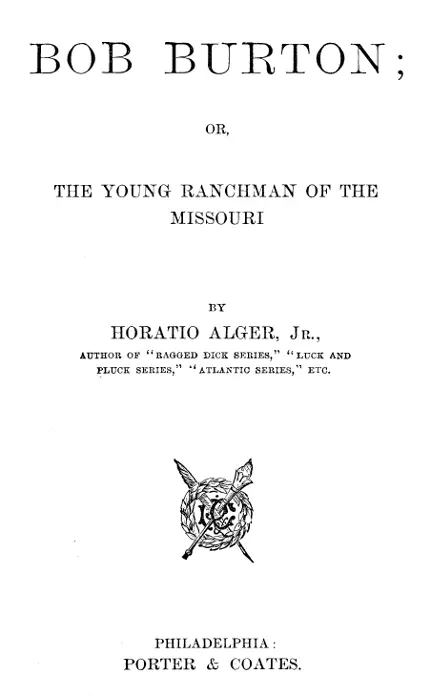
"Bob Burton; or, The Young Ranchman of the Missouri" by Horatio Alger, Jr. is a novel written in the late 19th century. The story centers around Bob Burton, a young ranchman navigating life on his family's ranch in Missouri. The opening chapters set the stage for a conflict involving Bob's father, Richard Burton, and Aaron Wolverton, the local moneylender, who harbors a hidden grudge against the family. At the start of the narrative, we are introduced to the Burton family as they prepare for Richard's trip to pay interest on a mortgage held by Wolverton. Tensions are hinted at in interactions between Richard and his wife, Mary, who expresses mistrust of Wolverton, recalling his past advances towards her. After Richard's tragic accident on the way home, where Wolverton is seen rifling through his pockets, a plot emerges involving accusations, deceit, and the desperate quest for justice. Bob, alongside his companion Clip, a young African American refugee, begins to confront the challenges threatening their livelihood while discovering the depths of Wolverton's malevolence.
Introduction adapted from the source catalogue; source summaries may be automatically generated.
Free to read · English · 49,874 words · No account needed
MAKE TIME FOR A GOOD BOOK
On by default. Untick to stop anonymous reading totals. Each page counts after 10 seconds in view. How this works.
Anonymous counting is on unless you have switched it off.
After disposing of his cargo, Bob was puzzled to know what to do with the ferry-boat. Finally he had an offer of one hundred dollars, from a speculative Yankee who had drifted out to St. Louis, and gladly accepted it. This sum paid all expenses, including his and Clip's return fare, and left him with a handsome sum to his credit, viz.:
1,400 bushels wheat, at $2.25, $3,150
Reward, 1,000
------
$4,150
This sum, with the exception of one hundred and fifty dollars, by advice of Mr. Pearson, he deposited in a St. Louis bank, and then started for home.
He could not make the whole passage by steamer, but went part way by railroad, and then engaged a carriage to a point four miles from home. Thence he and Clip walked. He wanted to surprise not only his mother, but Wolverton. He knew now that Brown and Minton had only been agents of his more crafty enemy, Brown having made a written confession, not so much out of friendship to Bob as out of spite against Wolverton, whom he held responsible for getting him into this scrape.
With soiled shoes and clothes covered with dust, Bob and Clip entered the village, and purposely walked by Wolverton's office.
The latter, spying them through the window, smiled maliciously, and
hurried out to meet them.
"Aha, my young friends," he said, with a pleased glance at their soiled clothes, "so you have returned?"
"Yes, sir," answered Bob, soberly.
"And what luck did you have, may I ask?"
"We had good luck at first, but at Rocky Creek two rascals entrapped us, and stole our boat and cargo."
Wolverton laughed outright. So it was true, after all.
"Excuse my smiling," he said; "but you seem to have come out at the
little end of the horn."
"It does seem so, sir."
"You remember what I told you before you started?"
"What was that?"
"That you were too young for such an expedition. It would have been much better for you to accept my offer."
"It seems so," answered Bob again.
"Seems so! Of course it would have been. But the trouble was, you were so puffed up by your own self-conceit that you thought you knew best."
"I plead guilty to that, sir; I did think so," answered Bob, candidly.
"I am glad you admit it. So you had to walk back?"
"You can judge for yourself, Mr. Wolverton."
"Well, you certainly do look like two tramps. The next time you may feel like following my advice."
"I may," answered Bob.
Your reading position is saved on this browser. Take it to another device with a library code. Reading pages adapt to text, rather than matching a printed edition.
William Rounseville Alger & Horatio, Jr. Alger

William Rounseville Alger & Horatio, Jr. Alger

Horatio, Jr. Alger

Horatio, Jr. Alger
BEHIND THE BOOK
This eBook is for the use of anyone anywhere in the United States and most other parts of the world at no cost and with almost no restrictions whatsoever. You may copy it, give it away or re-use it under the terms of the Project Gutenberg License included with this eBook or online at www.gutenberg.org. If you are not located in the United States, you will have to check the laws of the country where you are located before using this eBook. Read the source licence.
The original source file, including credits and licence, is retained by this library. Request an original-format copy at no charge. Please include the book title and Project Gutenberg identifier #52194.
KEEP YOUR CURIOSITY GOING
Coulson Kernahan

Maurice Baring
Frances Wright
Cécile Tormay

Frederic Jesup Stimson

W. H. P. (William Henry Pope) Jarvis