
Life of Edwin Forrest, the American Tragedian. Volume 2 (of 2)
William Rounseville Alger & Horatio, Jr. Alger
THE CLASSIC COLLECTION · 1888
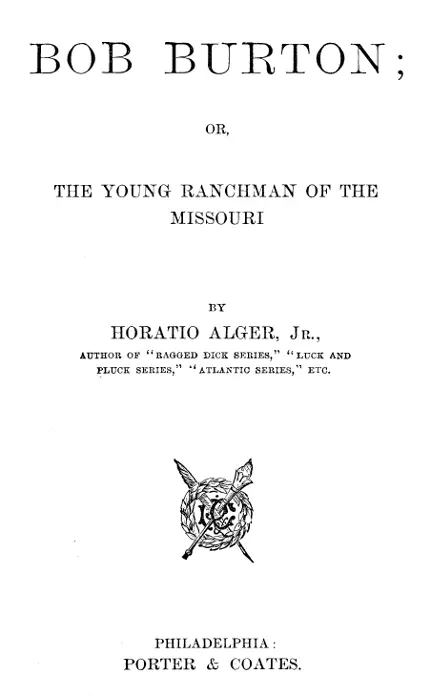
"Bob Burton; or, The Young Ranchman of the Missouri" by Horatio Alger, Jr. is a novel written in the late 19th century. The story centers around Bob Burton, a young ranchman navigating life on his family's ranch in Missouri. The opening chapters set the stage for a conflict involving Bob's father, Richard Burton, and Aaron Wolverton, the local moneylender, who harbors a hidden grudge against the family. At the start of the narrative, we are introduced to the Burton family as they prepare for Richard's trip to pay interest on a mortgage held by Wolverton. Tensions are hinted at in interactions between Richard and his wife, Mary, who expresses mistrust of Wolverton, recalling his past advances towards her. After Richard's tragic accident on the way home, where Wolverton is seen rifling through his pockets, a plot emerges involving accusations, deceit, and the desperate quest for justice. Bob, alongside his companion Clip, a young African American refugee, begins to confront the challenges threatening their livelihood while discovering the depths of Wolverton's malevolence.
Introduction adapted from the source catalogue; source summaries may be automatically generated.
Free to read · English · 49,874 words · No account needed
MAKE TIME FOR A GOOD BOOK
On by default. Untick to stop anonymous reading totals. Each page counts after 10 seconds in view. How this works.
Anonymous counting is on unless you have switched it off.
"What do you want, Mr. Wolverton?" asked Bob, coolly, as he stood at one end of the boat and surveyed the excited agent.
"Come ashore, or I'll have you arrested," shouted the irate Wolverton.
"You are very kind, Mr. Wolverton; but I am in considerable of a hurry, and have not time to comply with your request."
"You'd better come ashore, if you know what's best for yourself."
"Please state your business! If it is anything to my advantage, I may come; but I am just ready to start for St. Louis."
"Is my nephew Sam on your boat?"
"I don't see him. Why should he be on board?"
"I suspect him of running away, the ungrateful young rascal? I thought he might be scheming to go down the river with you."
"Clip," said Bob, gravely, "has Sam Wolverton engaged passage with us?"
"Not as I knows on, Massa Bob."
"If he should, charge him fifteen dollars."
"Yes, Massa Bob," answered Clip, with a grin.
"If you wish your nephew to go to St. Louis on my boat, Mr. Wolverton," said Bob, with ceremonious politeness, "I will take him, being a friend, for fifteen dollars, excursion ticket. You can't complain of that."
"But I don't want him to go," roared Wolverton. "I tell you he has run
away."
"That's very strange, considering how kindly and liberally you have
always treated him."
Wolverton eyed Bob suspiciously, for he knew well enough that the remark
was ironical.
"None of your gammon, young man!" he said, crabbedly. "Send Sam ashore."
"Really, Mr. Wolverton, you must be joking. What have I got to do with
Sam?"
"I don't believe a word you say. I mean to search your boat."
"You had better do it at once, then, for it is time for me to start."
"But how am I to get aboard," asked the agent, perplexed.
"You might swim," suggested Bob, "or wade. The water is shallow--not higher than your neck, anywhere."
"That is nonsense. Steer your boat to shore, that I may board her."
"It can't be done, Mr. Wolverton. We can only drift down with the
current."
"Then how am I to get aboard?"
"That is your lookout."
Just then Mr. Wolverton espied the flat-bottomed boat which Bob proposed to take with him. He had attached it by a line to the stern of the ferry-boat.
"Row over and take me across."
"I can't spare the time."
Wolverton was about to give vent to his wrath at this refusal, when he observed a boat approaching, rowed by a German boy named Otto Brandes.
"Come here, boy, and row me out to yonder boat," he said.
Your reading position is saved on this browser. Take it to another device with a library code. Reading pages adapt to text, rather than matching a printed edition.
William Rounseville Alger & Horatio, Jr. Alger

William Rounseville Alger & Horatio, Jr. Alger

Horatio, Jr. Alger

Horatio, Jr. Alger
BEHIND THE BOOK
This eBook is for the use of anyone anywhere in the United States and most other parts of the world at no cost and with almost no restrictions whatsoever. You may copy it, give it away or re-use it under the terms of the Project Gutenberg License included with this eBook or online at www.gutenberg.org. If you are not located in the United States, you will have to check the laws of the country where you are located before using this eBook. Read the source licence.
The original source file, including credits and licence, is retained by this library. Request an original-format copy at no charge. Please include the book title and Project Gutenberg identifier #52194.
KEEP YOUR CURIOSITY GOING
Coulson Kernahan

Maurice Baring
Frances Wright
Cécile Tormay

Frederic Jesup Stimson

W. H. P. (William Henry Pope) Jarvis