
Life of Edwin Forrest, the American Tragedian. Volume 2 (of 2)
William Rounseville Alger & Horatio, Jr. Alger
THE CLASSIC COLLECTION · 1888
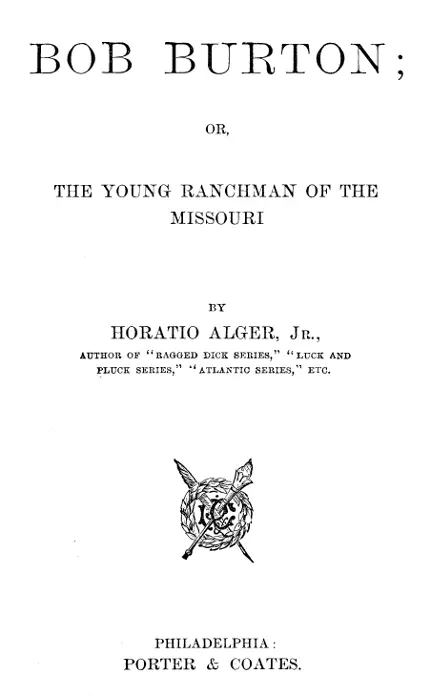
"Bob Burton; or, The Young Ranchman of the Missouri" by Horatio Alger, Jr. is a novel written in the late 19th century. The story centers around Bob Burton, a young ranchman navigating life on his family's ranch in Missouri. The opening chapters set the stage for a conflict involving Bob's father, Richard Burton, and Aaron Wolverton, the local moneylender, who harbors a hidden grudge against the family. At the start of the narrative, we are introduced to the Burton family as they prepare for Richard's trip to pay interest on a mortgage held by Wolverton. Tensions are hinted at in interactions between Richard and his wife, Mary, who expresses mistrust of Wolverton, recalling his past advances towards her. After Richard's tragic accident on the way home, where Wolverton is seen rifling through his pockets, a plot emerges involving accusations, deceit, and the desperate quest for justice. Bob, alongside his companion Clip, a young African American refugee, begins to confront the challenges threatening their livelihood while discovering the depths of Wolverton's malevolence.
Introduction adapted from the source catalogue; source summaries may be automatically generated.
Free to read · English · 49,874 words · No account needed
MAKE TIME FOR A GOOD BOOK
On by default. Untick to stop anonymous reading totals. Each page counts after 10 seconds in view. How this works.
Anonymous counting is on unless you have switched it off.
Rushford was a town of fifteen hundred inhabitants, and presented as busy an appearance as a town three times the size in the East. Clip, who was fond of variety, was reluctant to return to the boat, but Bob said:
"We must relieve Sam, and give him a chance to come ashore and get some coffee. You come with him, and show him the restaurant."
This arrangement suited Clip, who liked as much variety and excitement
as possible.
On returning to the boat Bob was somewhat surprised to find his young lieutenant in conversation with an old lady dressed in antediluvian costume. She had a sharp face, with an eager, birdlike look, and seemed to be preferring a request.
"Here's the captain; you can ask him," said Sam, who seemed much
relieved by the return of Bob.
"Is he the captain?" asked the old lady. "Why, he's nothin' but a
boy!"
"He's all the captain we have," answered Sam.
"Be you in charge of this boat?" asked the old lady.
"Yes, ma'am. What can I do for you?"
"I want to go down to St. Louis," said the old lady, "and I thought maybe you might find room for me."
"But, ma'am, why don't you take passage on a river steamer?"
"They charge too much," said the old lady. "I hain't got much money, and I s'pose you wouldn't charge me much. Are you any acquainted in St. Louis?"
"No, ma'am."
"I thought maybe you might know my darter's husband. He keeps a grocery store down near the river. His name is Jeremiah Pratt, and my darter's name is Melinda Ann. I want to give 'em a surprise."
"I never met the gentleman."
"When do you start?"
"To-morrow morning about half-past seven o'clock."
"Can't you put it off till eight? I've got to pack my trunk over night, and I've got to eat a bit of breakfast to stay my stummik. How much do you charge? I'd be willing to pay you seventy-five cents."
"How much do the steamboats charge?" asked Bob.
"I think it's six dollars, or it may be seven. That's too much for a
poor woman like me."
"I think you will have to pay it, madam, for we have no accommodation for passengers on our boat."
"Oh, I ain't a mite particular. You can put me anywhere."
"I suppose you wouldn't be willing to get into a grain bin?"
"Oh, now you're jokin'. Where do you sleep yourself?"
"On a mattress on the floor; that wouldn't be suitable for a lady like you. Besides, we have no separate rooms."
"Then you can't take me, no way?" asked the old lady, disappointed.
"I am afraid not, madam."
Your reading position is saved on this browser. Take it to another device with a library code. Reading pages adapt to text, rather than matching a printed edition.
William Rounseville Alger & Horatio, Jr. Alger

William Rounseville Alger & Horatio, Jr. Alger

Horatio, Jr. Alger

Horatio, Jr. Alger
BEHIND THE BOOK
This eBook is for the use of anyone anywhere in the United States and most other parts of the world at no cost and with almost no restrictions whatsoever. You may copy it, give it away or re-use it under the terms of the Project Gutenberg License included with this eBook or online at www.gutenberg.org. If you are not located in the United States, you will have to check the laws of the country where you are located before using this eBook. Read the source licence.
The original source file, including credits and licence, is retained by this library. Request an original-format copy at no charge. Please include the book title and Project Gutenberg identifier #52194.
KEEP YOUR CURIOSITY GOING
Coulson Kernahan

Maurice Baring
Frances Wright
Cécile Tormay

Frederic Jesup Stimson

W. H. P. (William Henry Pope) Jarvis