
Life of Edwin Forrest, the American Tragedian. Volume 2 (of 2)
William Rounseville Alger & Horatio, Jr. Alger
THE CLASSIC COLLECTION · 1888
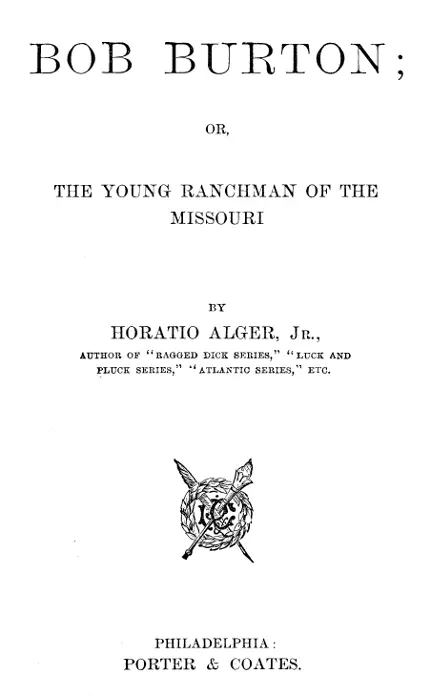
"Bob Burton; or, The Young Ranchman of the Missouri" by Horatio Alger, Jr. is a novel written in the late 19th century. The story centers around Bob Burton, a young ranchman navigating life on his family's ranch in Missouri. The opening chapters set the stage for a conflict involving Bob's father, Richard Burton, and Aaron Wolverton, the local moneylender, who harbors a hidden grudge against the family. At the start of the narrative, we are introduced to the Burton family as they prepare for Richard's trip to pay interest on a mortgage held by Wolverton. Tensions are hinted at in interactions between Richard and his wife, Mary, who expresses mistrust of Wolverton, recalling his past advances towards her. After Richard's tragic accident on the way home, where Wolverton is seen rifling through his pockets, a plot emerges involving accusations, deceit, and the desperate quest for justice. Bob, alongside his companion Clip, a young African American refugee, begins to confront the challenges threatening their livelihood while discovering the depths of Wolverton's malevolence.
Introduction adapted from the source catalogue; source summaries may be automatically generated.
Free to read · English · 49,874 words · No account needed
MAKE TIME FOR A GOOD BOOK
On by default. Untick to stop anonymous reading totals. Each page counts after 10 seconds in view. How this works.
Anonymous counting is on unless you have switched it off.
About half an hour after their young prisoners had escaped, Mrs. Springer raised her head from the table, and looked about her in a bewildered way. The bright sunshine entering at the window revealed to her that she had spent the night in a drunken stupor, even if Joe's prostrate form had not been a visible reminder. She went to her husband, and shook him roughly.
"Get up, Joe!" she said. "It's morning."
He opened his eyes, and looked around him with stupefaction.
"What's up, old woman?" he asked.
"I am, and you ought to be," she answered, sharply.
"Where's the whisky?"
"You've had enough. Now get up and hustle round, if you want some breakfast. I'll go up and dress the little girl."
Mrs. Springer went upstairs, but came down again two steps at a time, in a state of high excitement.
"Joe," said she, quickly, "the little gal's gone!"
"What?"
"The little gal's gone! Run out and see if you can't catch her. If we lose her, we lose fifty dollars!"
"Are the boys all right?"
"Yes; the door is bolted. They couldn't get out."
This was true. Bob had taken the precaution to lock the door, after leaving the room. For this reason, it was half an hour later before Joe discovered that all his prisoners had escaped. Then, as might have been expected, there was a wild scene of recrimination, ending in a fight, in which Mrs. Springer did her part, for she was by no means a weak or delicate lady, but a woman without fear, who believed in the right of self-defense. The worthy pair instituted a search throughout the village, but failed to discover any trace of the lost children. The next morning, however, Joe Springer got up unusually early, for him, and strolled to the steamboat-landing. The boat was already out in the stream, when on the deck he discovered Maud and the two boys.
"Stop the boat!" screamed Joe, in excitement.
"What's the matter?" asked the man beside him.
"Those three children. They have run away!"
"From you?"
"Yes; from my house."
"Why, man, you must be drunk. You have no children."
"I had charge of 'em, particularly the little gal! Stop the boat, I
say!"
"Has that man any claim on you?" asked the captain, who chanced to be
standing near Bob.
"Not the slightest," answered Bob.
"Or the little girl?"
"No; her father lives in St. Louis, and I am taking her to him."
"Stop the boat!" screamed Joe, frantically.
"He's drunk!" said Joe's neighbor. "He doesn't know what he's talking
about."
Your reading position is saved on this browser. Take it to another device with a library code. Reading pages adapt to text, rather than matching a printed edition.
William Rounseville Alger & Horatio, Jr. Alger

William Rounseville Alger & Horatio, Jr. Alger

Horatio, Jr. Alger

Horatio, Jr. Alger
BEHIND THE BOOK
This eBook is for the use of anyone anywhere in the United States and most other parts of the world at no cost and with almost no restrictions whatsoever. You may copy it, give it away or re-use it under the terms of the Project Gutenberg License included with this eBook or online at www.gutenberg.org. If you are not located in the United States, you will have to check the laws of the country where you are located before using this eBook. Read the source licence.
The original source file, including credits and licence, is retained by this library. Request an original-format copy at no charge. Please include the book title and Project Gutenberg identifier #52194.
KEEP YOUR CURIOSITY GOING
Coulson Kernahan

Maurice Baring
Frances Wright
Cécile Tormay

Frederic Jesup Stimson

W. H. P. (William Henry Pope) Jarvis