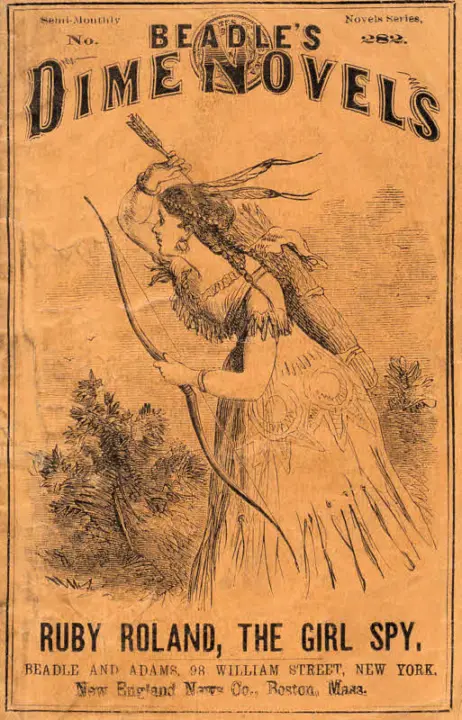
Ruby Roland, the Girl Spy; or, Simon Kenton’s Protege
Frederick Whittaker
THE CLASSIC COLLECTION · 1884
"Black Nick, the Hermit of the Hills; or, The Expiated Crime" by Frederick Whittaker is a historical novel written in the late 19th century. Set against the backdrop of the American Revolutionary War, the story involves themes of survival, espionage, and supernatural elements. The central characters include Indian warriors, a mysterious white man connected to Burgoyne's army, and the enigmatic figure of Black Nick, who embodies the supernatural aspect lurking in the wilderness. The opening of the novel introduces readers to a group of Indian warriors preparing to meet a British emissary in the midst of a twilight setting filled with portentous signs of an approaching storm. This atmosphere of tension and anticipation is compounded by the arrival of a messenger, who bears urgent news about a looming attack. Just as the plot thickens, the bizarre figure of Black Nick appears, disrupting the warrior's camp with a demoniacal presence that evokes both terror and awe. This blurs the lines between reality and myth, setting up a gripping narrative steeped in historical conflict and haunting intrigue as the characters navigate the dangers that surround them.
Introduction adapted from the source catalogue; source summaries may be automatically generated.
Free to read · English · 31,911 words · No account needed
MAKE TIME FOR A GOOD BOOK
On by default. Untick to stop anonymous reading totals. Each page counts after 10 seconds in view. How this works.
Anonymous counting is on unless you have switched it off.
The night brooded over the white tents, and glimmering fires of a great army, which lay on the open ground near Saratoga. Street after street of tents and marquees, in martial array, stretched its long lines, now silent and dark, perpendicular to the color line. Outside the camp glimmered embers of the few fires that were left burning, and some distance off, on the plain, and amid the little patches of wood, were the brighter fires that told of the outlying pickets.
Occasionally, the distant challenge of a sentry would be heard, to be followed by the same routine of “Who goes there?” “Rounds.” “Halt, rounds, advance one with the countersign. Countersign correct. Pass, Rounds, and a-all’s well!” The last words drawn out into a long, musical call, caught up and repeated along the line of outposts.
Inside the camp there were no lights, save in one spot, around the headquarter tents, which were clustered, in apparent confusion, in the vicinity of a large, half-ruined house, in which the commander kept his private quarters.
In these tents lights were burning, fires were kindled in front, and a number of officers were writing at different desks, while orderlies, at short intervals, entered and emerged from the quartermaster-general’s tent.
In the large, old-fashioned parlor of the farm-house, which was still comfortably furnished, and lighted with two wax-candles in silver candlesticks, a stout officer, in the scarlet uniform of a lieutenant-general, was walking up and down, with his hands behind his back, occasionally stopping to speak to a second officer in the dark green uniform of the Hessians, who stood in an attitude of attention, to listen and answer the questions of his commander.
General Sir John Burgoyne was a handsome and intellectual man, a little past the prime of life, and by no means the tyrannical blockhead he has been represented. On the contrary, his literary abilities were quite considerable, his powers of mind great; and, up to this time, his campaign had been conducted on sound military principles, his army having carried all before it.
The expression on his face that night, however, was one of decided anxiety, as he conversed with the officer before mentioned.
“How long has this been going on, baron?” he asked, at length.
“For a whole week, General, as near as I can find,” was the reply, in very pure English, for Baron Reidesel prided himself on his accent.
“And you say that the Indians are beginning to leave us?”
“General, they have already left us, in large numbers. If something be not done to stop the panic, to-morrow they will leave in a body.”
Sir John Burgoyne looked anxious and perplexed.
Your reading position is saved on this browser. Take it to another device with a library code. Reading pages adapt to text, rather than matching a printed edition.
Frederick Whittaker
BEHIND THE BOOK
This eBook is for the use of anyone anywhere in the United States and most other parts of the world at no cost and with almost no restrictions whatsoever. You may copy it, give it away or re-use it under the terms of the Project Gutenberg License included with this eBook or online at www.gutenberg.org. If you are not located in the United States, you will have to check the laws of the country where you are located before using this eBook. Read the source licence.
The original source file, including credits and licence, is retained by this library. Request an original-format copy at no charge. Please include the book title and Project Gutenberg identifier #69323.
KEEP YOUR CURIOSITY GOING
Cécile Tormay

Moritz Busch
Coulson Kernahan
John L. Ransom

Maurice Baring
Frances Wright