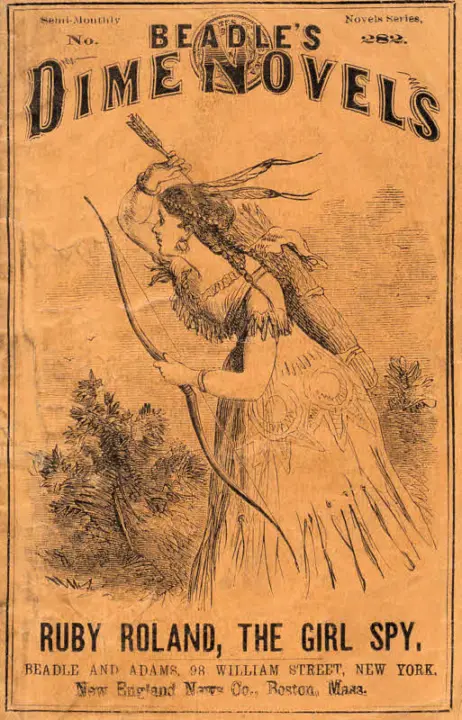
Ruby Roland, the Girl Spy; or, Simon Kenton’s Protege
Frederick Whittaker
THE CLASSIC COLLECTION · 1884
"Black Nick, the Hermit of the Hills; or, The Expiated Crime" by Frederick Whittaker is a historical novel written in the late 19th century. Set against the backdrop of the American Revolutionary War, the story involves themes of survival, espionage, and supernatural elements. The central characters include Indian warriors, a mysterious white man connected to Burgoyne's army, and the enigmatic figure of Black Nick, who embodies the supernatural aspect lurking in the wilderness. The opening of the novel introduces readers to a group of Indian warriors preparing to meet a British emissary in the midst of a twilight setting filled with portentous signs of an approaching storm. This atmosphere of tension and anticipation is compounded by the arrival of a messenger, who bears urgent news about a looming attack. Just as the plot thickens, the bizarre figure of Black Nick appears, disrupting the warrior's camp with a demoniacal presence that evokes both terror and awe. This blurs the lines between reality and myth, setting up a gripping narrative steeped in historical conflict and haunting intrigue as the characters navigate the dangers that surround them.
Introduction adapted from the source catalogue; source summaries may be automatically generated.
Free to read · English · 31,911 words · No account needed
MAKE TIME FOR A GOOD BOOK
On by default. Untick to stop anonymous reading totals. Each page counts after 10 seconds in view. How this works.
Anonymous counting is on unless you have switched it off.
The little mountain town of Derryfield[1] was full of the sounds of the drum and fife, while companies of tall, raw-boned countrymen, some with uniforms, more without, but all bearing arms and belts, were marching to and fro in the streets, and on the green, to the lively notes of “Yankee Doodle.”
In the best parlor of the “Patriot Arms,” the principal tavern of the village, a remarkably tall and scraggy-looking officer, in the uniform of a Continental General, was standing before the fire, with one foot on the huge andiron, looking shrewdly at our friend, Adrian Schuyler, who stood before him, still shackled.
The scraggy officer had very broad shoulders, and huge hands and feet, but the flesh seemed to have been forgotten in the formation of his powerful frame. He had a tall, narrow forehead, and a very stern, shrewd-looking face of a Scotch cast of feature, with high cheek bones, and very sharp black eyes. His nose and chin were both long, the latter very firm withal. His manner was remarkably sharp and abrupt. The nervous energy of the man seemed to be ever overflowing in impatience and fiery ardor. Such was Brigadier-General--afterwards Major-General--John Stark, the first leader of militia during the Revolutionary War.
“Well, sir,” he said, as Schuyler concluded his relation, “I’m very sorry that the rascals stole your commission, but your face is sufficient. I believe your story. What does Schuyler want me to do?”
“To join him at Bemis’ Hights, General,” said the Hussar, with equal business-like promptness.
“Well, sir, I’ll see him hanged first,” said Stark, with a snap of his
teeth.
Adrian hardly knew what to say to the eccentric brigadier, as he stood there, nodding his head as if to confirm his words.
“General,” he began, “if any unfortunate accident deprives me of credit--if you don’t believe I am properly authorized--”
“I told you I did, young man,” said Stark, with all his old abruptness. “You’re enough like Phil Schuyler to let me see you’re his cousin.”
“Then, General, what am I to understand?”
“That I’ll see them all hanged first.”
And the iron brigadier compressed his teeth like a vise.
Adrian Schuyler began to wax indignant. Without even waiting for a smith to file off his irons, he had ridden to Derryfield, turning loose the black horse, as he had been bidden. Seeking General Stark in the town, in his equivocal guise, he had been arrested by the patrol, and brought in as a prisoner, when he had told his whole story without reserve.
Your reading position is saved on this browser. Take it to another device with a library code. Reading pages adapt to text, rather than matching a printed edition.
Frederick Whittaker
BEHIND THE BOOK
This eBook is for the use of anyone anywhere in the United States and most other parts of the world at no cost and with almost no restrictions whatsoever. You may copy it, give it away or re-use it under the terms of the Project Gutenberg License included with this eBook or online at www.gutenberg.org. If you are not located in the United States, you will have to check the laws of the country where you are located before using this eBook. Read the source licence.
The original source file, including credits and licence, is retained by this library. Request an original-format copy at no charge. Please include the book title and Project Gutenberg identifier #69323.
KEEP YOUR CURIOSITY GOING
Cécile Tormay

Moritz Busch
Coulson Kernahan
John L. Ransom

Maurice Baring
Frances Wright