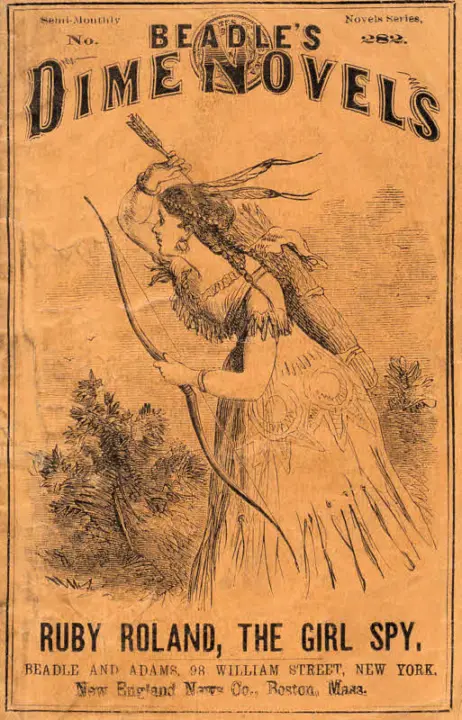
Ruby Roland, the Girl Spy; or, Simon Kenton’s Protege
Frederick Whittaker
THE CLASSIC COLLECTION · 1884
"Black Nick, the Hermit of the Hills; or, The Expiated Crime" by Frederick Whittaker is a historical novel written in the late 19th century. Set against the backdrop of the American Revolutionary War, the story involves themes of survival, espionage, and supernatural elements. The central characters include Indian warriors, a mysterious white man connected to Burgoyne's army, and the enigmatic figure of Black Nick, who embodies the supernatural aspect lurking in the wilderness. The opening of the novel introduces readers to a group of Indian warriors preparing to meet a British emissary in the midst of a twilight setting filled with portentous signs of an approaching storm. This atmosphere of tension and anticipation is compounded by the arrival of a messenger, who bears urgent news about a looming attack. Just as the plot thickens, the bizarre figure of Black Nick appears, disrupting the warrior's camp with a demoniacal presence that evokes both terror and awe. This blurs the lines between reality and myth, setting up a gripping narrative steeped in historical conflict and haunting intrigue as the characters navigate the dangers that surround them.
Introduction adapted from the source catalogue; source summaries may be automatically generated.
Free to read · English · 31,911 words · No account needed
MAKE TIME FOR A GOOD BOOK
On by default. Untick to stop anonymous reading totals. Each page counts after 10 seconds in view. How this works.
Anonymous counting is on unless you have switched it off.
“Would to heaven the Government would not employ them at all,” he said. “They do us more harm with their atrocities, than their services balance. That unfortunate affair of Jenny McCrea has raised public feeling against us to a fearful extent, and now, when they might be most useful, they are frightened to death, and deserting, because of some masquerading rebel, who plays tricks on them with raw-head-and-bloody-bones apparitions. Have the soldiers heard of the panic, baron?”
“I regret to say, General, that our own outposts are catching the infection, since the Indian chief, Creeping Wolf, was killed in sight of our pickets. The man or demon, whichever it be, seemed to laugh at their bullets, and disappeared, so they say, in a blaze of red flame.”
“Bah!” said Burgoyne, contemptuously, “’tis some conjuring trick. It can not be possible that our men are so foolish as to fear it. I must see that the rounds keep them awake. The fellows grow lazy, and dream. I shall visit the pickets myself to-night.”
Baron Reidesel brightened.
“The very thing, General. If we keep up their spirits, they will recover. I only hope we can gain the Indians back.”
“There is only one way, that I see, baron. We must catch this fellow who disturbs us, and hang him. Doubtless it is some rebel spy. One good thing. St. Leger sends me word that Fort Schuyler must soon surrender, and that will encourage the waverers. Then, Baum’s dragoons must be at Bennington by this time. Let them bring us provisions, and I’ll make short work of Schuyler’s militia. Go and ask General Fraser, and Philips, and the rest, to come with us, baron. I’ll be ready in five minutes, and will make a grand round of all the outposts.”
“Very good, General,” was the reply, as the baron saluted and left the apartment, while Burgoyne, mechanically putting on his sword, stood by the fire, moodily cogitating.
He was roused from his reverie by a slight noise in the room, and
looking, started in amazement.
A man of wonderful hight, but gaunt as a skeleton, stood within six feet of him, looking at him out of great cavernous eyes, that glared from the midst of a deadly pale face. The man was muffled in a long black cloak, and his face was shadowed by a broad slouched hat. He stood regarding Burgoyne in silence.
“Who the devil are you, sir?” asked the General, angrily, as soon as he had recovered his first shock.
“Your fate,” answered the stranger, in a hollow voice.
“My fate?” echoed Burgoyne, contemptuously. “Perhaps, then, you are the masquerading rebel who has frightened my Indians?”
Your reading position is saved on this browser. Take it to another device with a library code. Reading pages adapt to text, rather than matching a printed edition.
Frederick Whittaker
BEHIND THE BOOK
This eBook is for the use of anyone anywhere in the United States and most other parts of the world at no cost and with almost no restrictions whatsoever. You may copy it, give it away or re-use it under the terms of the Project Gutenberg License included with this eBook or online at www.gutenberg.org. If you are not located in the United States, you will have to check the laws of the country where you are located before using this eBook. Read the source licence.
The original source file, including credits and licence, is retained by this library. Request an original-format copy at no charge. Please include the book title and Project Gutenberg identifier #69323.
KEEP YOUR CURIOSITY GOING
Cécile Tormay

Moritz Busch
Coulson Kernahan
John L. Ransom

Maurice Baring
Frances Wright