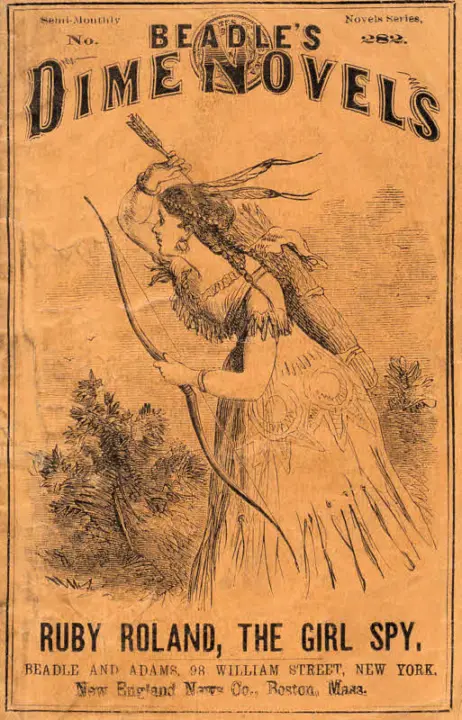
Ruby Roland, the Girl Spy; or, Simon Kenton’s Protege
Frederick Whittaker
THE CLASSIC COLLECTION · 1884
"Black Nick, the Hermit of the Hills; or, The Expiated Crime" by Frederick Whittaker is a historical novel written in the late 19th century. Set against the backdrop of the American Revolutionary War, the story involves themes of survival, espionage, and supernatural elements. The central characters include Indian warriors, a mysterious white man connected to Burgoyne's army, and the enigmatic figure of Black Nick, who embodies the supernatural aspect lurking in the wilderness. The opening of the novel introduces readers to a group of Indian warriors preparing to meet a British emissary in the midst of a twilight setting filled with portentous signs of an approaching storm. This atmosphere of tension and anticipation is compounded by the arrival of a messenger, who bears urgent news about a looming attack. Just as the plot thickens, the bizarre figure of Black Nick appears, disrupting the warrior's camp with a demoniacal presence that evokes both terror and awe. This blurs the lines between reality and myth, setting up a gripping narrative steeped in historical conflict and haunting intrigue as the characters navigate the dangers that surround them.
Introduction adapted from the source catalogue; source summaries may be automatically generated.
Free to read · English · 31,911 words · No account needed
MAKE TIME FOR A GOOD BOOK
On by default. Untick to stop anonymous reading totals. Each page counts after 10 seconds in view. How this works.
Anonymous counting is on unless you have switched it off.
A silent and dejected cavalcade was slowly emerging from the woods behind Burgoyne’s quarters, on the morning of the 7th of October. It was the returning party under Butler, disappointed of their aim, beaten and dispirited.
The partisan, after his ducking in the lake and the flight of his men, had certainly evinced rare courage, for he had actually returned to the assault on the following morning, provided with a quantity of torches of flaring pitch pine.
Under the stimulus of plenty of light, the dragoons had behaved better, although nothing could induce the Indians to venture back. They had thoroughly explored the first and second cave without any further annoyance, but neither did they make any more discoveries. By what means the three strange apparitions had managed to execute their flight over the lake, remained a mystery, but they had evidently vanished, for not a trace of living creature, save bats, was found.
Chamber after chamber, grand, beautiful, grotesque, and horrible, was passed, but they heard no more the mocking echo of demoniac laughter.
Full of rage and disappointment, Butler returned to the outer air, to find that his Indians, useless and superstitious as they were underground, had made an important discovery by the light of day, outside the limits of the cavern.
The tracks of three horses were found, quite fresh, at a little distance from the cave mouth, and they led toward the camp of Burgoyne, from another ravine.
The back trail, when followed, led to another opening in the hillside, and it became evident that the tenants of the cave, human or supernatural, had escaped.
The brow of the partisan grew dark and gloomy when he heard the news, but he made no remark. Even since the plunge into the subterranean lake, he had been much depressed in spirits, and now it was with sullen apathy that he agreed to the proposal of Sir Francis Clark, and led the return to Burgoyne’s camp.
The distance was so great--nearly forty miles--and their pace so slow, that it was not till the dawn of the following day that they came in sight of the English army, and started to hear the first guns of the decisive battle of Bemis’ Hights, better known as Saratoga.
Sir Francis Clark started when he heard the sound, and when a second report came booming through the woods, he gathered up his reins, turned to Butler hastily, and said:
“Excuse me, colonel. Bring on the party as slowly as you like. My duty takes me to the General.”
Your reading position is saved on this browser. Take it to another device with a library code. Reading pages adapt to text, rather than matching a printed edition.
Frederick Whittaker
BEHIND THE BOOK
This eBook is for the use of anyone anywhere in the United States and most other parts of the world at no cost and with almost no restrictions whatsoever. You may copy it, give it away or re-use it under the terms of the Project Gutenberg License included with this eBook or online at www.gutenberg.org. If you are not located in the United States, you will have to check the laws of the country where you are located before using this eBook. Read the source licence.
The original source file, including credits and licence, is retained by this library. Request an original-format copy at no charge. Please include the book title and Project Gutenberg identifier #69323.
KEEP YOUR CURIOSITY GOING
Cécile Tormay

Moritz Busch
Coulson Kernahan
John L. Ransom

Maurice Baring
Frances Wright