THE CLASSIC COLLECTION✦An outlaw’s diary: the CommuneCLASSIC FREE BOOKS
An outlaw’s diary: the Commune
Cécile Tormay
THE CLASSIC COLLECTION · 1918
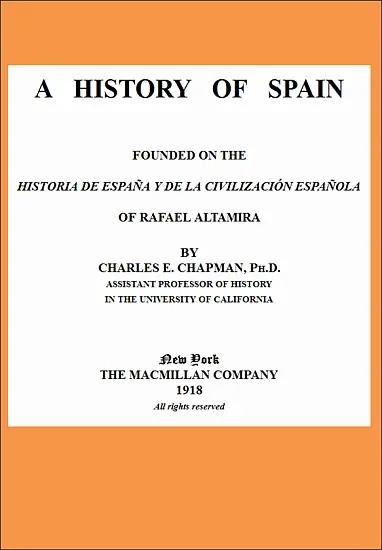
"A History of Spain" by Charles E. Chapman is a comprehensive historical account written in the early 20th century. The work aims to provide an in-depth overview of Spanish history with a particular focus on its civilization and cultural evolution, especially concerning its transfer to the Americas. It looks at the growth of institutions and societal structures from the beginning of recorded history in Spain, positioning these developments within a broader historical and cultural context." "The opening of the book outlines Chapman's intention to present a concise narrative that reflects the evolution of Spanish civilization from various perspectives, acknowledging both historical continuity and change. The preface discusses the significance of understanding Spanish history in relation to American cultures, which have been influenced by Spanish institutions and civilization. It introduces the book as a selection rather than a summary, indicating that it distills rich historical material into an accessible format designed for both general readers and academic settings. Moreover, it emphasizes the geographic and cultural uniqueness of Spain, setting the stage for a discussion of its early peoples and the historic ramifications of its geographical identity."
Introduction adapted from the source catalogue; source summaries may be automatically generated.
Free to read · English · 201,168 words · No account needed
MAKE TIME FOR A GOOD BOOK
On by default. Untick to stop anonymous reading totals. Each page counts after 10 seconds in view. How this works.
Anonymous counting is on unless you have switched it off.
[Sidenote: Revival of economic prosperity.]
Spaniards are in the habit of discussing their recent national development with reference to the year 1898, which is recognized as a turning-point in Spanish life, a change held by them to have been decidedly for the better. Nevertheless, the way had begun to be prepared with the accession of Alfonso XII to the throne; the splendid monument to that king in the Retiro at Madrid can be explained only on the ground that he symbolizes the re-establishment of good order in the peninsula, with a government based on what the Spanish people will stand, rather than on the full meed of an unworkable ideal. The country was tired of domestic strife, and asked only to be left in peace, with an opportunity to give attention to its material resources. This wish the government granted, and all Spain profited. Roads, railways, and irrigation ditches were built, and mining and the wine trade developed, while more recent times have witnessed a notable industrial growth in some of the northern cities. These matters were left very largely in the hands of foreigners, with Spaniards either wasting their blood and treasure in the colonies, or merely failing to participate in the economic enterprises of the peninsula. After 1898, however, Spaniards began to join with Englishmen, Germans, and Frenchmen in investing their capital in Spain. Many evils remained to be overcome, but the country recuperated to such an extent that its present wealth would compare favorably with that of the past at almost any stage of Spanish history, although the rate of economic progress has probably not equalled that of other countries.
[Sidenote: Conservative rule in a pseudo-Liberal state.]
On the surface the old politico-social ideas of Liberalism seemed for a while to have died, and the country came to be ruled by parties which supported the conservative constitution of 1876, although there was a widespread opposition in opinions it not in power. At the present time there is a Liberal and a Conservative party, but the difference between the two is recognized, even by many Spaniards, as being very slight. In 1911 there was a strike on the government-owned railways, whereupon the authorities suspended the constitutional guarantees, on the ground that the nation was in danger. One result was that bodies of men could not congregate,--and the strikers were helpless. In 1912 a general railway strike was threatened. The premier, Canalejas, called out the military reserves, and put them on the trains not only as guards but also as train operatives,--for, since all Spaniards who have served their term in the active army are in the reserves, the strikers were employed as military trainmen to put down their own strike,--a thing which they could not refuse to do, as they were under martial law. An early Cortes was promised, at which the questions of increase in wages and decrease in the hours of labor would be taken up. The Cortes was called,--and the matter of the strike was dropped. The interesting thing is that all of this took place while a Liberal government was in power! It is also said that the Liberals and Conservatives agreed, a few years ago, to alternate in office, thus showing their contempt for the spirit of representative institutions, but the Liberals did not retire from their control of the government in 1913, wherefore not a little ill-concealed resentment was displayed by the organs of the Conservative party. In fact, parties are divided on lines of the allegiance of individuals to the chieftain (cacique) of their group. National policies and projects of reform on the part of those in power get little beyond the stage of rhetoric, while government is too largely given over to the interplay of personal ambitions. To many the young king, Alfonso XIII, has seemed the most liberal-minded of the higher officers of the Spanish state, and in both word and deed he has appeared, until recently at least, to merit the characterization. Attaining to his majority at the age of sixteen, in 1902, he married the granddaughter of the English Queen Victoria in 1906,--an augury in itself of liberal views. A savage attempt was made, without success, to murder the young couple on their wedding day; on that occasion and two others when later assassinations were tried, Alfonso displayed such courage and coolness as to win for himself an immense popularity; “the valiant king” (El rey valiente) he is often called.
Your reading position is saved on this browser. Take it to another device with a library code. Reading pages adapt to text, rather than matching a printed edition.
BEHIND THE BOOK
This eBook is for the use of anyone anywhere in the United States and most other parts of the world at no cost and with almost no restrictions whatsoever. You may copy it, give it away or re-use it under the terms of the Project Gutenberg License included with this eBook or online at www.gutenberg.org. If you are not located in the United States, you will have to check the laws of the country where you are located before using this eBook. Read the source licence.
The original source file, including credits and licence, is retained by this library. Request an original-format copy at no charge. Please include the book title and Project Gutenberg identifier #40646.
KEEP YOUR CURIOSITY GOING
Cécile Tormay

Moritz Busch
John L. Ransom
Frances Wright
Cécile Tormay

Mabel Potter Daggett