THE CLASSIC COLLECTION✦An outlaw’s diary: the CommuneCLASSIC FREE BOOKS
An outlaw’s diary: the Commune
Cécile Tormay
THE CLASSIC COLLECTION · 1918
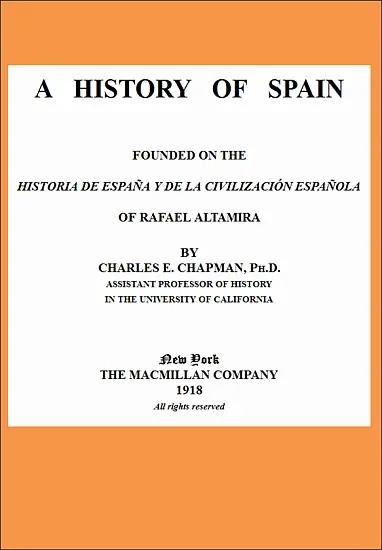
"A History of Spain" by Charles E. Chapman is a comprehensive historical account written in the early 20th century. The work aims to provide an in-depth overview of Spanish history with a particular focus on its civilization and cultural evolution, especially concerning its transfer to the Americas. It looks at the growth of institutions and societal structures from the beginning of recorded history in Spain, positioning these developments within a broader historical and cultural context." "The opening of the book outlines Chapman's intention to present a concise narrative that reflects the evolution of Spanish civilization from various perspectives, acknowledging both historical continuity and change. The preface discusses the significance of understanding Spanish history in relation to American cultures, which have been influenced by Spanish institutions and civilization. It introduces the book as a selection rather than a summary, indicating that it distills rich historical material into an accessible format designed for both general readers and academic settings. Moreover, it emphasizes the geographic and cultural uniqueness of Spain, setting the stage for a discussion of its early peoples and the historic ramifications of its geographical identity."
Introduction adapted from the source catalogue; source summaries may be automatically generated.
Free to read · English · 201,168 words · No account needed
MAKE TIME FOR A GOOD BOOK
On by default. Untick to stop anonymous reading totals. Each page counts after 10 seconds in view. How this works.
Anonymous counting is on unless you have switched it off.
[Sidenote: Social characteristics of the era.]
FUNDAMENTALLY, there was no change in the classes of Spanish society in this period as regards their legal and social standing, except in the case of the rural population of Aragon. One of the characteristic notes of the era was a certain democratic sentiment of a philanthropic kind, exhibiting itself vaguely in a desire for the well-being of mankind, and practically in the social, economic, and intellectual betterment of the masses, without any attempt being made to improve their juridical position. This ideal, which was not confined to Spain, became more and more widespread with the increase in influence of the French encyclopedists, and got to be a fad of high society, being encouraged by the kings themselves. Many of its manifestations will be taken up later in dealing with economic institutions, but the sentimental discussion of the ideal may be remarked upon here; this at length went so far as to result in the formulation of political doctrines of a democratic character, but they were not yet translated into law. Such social reforms as were made came for the most part in the last three reigns of the era, especially in that of Charles III.
[Sidenote: Pride, wealth, and privileges of the nobles.]
[Sidenote: Real decline of their power.]
The description of the nobility in the period of the House of Austria might almost be repeated for this era. The nobles had long since lost their political power, but the wealth of the grandees and the privileges and the prestige of all ranks of the nobility were so great that this class was a more important factor in Spanish life than it is today. Pride of noble rank continued to be almost an obsession, despite the attempts to check it; with a view to diminishing petitions for the recognition of rights of hidalguía, a law was passed in 1758 calling for the payment of a large sum of money when the petitioner’s title dated back to the fourth or fifth grandfather. On the other hand, the kings were responsible for acts which tended to encourage the eagerness for noble rank. Ferdinand VI officially recognized that the people of Vizcaya were all of hidalgo rank; Charles III created the order which bears his name, and Charles IV founded that of the “noble ladies of María Luisa”; various societies of nobles for equestrian exercises, in imitation of the military orders, were formed, and they were given certain privileges in criminal jurisdiction. To be sure, the grant of these honors was a source of revenue to the state. The recognition of the privileged character of the nobles was manifest, even in the case of the more degraded members of that class; a law of 1781 provided that nobles who were arrested as vagabonds should be sent to the army with the rank of “distinguished soldiers.” The grandees and the other nobles possessed of seigniorial estates still controlled the appointment of many municipal functionaries; in 1787 there were 17 cities, 2358 villas, and 1818 aldeas and pueblos in seigniorial hands, in some of which the king shared jurisdiction with the lords. Similarly, the military orders had the right to appoint the clergymen of 3 cities, 402 villas, 119 pueblos, and 261 aldeas. Many monopolies of a medieval type still survived in favor of the lords, such as those of hunting, fishing, the baking of bread, the making of flour, and the use of streams and forests, and in some cases the lord’s vassals were subject to medieval tributes and services. It is rather by comparison with matters as they are today, however, that these incidents loom large; they were but the survivals of a system which was already dead. The worst of these seigniorial rights, the Aragonese lord’s power of life and death over his villeins, was abolished by Philip V. The kings did not dare to suppress all of the seigniorial privileges, but took steps to overcome them, as by submitting the rights of certain lords to rigorous proofs, by hindering sales of jurisdiction, by subjecting the appointments of the lords to the approval of the Cámara, by naming special royal officials for the various seigniorial holdings, and in general by facilitating the reincorporation in the crown of such estates. By this time the lesser nobility enjoyed few exemptions of a financial character, but the great nobles still possessed such privileges. The kings employed indirect methods to cause them to submit to taxation. Thus payments were demanded in lieu of military service, and the media anata (half annates) was required for the recognition of the title of a successor to landed estates; certainly the immensely wealthy grandees were able to pay these tributes without serious economic loss to themselves. Furthermore, the great nobles continued to be a court nobility, and were jealously proud of the special privileges of an empty character which marked them off from the classes below them. For example, a grandee had the right to keep his hat on and to sit down in the presence of the king; to be called “cousin” by the king; to have a private guard; to preside over the sessions of the noble branch of the Cortes; to be visited and saluted by ayuntamientos, viceroys, and other authorities; to have a better place than others, both indoors and out; and to be free from imprisonment except by a special decree of the king.
Your reading position is saved on this browser. Take it to another device with a library code. Reading pages adapt to text, rather than matching a printed edition.
BEHIND THE BOOK
This eBook is for the use of anyone anywhere in the United States and most other parts of the world at no cost and with almost no restrictions whatsoever. You may copy it, give it away or re-use it under the terms of the Project Gutenberg License included with this eBook or online at www.gutenberg.org. If you are not located in the United States, you will have to check the laws of the country where you are located before using this eBook. Read the source licence.
The original source file, including credits and licence, is retained by this library. Request an original-format copy at no charge. Please include the book title and Project Gutenberg identifier #40646.
KEEP YOUR CURIOSITY GOING
Cécile Tormay

Moritz Busch
John L. Ransom
Frances Wright
Cécile Tormay

Mabel Potter Daggett