THE CLASSIC COLLECTION✦An outlaw’s diary: the CommuneCLASSIC FREE BOOKS
An outlaw’s diary: the Commune
Cécile Tormay
THE CLASSIC COLLECTION · 1918
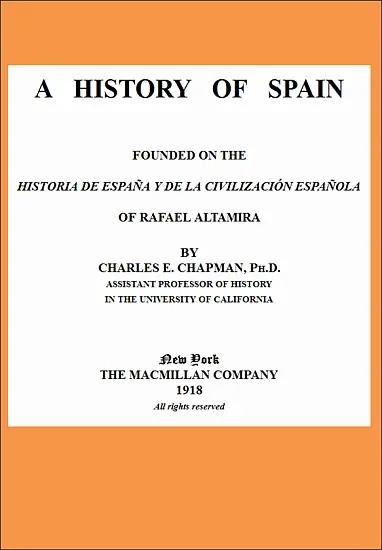
"A History of Spain" by Charles E. Chapman is a comprehensive historical account written in the early 20th century. The work aims to provide an in-depth overview of Spanish history with a particular focus on its civilization and cultural evolution, especially concerning its transfer to the Americas. It looks at the growth of institutions and societal structures from the beginning of recorded history in Spain, positioning these developments within a broader historical and cultural context." "The opening of the book outlines Chapman's intention to present a concise narrative that reflects the evolution of Spanish civilization from various perspectives, acknowledging both historical continuity and change. The preface discusses the significance of understanding Spanish history in relation to American cultures, which have been influenced by Spanish institutions and civilization. It introduces the book as a selection rather than a summary, indicating that it distills rich historical material into an accessible format designed for both general readers and academic settings. Moreover, it emphasizes the geographic and cultural uniqueness of Spain, setting the stage for a discussion of its early peoples and the historic ramifications of its geographical identity."
Introduction adapted from the source catalogue; source summaries may be automatically generated.
Free to read · English · 201,168 words · No account needed
MAKE TIME FOR A GOOD BOOK
On by default. Untick to stop anonymous reading totals. Each page counts after 10 seconds in view. How this works.
Anonymous counting is on unless you have switched it off.
[Sidenote: Dominating character of relations with France and their
effects upon Spain]
IF the reign of Charles III, despite the close union of the Bourbon crowns, had been characterized mainly in its external manifestations by the hostility of Spain to England, that of Charles IV (1788-1808) was dominated by relations with France. Unaffected for a while by the principles underlying the French Revolution, Spain was toppled from her position as a first-rate power by the Emperor Napoleon, whose designs for world power and whose methods in seeking it were not unlike those followed over a century later by William II of Germany. Meanwhile, the ideas of the American and the French revolutions were permeating the Spanish colonies, and as the wars with England continued during much of this reign, shutting off effective communication between the colonies and Spain, a chance was offered for putting them into effect in the new world. The way was well prepared in the reign of Charles IV, though the outbreak was postponed until after his fall. The blow struck by Napoleon was not without its compensations, which in the long run may be considered to have outweighed the loss of prestige. Napoleon, quite without intention, gave Spain an impulse to national feeling, in the uprising against French domination, which was greater than any she had formerly experienced, and of sufficient force to endure to the present day. In the same roundabout way Napoleon gave the Spain of the Dos de Mayo, or Second of May (the date of the revolt against Napoleon, and the national holiday of Spain), her first opportunity to imbibe democratic ideas.
[Sidenote: The Nootka affair and the virtual repudiation of the Family
Compact.]
To cope with the great forces of the French Revolution and the Napoleonic Empire, Spain had to rely on the leadership of the weak, timid, vacillating Charles IV. His predecessor had left him a legacy of able ministers, but these were not long sustained by the king. At the outset Floridablanca still ruled as first minister of state. He was liberal-minded as concerned social and economic institutions, but was profoundly royalist in his political ideas and an enemy of anything which represented a diminution in the prerogatives of the crown. He was alarmed by the ideas which were being spread broadcast in France, and took steps to prevent their introduction into Spain, becoming recognized as an opponent of the French Revolution. In the midst of this situation, there occurred the Nootka affair, which obliged him for a time to change his policy. A Spanish voyage of 1789 to the northwest coast of North America had resulted in the discovery and capture of two English ships at Nootka, on the western shore of Vancouver Island. Floridablanca informed the English government of this event, in January, 1790, complaining of the frequent usurpations of Spanish colonial territories by British subjects, and asking for the recognition of Spain’s ownership of Nootka, which had been discovered by a Spanish voyage of 1774. What followed was very nearly a duplicate of the Falkland incident, twenty years before. England claimed that the British flag had been insulted, and demanded satisfaction, which Floridablanca refused to give, as it involved the acknowledgment of a doubt concerning Spain’s ownership of Nootka. War seemed imminent, and the French government was invoked to stand by the Family Compact. The National Assembly, then in actual control in France, acknowledged the obligation, but attached conditions (having to do with the revolution) to their willingness to declare war,--with the result that Charles IV and Floridablanca decided that it was better to avoid a rupture with England. A series of three treaties, from 1790 to 1794, arranged for the payment of an indemnity by Spain, and among other matters agreed that the ships of both nations should have a right to sail the waters and make landings freely in regions not already settled by either power. In effect, therefore, the lands north of the Spanish settlements were thrown open to the entry of England. These treaties had a significance which was wider than that of the matters directly involved. They marked a new spirit in the direction of colonial affairs. In the early years of the conquest Spain had played an aggressive part, followed soon by the adoption of what might be termed an aggressive defensive, or a willingness to fight for the retention of what she had, leading also to further conquests in order to ward off foreign attack. The Nootka affair was the beginning of a spiritless, waiting kind of defensive, the inevitable outcome of which was disintegration.
Your reading position is saved on this browser. Take it to another device with a library code. Reading pages adapt to text, rather than matching a printed edition.
BEHIND THE BOOK
This eBook is for the use of anyone anywhere in the United States and most other parts of the world at no cost and with almost no restrictions whatsoever. You may copy it, give it away or re-use it under the terms of the Project Gutenberg License included with this eBook or online at www.gutenberg.org. If you are not located in the United States, you will have to check the laws of the country where you are located before using this eBook. Read the source licence.
The original source file, including credits and licence, is retained by this library. Request an original-format copy at no charge. Please include the book title and Project Gutenberg identifier #40646.
KEEP YOUR CURIOSITY GOING
Cécile Tormay

Moritz Busch
John L. Ransom
Frances Wright
Cécile Tormay

Mabel Potter Daggett