THE CLASSIC COLLECTION✦An outlaw’s diary: the CommuneCLASSIC FREE BOOKS
An outlaw’s diary: the Commune
Cécile Tormay
THE CLASSIC COLLECTION · 1918
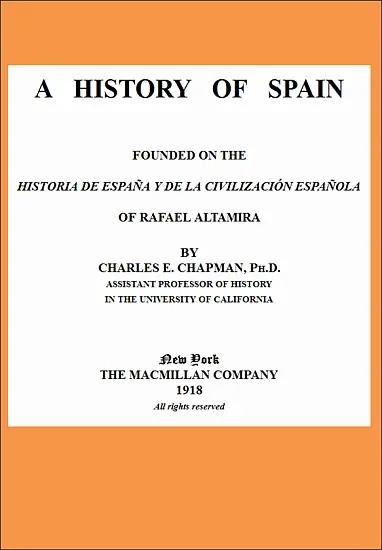
"A History of Spain" by Charles E. Chapman is a comprehensive historical account written in the early 20th century. The work aims to provide an in-depth overview of Spanish history with a particular focus on its civilization and cultural evolution, especially concerning its transfer to the Americas. It looks at the growth of institutions and societal structures from the beginning of recorded history in Spain, positioning these developments within a broader historical and cultural context." "The opening of the book outlines Chapman's intention to present a concise narrative that reflects the evolution of Spanish civilization from various perspectives, acknowledging both historical continuity and change. The preface discusses the significance of understanding Spanish history in relation to American cultures, which have been influenced by Spanish institutions and civilization. It introduces the book as a selection rather than a summary, indicating that it distills rich historical material into an accessible format designed for both general readers and academic settings. Moreover, it emphasizes the geographic and cultural uniqueness of Spain, setting the stage for a discussion of its early peoples and the historic ramifications of its geographical identity."
Introduction adapted from the source catalogue; source summaries may be automatically generated.
Free to read · English · 201,168 words · No account needed
MAKE TIME FOR A GOOD BOOK
On by default. Untick to stop anonymous reading totals. Each page counts after 10 seconds in view. How this works.
Anonymous counting is on unless you have switched it off.
[Sidenote: General characteristics of intellectual life in Spain and the
Americas.]
In intellectual expression, as well as in other phases of Spain’s national life, the eighteenth century was a period of recovery from the degradation which marked the close of the preceding era. Spain placed herself abreast of the times, but not as formerly in a leading position; among the many who distinguished themselves by their achievements there were few who attained to a European reputation, and perhaps only one, the painter Goya, may be reckoned with the immortals. On the other hand Spain entered more definitely into the general current of western European thought than at any previous time in her history; intellectual activities in France reacted almost at once in Spain, and the influences springing out of Italy and England were potent. The Americas began to take over the intellectual side of their Spanish heritage much more completely than before, and while not nearly approximating the mother country in the amount or excellence of their contributions furnished illustrious names in almost every branch worthy to stand beside those of their contemporaries in Spain. Education there became more general, more secular, and more highly regarded than ever before. Two obstacles, however, were a serious check upon the development of a broad culture in the colonies: the problems of race, reducing the number of those able to participate, and lessening the desirability of a propaganda for the ideal involved; and the suspicions of the Spanish-controlled government, lest ideas convert themselves into thoughts of revolution.
[Sidenote: Progress in education.]
Cultivated Spaniards of the eighteenth century had a clear understanding of the national problem of education, realizing (just as they did with regard to matters having an economic bearing) the profound ignorance of the masses and the decadent state of the institutions upon which they had to rely to combat it. The mass of the people were not only illiterate but also full of almost ineradicable superstitions and the conservatism of the undeveloped mind. In 1766 Queen Amalia, the wife of Charles III, wrote to Tanucci (one of Charles’ leading ministers while he was king of Naples), “In everything (in Spain) there is something of barbarism, together with great pride.” As for the women, she said, “One does not know what to talk about with them; their ignorance is beyond belief.” This pessimistic view finds ample corroboration in the writings of the Benedictine Feyjóo, or Feijóo (1676-1764), and Jovellanos, both of whom devoted themselves to the struggle against the defects in Spanish mentality and its expression, leaving published works which touched upon virtually every phase of the intellectual life, or its lack, in the Iberian Peninsula. The endeavors of these men and numerous others to regenerate the country were not wholly in obedience to the national necessity or to patriotism, but responded also to the general current of humanitarianism and philanthropy characteristic of the eighteenth century. The close relationship of Spain with France during most of the era and the conditions of peace imposed by Protestant countries as a result of their military successes had favored the penetration of these ideas into Spain, where they were taken up by the well-to-do elements of the nobility, the clergy, and the wealthy middle class. The great nobles furnished few of the illustrious names of the period, although there were some exceptions (for example, the Count of Fernán-Núñez and the Count of Aranda), but they gave both financial and moral support to the efforts for intellectual reform. Some of those who held high office, notably Godoy, aided authors in the publication of their works or the continuation of their studies, giving them official employment, or subsidies, or bringing out their volumes through the royal printing establishment. Despite the characterization of them by Queen Amalia, the women shared in the intellectual activities of the age. Thus there was a revival of interest in education, but with a difference from the spirit which had dominated the works of Vives and others of the Hapsburg era; now the ideal was that of secular education without the intervention of the clergy. Encyclopedism and monarchism worked together to this end, while the expulsion of the Jesuits helped greatly to make its attainment possible, although the new attitude did not go so far as to oppose religion; indeed, that remained the basis of primary education. All this manifested itself with especial force beginning with the reign of Charles III, but precedents were not lacking in earlier years. It made itself felt chiefly in the sphere of professional training, in instruction in the humanities, and in university education, but it did not fail to produce effects of undoubted value on the primary schools.
Your reading position is saved on this browser. Take it to another device with a library code. Reading pages adapt to text, rather than matching a printed edition.
BEHIND THE BOOK
This eBook is for the use of anyone anywhere in the United States and most other parts of the world at no cost and with almost no restrictions whatsoever. You may copy it, give it away or re-use it under the terms of the Project Gutenberg License included with this eBook or online at www.gutenberg.org. If you are not located in the United States, you will have to check the laws of the country where you are located before using this eBook. Read the source licence.
The original source file, including credits and licence, is retained by this library. Request an original-format copy at no charge. Please include the book title and Project Gutenberg identifier #40646.
KEEP YOUR CURIOSITY GOING
Cécile Tormay

Moritz Busch
John L. Ransom
Frances Wright
Cécile Tormay

Mabel Potter Daggett