THE CLASSIC COLLECTION✦An outlaw’s diary: the CommuneCLASSIC FREE BOOKS
An outlaw’s diary: the Commune
Cécile Tormay
THE CLASSIC COLLECTION · 1918
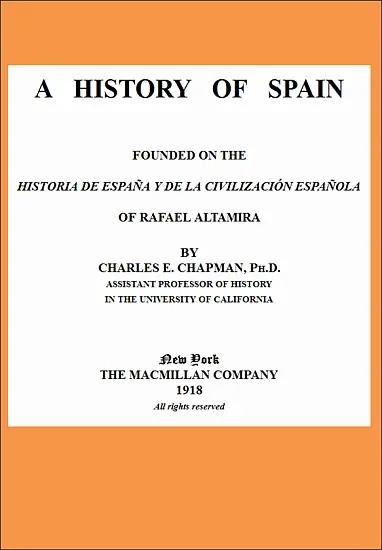
"A History of Spain" by Charles E. Chapman is a comprehensive historical account written in the early 20th century. The work aims to provide an in-depth overview of Spanish history with a particular focus on its civilization and cultural evolution, especially concerning its transfer to the Americas. It looks at the growth of institutions and societal structures from the beginning of recorded history in Spain, positioning these developments within a broader historical and cultural context." "The opening of the book outlines Chapman's intention to present a concise narrative that reflects the evolution of Spanish civilization from various perspectives, acknowledging both historical continuity and change. The preface discusses the significance of understanding Spanish history in relation to American cultures, which have been influenced by Spanish institutions and civilization. It introduces the book as a selection rather than a summary, indicating that it distills rich historical material into an accessible format designed for both general readers and academic settings. Moreover, it emphasizes the geographic and cultural uniqueness of Spain, setting the stage for a discussion of its early peoples and the historic ramifications of its geographical identity."
Introduction adapted from the source catalogue; source summaries may be automatically generated.
Free to read · English · 201,168 words · No account needed
MAKE TIME FOR A GOOD BOOK
On by default. Untick to stop anonymous reading totals. Each page counts after 10 seconds in view. How this works.
Anonymous counting is on unless you have switched it off.
The entire reign of Abd-er-Rahman I (755-788) was one of war. He had to fight the Yemenite (Sunnite) Arabs, the Berbers, and many chiefs of various tribes, as well as the governors sent out by the Abbassides, before his authority was recognized. His ideal was that of an absolute monarchy which should bring to an end the aristocratic independence and anarchy in Spain, but in order to accomplish this he had to combat Arabic tradition and pride, Berber democracy, and inter-tribal hatred. Abd-er-Rahman was at least able to subject his opponents if not to change them. It was during his reign that the Frankish king Charlemagne invaded Spain and got as far as Saragossa. Obliged by events in France to recross the Pyrenees he was attacked by the Basques in the pass of Roncesvalles, and his rear-guard was completely destroyed. It was this event which gave rise to the celebrated French epic poem, the Chanson de Roland (Song of Roland), in which the Frankish hero Roland is supposed to combat the forces of Islam. No Mohammedan forces in fact engaged in the battle, for the Basques were Christians; they were then, as later, opposed to any foreign army which should invade their lands.
[Sidenote: Internal strife.]
Hisham I, the next emir, was not free from wars, but his reign was more notable in its religious aspects. He was a devout Mohammedan, and enabled the religious class to attain to great power. His successor, Hakem I, was a sincere believer, but did not refrain from drinking wine, thus breaking the religious law, and he conceded less influence in the government to the church than his father had. This led to several uprisings, in which the Renegados were a principal element. Hakem subdued them, and exiled many thousands, most of them Renegados, who went to different parts of northern Africa and Egypt. Another serious revolt broke out in Toledo, which had been enjoying virtual independence, though nominally subject to the emir. The citizens of Toledo were most of them Renegados, but they were also Spanish, and were unable to forget that Toledo had once been the capital of Spain. Hakem resolved to bring them into real subjection, and was able to effect his will. Seven years later, in 829, when Abd-er-Rahman II was emir, the people of Toledo revolted again, and it took eight years to subdue them. War and disorder were also prevalent in other parts of the realm. The inhabitants of Mérida, who were Christians, rose several times; in Murcia there was a seven years’ war between the Sunnites and Shiites. At this time, too, the Normans began to attack the coasts of Spain just as they were doing in other parts of Europe. They made no permanent conquest, but rendered the coasts unsafe during the greater part of the century. Toward the close of the ninth century the emirate began to break under the strain of constant war. After repeated rebellions the city of Toledo formed itself into a republic, and on the basis of an annual tribute to the emir was recognized by the latter, who had no other right there. In Aragon the Visigothic but Renegado family of Beni-Casi founded an independent kingdom. A similar kingdom sprang up in Extremadura, and another in the mountains of southern Spain. Meanwhile, the Christian kingdoms were making gains. Except for them the new states were usually made up of Renegados. They did not work together, however, or the Arabic domination might have been completely broken: rather, each little state followed a selfish policy of its own. The most important was that of Omar-ben Hafsun in the south. Omar founded his kingdom in 884, with his capital at the castle of Bobastro. In 886 the emir attacked him, and for more than thirty years thereafter there was war between Omar and the emirs of Cordova. Omar was usually successful, acquiring nearly all of Andalusia, but his political plans illustrate the lack of a truly Spanish ideal in the kingdoms carved out of the emirate. At first he planned only a tiny kingdom of his own; later he aimed to get the governor of Africa to appoint him emir of Spain; finally he became converted to Christianity, and resolved to wage a religious war, whereupon his Renegado followers abandoned him. During the same period civil wars of a racial nature broke out in other parts of Spain between the Arabic aristocracy and the Renegados, especially around the cities of Elvira and Seville. The Arabs despised the Renegados, who were at this time the principal industrial and commercial class, especially in Seville, and envied their wealth. Many Arabic chiefs also refused obedience to the emirs. For a time the aristocratic party was successful, inflicting great blows on the Renegados, and increasing their own estates, but in the reign of Abdallah, early in the ninth century, they received a check. The same Abdallah inflicted a crushing defeat on King Omar. Thus the way was prepared for Abdallah’s successor, Abd-er-Rahman III, who was to establish peace in Spain after two centuries of almost continuous disorder.
Your reading position is saved on this browser. Take it to another device with a library code. Reading pages adapt to text, rather than matching a printed edition.
BEHIND THE BOOK
This eBook is for the use of anyone anywhere in the United States and most other parts of the world at no cost and with almost no restrictions whatsoever. You may copy it, give it away or re-use it under the terms of the Project Gutenberg License included with this eBook or online at www.gutenberg.org. If you are not located in the United States, you will have to check the laws of the country where you are located before using this eBook. Read the source licence.
The original source file, including credits and licence, is retained by this library. Request an original-format copy at no charge. Please include the book title and Project Gutenberg identifier #40646.
KEEP YOUR CURIOSITY GOING
Cécile Tormay

Moritz Busch
John L. Ransom
Frances Wright
Cécile Tormay

Mabel Potter Daggett