THE CLASSIC COLLECTION✦An outlaw’s diary: the CommuneCLASSIC FREE BOOKS
An outlaw’s diary: the Commune
Cécile Tormay
THE CLASSIC COLLECTION · 1918
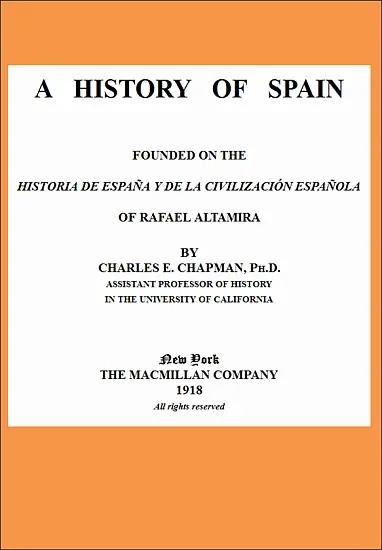
"A History of Spain" by Charles E. Chapman is a comprehensive historical account written in the early 20th century. The work aims to provide an in-depth overview of Spanish history with a particular focus on its civilization and cultural evolution, especially concerning its transfer to the Americas. It looks at the growth of institutions and societal structures from the beginning of recorded history in Spain, positioning these developments within a broader historical and cultural context." "The opening of the book outlines Chapman's intention to present a concise narrative that reflects the evolution of Spanish civilization from various perspectives, acknowledging both historical continuity and change. The preface discusses the significance of understanding Spanish history in relation to American cultures, which have been influenced by Spanish institutions and civilization. It introduces the book as a selection rather than a summary, indicating that it distills rich historical material into an accessible format designed for both general readers and academic settings. Moreover, it emphasizes the geographic and cultural uniqueness of Spain, setting the stage for a discussion of its early peoples and the historic ramifications of its geographical identity."
Introduction adapted from the source catalogue; source summaries may be automatically generated.
Free to read · English · 201,168 words · No account needed
MAKE TIME FOR A GOOD BOOK
On by default. Untick to stop anonymous reading totals. Each page counts after 10 seconds in view. How this works.
Anonymous counting is on unless you have switched it off.
The Republicans now had their innings, but the time could hardly have been worse for the trial of their ideas. The Carlists had under arms a force of 45,000 men in 1873, which swelled to 75,000 by the close of 1875. The south received the proclamation of the republic with a resort to self-governing, jealous particularism, as if the day of democratic taifa states had dawned, for they were able to agree on one thing alone,--that of refusing to pay taxes to the central government. One Figueras had been proclaimed ad interim president until a Cortes could be elected, but he became terrified by the republic when he saw it, and fled before the Cortes could meet. There were three more presidents in 1873. Pi y Margall was a federalist who believed that the newly won freedom would provide a remedy for the prevailing disorder,--but it did not. He was therefore put aside, and Salmerón, a unitary Republican, took the helm. Salmerón initiated vigorous measures to crush the forces of disintegration, but, as he was about to succeed, drew back before the fear of militarism. Castelar was put in his place, and he revived the army. This measure strengthened the central authority, but it killed Republicanism, which had made the abolition of enforced military service one of the cardinal tenets of its creed. It was now only a question of time before the Alfonsists would take control. Carlists of constitutional leanings went over to that side as did many Republicans, since it now seemed clear that the accession of Alfonso was the only alternative to the enthronement of the Carlist representative. In December, 1874, Alfonso issued a proclamation, promising an amnesty and constitutional government. With hardly a struggle the republic fell.
[Sidenote: Alfonso XII and the establishment of a conservative
monarchy.]
The reign of Alfonso XII (1874-1885) marked the beginning of a new era, based upon the acceptance of pseudo-democracy under constitutional forms, and accompanied by a growing tendency toward internal peace. Minor outbreaks in Spain, now of Carlists, now of Republicans, continued to require military attention down to 1886, but no such disorder as had so long been the rule again prevailed. A new constitution was promulgated in 1876 which had the effect of conciliating the clergy, since it provided for state support of the church, although that institution did not receive all it had been promised; indeed, it protested bitterly against the grant of toleration to other faiths. The constitution of 1876, which with some modifications is still operative, was patterned after that of 1845, with the addition of certain of the more recent reforms. Some of its provisions were the following: the Cortes was to be composed of two houses, respectively the senate and the congress; the senate was to contain eighty members in their own right, such as princes of the royal family, grandees, presidents of the great councils, archbishops, and captain-generals, one hundred more by royal appointment, and one hundred and eighty elected for a term of five years by municipal and provincial assemblies, universities, and taxpayers of the highest class; congress was to be made up of 431 deputies, representing districts of 50,000 people each, chosen by an electorate which was limited by the imposition of a property qualification,--changed in 1889 by the restoration of universal manhood suffrage; legislative power was vested in the Cortes with the king; the king was made irresponsible, but his decrees had to be countersigned by a responsible minister; and the jury system was abolished,--although it was restored early in the next reign. The net result was a centralized monarchy in the control of the conservative elements. Many principles of the Liberal program, taken especially from the constitution of 1869 when Prim was in power, have since been added. The death of the king, who had ruined his health as the result of excesses which recalled the scandals of his mother’s reign, seemed likely to raise fresh difficulties at the close of the year 1885. The queen was then pregnant, and it was not until 1886 that her son, the present Alfonso XIII, was born. The ex-queen, Isabella II, attempted to intervene, but only succeeded in strengthening the position of the queen-mother, María Cristina of Austria, who ruled henceforth as regent until Alfonso attained his majority in 1902.
Your reading position is saved on this browser. Take it to another device with a library code. Reading pages adapt to text, rather than matching a printed edition.
BEHIND THE BOOK
This eBook is for the use of anyone anywhere in the United States and most other parts of the world at no cost and with almost no restrictions whatsoever. You may copy it, give it away or re-use it under the terms of the Project Gutenberg License included with this eBook or online at www.gutenberg.org. If you are not located in the United States, you will have to check the laws of the country where you are located before using this eBook. Read the source licence.
The original source file, including credits and licence, is retained by this library. Request an original-format copy at no charge. Please include the book title and Project Gutenberg identifier #40646.
KEEP YOUR CURIOSITY GOING
Cécile Tormay

Moritz Busch
John L. Ransom
Frances Wright
Cécile Tormay

Mabel Potter Daggett