THE CLASSIC COLLECTION✦An outlaw’s diary: the CommuneCLASSIC FREE BOOKS
An outlaw’s diary: the Commune
Cécile Tormay
THE CLASSIC COLLECTION · 1918
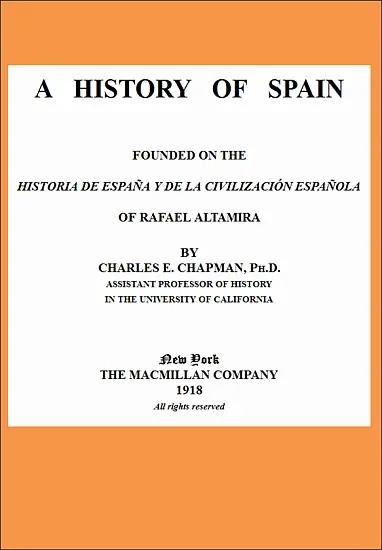
"A History of Spain" by Charles E. Chapman is a comprehensive historical account written in the early 20th century. The work aims to provide an in-depth overview of Spanish history with a particular focus on its civilization and cultural evolution, especially concerning its transfer to the Americas. It looks at the growth of institutions and societal structures from the beginning of recorded history in Spain, positioning these developments within a broader historical and cultural context." "The opening of the book outlines Chapman's intention to present a concise narrative that reflects the evolution of Spanish civilization from various perspectives, acknowledging both historical continuity and change. The preface discusses the significance of understanding Spanish history in relation to American cultures, which have been influenced by Spanish institutions and civilization. It introduces the book as a selection rather than a summary, indicating that it distills rich historical material into an accessible format designed for both general readers and academic settings. Moreover, it emphasizes the geographic and cultural uniqueness of Spain, setting the stage for a discussion of its early peoples and the historic ramifications of its geographical identity."
Introduction adapted from the source catalogue; source summaries may be automatically generated.
Free to read · English · 201,168 words · No account needed
MAKE TIME FOR A GOOD BOOK
On by default. Untick to stop anonymous reading totals. Each page counts after 10 seconds in view. How this works.
Anonymous counting is on unless you have switched it off.
[Sidenote: María Cristina and the Carlist wars.]
[Sidenote: Progress of Liberalism.]
[Sidenote: Rule of Espartero.]
Reactionary as Ferdinand had shown himself to be, he did not go far enough to suit the extremists in the absolutist faction headed by the king’s brother Don Carlos (Charles). This group soon formed a party, which believed that its principles could be secured only through the accession of Don Carlos to the throne, wherefore its members came to be known as Carlists. The king was childless and in feeble health, but the hopes of the Carlists received a setback when in 1829 he married again. The new queen, María Cristina of Naples, was reactionary by instinct, but was forced by Carlist opposition to lean toward the Liberal faction in order to find some element on which she could depend for support. As it soon became clear that she was about to give birth to a child, the chances of Don Carlos’ succession were gone in case the infant should prove to be a boy, but the Carlists relied upon the so-called Spanish Salic Law of Philip V to exclude the enthronement of a girl. The exigencies of the political situation in 1713 had led Philip V to declare that the male line should always succeed to the Spanish throne. In 1789 Charles IV in agreement with the Cortes abrogated the law, but the decision seems not to have been published. To meet every contingency Cristina persuaded Ferdinand in 1830 to publish the law of 1789. Henceforth the struggle turned on the question of the validity of the law of 1789. In October, 1830, Cristina gave birth to a daughter, María Isabel, who was crowned as Queen Isabel, or Isabella II, with her mother as regent, on the death of the king in 1833. This was the signal for the outbreak of the Carlist wars, fought principally in the north and east of Spain, where the party of Don Carlos had a strong following. Meanwhile, a Liberal policy had been inaugurated, but in the main it was of a half-hearted type, for Cristina was both illiberal by temperament and unreliable in government; she would promise reforms, only to withdraw them, and would perhaps re-enact them in the very next breath. Nevertheless, the period of her regency was one of distinct gain for the principle of limited monarchy. A wider and wider circle of the people came to believe in that ideal, the Cortes met frequently, Liberal legislation was passed which was not to be so lightly tossed aside as formerly, and the constitutional principle was definitely established. To be sure, the same divisions as before tore the Liberal element asunder, and even led to insurrections at the very time that the Carlist wars were in their most dangerous stage; Spain still had a long road to travel to achieve democracy. The most important piece of legislation was the constitution of 1837, overthrowing the impossible instrument of 1812, though agreeing with it in many respects, including its recognition of the sovereignty of the people, and establishing a Cortes of two houses, with an absolute veto by the crown, and a restricted suffrage,--a compromise between the position of the Moderates, or conservative element of the Liberals, and that of the Progressives, or radicals. Neither party was satisfied, and as a working instrument the constitution was not long-lived, but henceforth this, and not the idolized 1812 document, was to serve as a basis in constitution making. The year 1837 marked the first appearance in power of Espartero, who had distinguished himself as a general in the war against the Carlists, thus beginning an era in which successful military men were to be the virtual rulers of Spain, more or less under constitutional forms, but in reality depending upon the army as the only force which all elements would recognize. Espartero’s credit reached still higher when he was able to bring the Carlist war to a close in 1840, following his negotiations with the leading enemy generals. In the same year, Cristina, who had long maintained a precarious hold on the regency as a result of her insincerity and her affiliations with the Moderates, was at length compelled to abdicate. Espartero stepped into the breach, becoming regent in 1841, and for another two years maintained himself as a veritable dictator, but proclaiming Liberal principles, fighting the Moderates, defending himself against the intrigues of Cristina, and resisting the Progressives, who were dissatisfied with his policy or jealous of his preponderance. In 1843 the storm broke, and Espartero fled to England.
Your reading position is saved on this browser. Take it to another device with a library code. Reading pages adapt to text, rather than matching a printed edition.
BEHIND THE BOOK
This eBook is for the use of anyone anywhere in the United States and most other parts of the world at no cost and with almost no restrictions whatsoever. You may copy it, give it away or re-use it under the terms of the Project Gutenberg License included with this eBook or online at www.gutenberg.org. If you are not located in the United States, you will have to check the laws of the country where you are located before using this eBook. Read the source licence.
The original source file, including credits and licence, is retained by this library. Request an original-format copy at no charge. Please include the book title and Project Gutenberg identifier #40646.
KEEP YOUR CURIOSITY GOING
Cécile Tormay

Moritz Busch
John L. Ransom
Frances Wright
Cécile Tormay

Mabel Potter Daggett