THE CLASSIC COLLECTION✦An outlaw’s diary: the CommuneCLASSIC FREE BOOKS
An outlaw’s diary: the Commune
Cécile Tormay
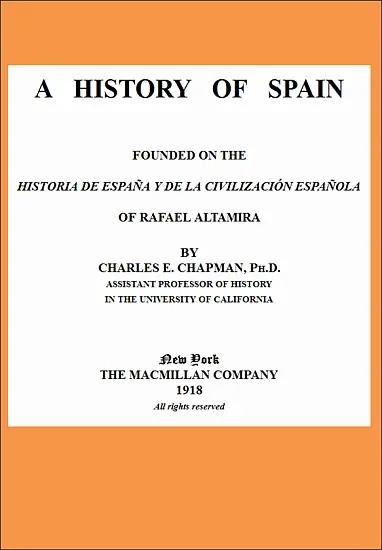
THE CLASSIC COLLECTION · 1918
"A History of Spain" by Charles E. Chapman is a comprehensive historical account written in the early 20th century. The work aims to provide an in-depth overview of Spanish history with a particular focus on its civilization and cultural evolution, especially concerning its transfer to the Americas. It looks at the growth of institutions and societal structures from the beginning of recorded history in Spain, positioning these developments within a broader historical and cultural context." "The opening of the book outlines Chapman's intention to present a concise narrative that reflects the evolution of Spanish civilization from various perspectives, acknowledging both historical continuity and change. The preface discusses the significance of understanding Spanish history in relation to American cultures, which have been influenced by Spanish institutions and civilization. It introduces the book as a selection rather than a summary, indicating that it distills rich historical material into an accessible format designed for both general readers and academic settings. Moreover, it emphasizes the geographic and cultural uniqueness of Spain, setting the stage for a discussion of its early peoples and the historic ramifications of its geographical identity."
Introduction adapted from the source catalogue; source summaries may be automatically generated.
Free to read · English · 201,168 words · No account needed
MAKE TIME FOR A GOOD BOOK
On by default. Untick to stop anonymous reading totals. Each page counts after 10 seconds in view. How this works.
Anonymous counting is on unless you have switched it off.
[Sidenote: Constructive attempts of the state and private individuals to overcome economic evils.]
The evils of the economic situation being clear, efforts were made, especially in the reign of Charles III, to correct them at their sources. To combat the ignorance, indifference, and in some cases the laziness and prejudice of the masses with regard to labor technical and primary schools were founded and model shops and factories established; prizes were awarded for debates and papers on various industrial subjects; printed manuals, including many translated from foreign languages, were scattered broadcast; teachers and skilled laborers from foreign lands were induced to come to Spain, and Spaniards were pensioned to go abroad to study; privileges, exemptions, and monopolies were granted to persons distinguishing themselves by their initiative and zeal in industry; and laws were passed to raise the dignity of manual labor. In this campaign the government received substantial aid from private individuals. In 1746 the first of the Sociedades Económicas de los Amigos del País (economic societies of the friends of the country) was founded. In 1766 its statutes were published, serving thenceforth as the model for other like institutions in Spain, all of them devoted philanthropically to the encouragement of agriculture and other phases of the economic life of their particular district. Nobles, churchmen, and members of the wealthy middle class formed the backbone of these societies, of which there were sixty-two in 1804. Many of them published periodicals, or founded schools for the study of such subjects as agriculture, botany, chemistry, the various trades, stenography, and economics. To promote the cultivation of the soil the state itself assisted in schemes for the colonization of waste lands. The most famous instance was that of the government colonies in the Sierra Morena country of northern Andalusia. In 1766 a certain Bavarian adventurer offered to bring six thousand German and Flemish laborers to settle that district. Charles III favored the project, and it was at once undertaken. For a time it was successful; a number of settlements were made,--there were forty-one in 1775,--and considerable crops were raised. In the end the project failed, due to bad administration, lack of funds, the imposition of heavy taxes, the opposition of the clergy to the predominantly lay spirit of the undertaking, the jealousies arising between the Spanish and foreign elements (for many of the colonists were Spaniards), and the failure to provide adequate means of communication whereby the colonists could export their surplus products. Some of the towns continued to exist, however, and the project was influential in causing private individuals to attempt colonizations, several of which were successful. Among other constructive governmental measures were the removal of the legal obstacles to the sale or division of waste lands or lands common, the restriction of the privileges of the Mesta, the betterment of the conditions surrounding leases (favoring the prolongation of the period of the lease, and aiming to assist the individual who actually cultivated the soil), and the reduction of customs duties or a grant of complete freedom of entry in the case of certain raw materials used in Spanish manufacturing establishments. Public works were also undertaken, such as the construction of irrigation canals, though many were not completed or were made so imperfectly that they soon went to ruin; great highways to open up the peninsula were planned, and under Charles III much work upon them was done, though not enough to meet the needs of the country; an efficient mail service was developed by Floridablanca; shipbuilding was encouraged; banditry and piracy were to a great extent suppressed; government support was given to commercial companies; and a national bank was established by Charles III,--which failed in the reign of Charles IV. The government also intervened in problems of local subsistence, with a view to maintaining articles of prime necessity at a low price and in sufficient quantity, but its action in this particular did not always produce the desired result. Finally, the government interested itself in charity. Benevolent institutions were founded, not only with a view to checking mendicancy and vagabondage, but also to provide homes for unfortunate women, insane persons, and orphans. Private individuals gave liberally for these purposes, or founded charitable organizations, which rendered service of a somewhat remarkable character in succoring the poor, building hospitals, and rescuing children. Mutual benefit societies were formed, reaching into every walk of life, and some of these, termed montepíos or montes de piedad, were made compulsory for the employes of the government; thus the montepío for soldiers, dating from 1761, served as a pension system whereby some provision was made for the widows and orphans of the deceased. All of these reforms encountered the difficulties arising from ignorance, conservatism, the resistance of vested interests, graft, and bureaucratic cumbersomeness which have already been discussed. The very immensity of the reforms projected was against their satisfactory execution, for more was tried than could be done well. Other obstacles already mentioned, such as bad administration, insufficiency of funds, and lack of persistence, contributed to the same result. Nevertheless, though plans outran accomplishment, a vast amount was done, especially in the reign of Charles III, when the spirit of the era reached its culminating point.
Your reading position is saved on this browser. Take it to another device with a library code. Reading pages adapt to text, rather than matching a printed edition.
BEHIND THE BOOK
This eBook is for the use of anyone anywhere in the United States and most other parts of the world at no cost and with almost no restrictions whatsoever. You may copy it, give it away or re-use it under the terms of the Project Gutenberg License included with this eBook or online at www.gutenberg.org. If you are not located in the United States, you will have to check the laws of the country where you are located before using this eBook. Read the source licence.
The original source file, including credits and licence, is retained by this library. Request an original-format copy at no charge. Please include the book title and Project Gutenberg identifier #40646.
KEEP YOUR CURIOSITY GOING
Cécile Tormay

Moritz Busch
John L. Ransom
Frances Wright
Cécile Tormay

Mabel Potter Daggett