THE CLASSIC COLLECTION✦An outlaw’s diary: the CommuneCLASSIC FREE BOOKS
An outlaw’s diary: the Commune
Cécile Tormay
THE CLASSIC COLLECTION · 1918
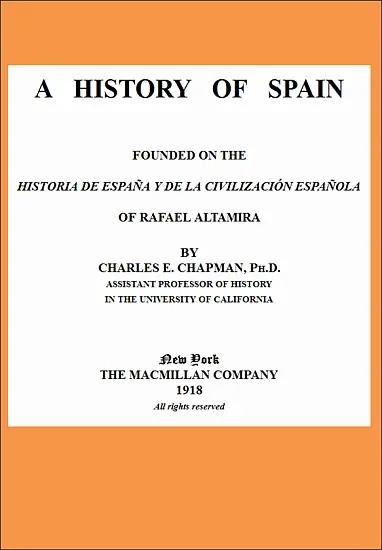
"A History of Spain" by Charles E. Chapman is a comprehensive historical account written in the early 20th century. The work aims to provide an in-depth overview of Spanish history with a particular focus on its civilization and cultural evolution, especially concerning its transfer to the Americas. It looks at the growth of institutions and societal structures from the beginning of recorded history in Spain, positioning these developments within a broader historical and cultural context." "The opening of the book outlines Chapman's intention to present a concise narrative that reflects the evolution of Spanish civilization from various perspectives, acknowledging both historical continuity and change. The preface discusses the significance of understanding Spanish history in relation to American cultures, which have been influenced by Spanish institutions and civilization. It introduces the book as a selection rather than a summary, indicating that it distills rich historical material into an accessible format designed for both general readers and academic settings. Moreover, it emphasizes the geographic and cultural uniqueness of Spain, setting the stage for a discussion of its early peoples and the historic ramifications of its geographical identity."
Introduction adapted from the source catalogue; source summaries may be automatically generated.
Free to read · English · 201,168 words · No account needed
MAKE TIME FOR A GOOD BOOK
On by default. Untick to stop anonymous reading totals. Each page counts after 10 seconds in view. How this works.
Anonymous counting is on unless you have switched it off.
The most genuine representative of the century’s political economists in Spain was Campomanes. Although a follower of the French physiocratic school, which maintained that agriculture was the principal sustain of a nation’s wealth, he did not fail to recognize the importance of manufacturing, and endeavored to foster that industry through the dissemination of works of an educative character, the enactment of protective laws, and the founding of model establishments. Of equal rank with Campomanes, though not as effective in achieving reforms, was Jovellanos, while there was hardly a minister of prominence in the entire period who did not attain to some distinction as an economist. The general effect of the reforms was beneficial, making itself felt in all branches of the production, exchange, and consumption of goods, as well as in an increase in population. Thus the 5,700,000 inhabitants of Spain at the beginning of the era had nearly doubled by 1787, when the total was 10,409,879 (or 10,286,150 by another estimate), and had still further increased to 10,541,221 in 1797. The following table of occupations for these two years is interesting both as showing the economic distribution of the population and as indicating the direction of the reforms.
-------------------------------+------------+----------- | 1787 | 1797 -------------------------------+------------+----------- Ecclesiastics | 182,425 | 168,248 Nobles | 480,589 | 402,059 Employees (of the government?) | 41,014 | 31,981 Soldiery | 77,884 | 149,340 Students | 50,994 | 29,812 Farmers and (farm?) laborers | 1,871,768 | 1,677,172 Manufacturers and artisans | 310,739 | 533,769 Servants | 280,092 | 174,095 Merchants | No figures | 25,685 -------------------------------+------------+-----------
The discrepancies between the two columns are in part accounted for by the fact that Spain was at peace in 1787, and at war with England in 1797. In a total of some 3,000,000 workers it is notable that the majority were devoted to agricultural pursuits (including about 100,000 engaged in pastoral labors), showing that the cultivation of the soil was the principal basis of the national life. The vast number of ecclesiastics, nobles, and servants, nearly a third of the total, is eloquent of the social problem which the government had to face. In the course of ten years they had fallen away to less than a fourth of the whole. Statistics as to density of population showed Guipúzcoa, Valencia, Asturias, Navarre, and Vizcaya in the lead, with respectively eighty, forty-eight, forty-seven, forty-three, and forty-two inhabitants to the square kilometer. Andalusia had thirty-nine, Granada and Catalonia thirty-four each, Aragon only twenty-one, while Extremadura with fourteen and La Mancha and Cuenca with thirteen each brought up the rear. In total population Galicia led with 1,345,000. Catalonia had 814,412, Valencia 783,084, Andalusia 754,293, Granada 661,661, and Aragon 623,308. Large urban groups were rare; there were fewer than forty cities with a population of 10,000, and seventeen of them were in Andalusia. The four largest cities were Madrid (156,000), Barcelona (115,000), Seville (96,000), and Valencia (80,000). Economic prosperity did not correspond exactly with these figures, for the factors of climate, soil, irrigation, and nearness to the sea entered into the situation.
Your reading position is saved on this browser. Take it to another device with a library code. Reading pages adapt to text, rather than matching a printed edition.
BEHIND THE BOOK
This eBook is for the use of anyone anywhere in the United States and most other parts of the world at no cost and with almost no restrictions whatsoever. You may copy it, give it away or re-use it under the terms of the Project Gutenberg License included with this eBook or online at www.gutenberg.org. If you are not located in the United States, you will have to check the laws of the country where you are located before using this eBook. Read the source licence.
The original source file, including credits and licence, is retained by this library. Request an original-format copy at no charge. Please include the book title and Project Gutenberg identifier #40646.
KEEP YOUR CURIOSITY GOING
Cécile Tormay

Moritz Busch
John L. Ransom
Frances Wright
Cécile Tormay

Mabel Potter Daggett