THE CLASSIC COLLECTION✦An outlaw’s diary: the CommuneCLASSIC FREE BOOKS
An outlaw’s diary: the Commune
Cécile Tormay
THE CLASSIC COLLECTION · 1918
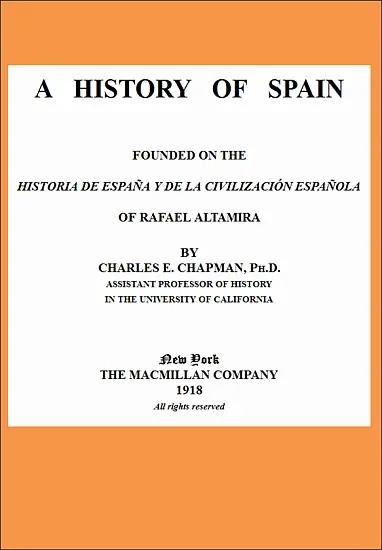
"A History of Spain" by Charles E. Chapman is a comprehensive historical account written in the early 20th century. The work aims to provide an in-depth overview of Spanish history with a particular focus on its civilization and cultural evolution, especially concerning its transfer to the Americas. It looks at the growth of institutions and societal structures from the beginning of recorded history in Spain, positioning these developments within a broader historical and cultural context." "The opening of the book outlines Chapman's intention to present a concise narrative that reflects the evolution of Spanish civilization from various perspectives, acknowledging both historical continuity and change. The preface discusses the significance of understanding Spanish history in relation to American cultures, which have been influenced by Spanish institutions and civilization. It introduces the book as a selection rather than a summary, indicating that it distills rich historical material into an accessible format designed for both general readers and academic settings. Moreover, it emphasizes the geographic and cultural uniqueness of Spain, setting the stage for a discussion of its early peoples and the historic ramifications of its geographical identity."
Introduction adapted from the source catalogue; source summaries may be automatically generated.
Free to read · English · 201,168 words · No account needed
MAKE TIME FOR A GOOD BOOK
On by default. Untick to stop anonymous reading totals. Each page counts after 10 seconds in view. How this works.
Anonymous counting is on unless you have switched it off.
[Sidenote: Increased hostility against the Jesuits.]
The case of the Jesuit order was similar to that of the Inquisition, but the result of royal action was even more decisive. The hostility to the Jesuits in Catholic countries, already very great in the sixteenth and seventeenth centuries, was even more intense in the eighteenth. The other religious orders and the secular clergy were almost a unit in opposing them, for the Jesuits occupied a dominant place in church affairs, and were charged with tyrannizing over the others both in matters of theology and in questions of a temporal character. The ranks of their enemies were swelled by the continued adhesion of the universities to the Jesuit opposition and by the encyclopedists. The former complained because the youth were attending the Jesuit colleges, especially the nobility, from whom the leading ministers of state were chosen, thus continuing the Jesuit influence, while those who were more or less addicted to encyclopedist views were hostile to the order both because of its power in the church and because of its partisanship in favor of papal jurisdiction and authority. In defending themselves the Jesuits had the support of many royal ministers and of the kings themselves for over half a century; Philip V and Ferdinand VI as well as Isabel Farnesio and the children of Charles III had Jesuit confessors. Furthermore, the once hostile Inquisition became an instrument in Jesuit hands when that order got control of the institution. Finally, the Jesuits had achieved vast power as a result of their hold on the affections of great numbers of the people, high and low, and in consequence of the extraordinary wealth which they had accumulated.
[Sidenote: Expulsion and suppression of the Jesuits.]
It was not until the reign of Charles III that any effective action was taken against them. While yet king of Naples, Charles had demonstrated his lack of cordiality toward the Jesuit order, and had begun to feel a suspicion, in common with other European monarchs, that the Jesuits might prove to be a danger to the state; in view of the actual power which the Jesuits possessed, it is not to be wondered at that the ultra-absolutist statesmen and kings of the eighteenth century should look upon them with disfavor. In the very year that Charles became king of Spain they were expelled from Portugal, and in the years 1764 to 1767 similar action was taken in France. The accession of Charles was a blow to the Jesuits in Spain, who now lost their influential place at court. Four events of a political character tended to increase the feeling of hostility toward them. One of these occurred in the reign of Ferdinand, when the Jesuits of Paraguay opposed the cession of that territory to Portugal in exchange for Sacramento. The Indians of Paraguay rose in rebellion against the transfer, and it was believed that the Jesuits were in some way concerned. The second of the events was the attempted assassination of the kings of Portugal and France, which was attributed to the Jesuit order on account of the hostility of those monarchs to the Jesuits. Many were of the opinion that Charles might be in danger of a like fate. In the third place friction arose between Charles and the Jesuits as a result of the former’s advocacy of the canonization of Juan de Palafox, a seventeenth century bishop of Puebla de los Ángeles in New Spain. The Jesuits opposed the king in this matter, and even procured the removal from the palace of the works of Palafox which Charles had given to members of his family. The fourth matter was of far more consequence,--the riots of 1766 at the time when the proposals of Squillace with regard to the modification of Spanish dress were enacted into law. On that occasion there was grave disorder in Madrid, including an attack on the king’s guards, a number of whom were cruelly put to death. The king was obliged to yield to the demands of the mob, and a few days later unexpectedly left Madrid for Aranjuez,--a virtual flight, taken as a measure of precaution. Not only in Madrid, but also in Saragossa, Cuenca, Guadalajara, Alicante, Salamanca, Daroca, Tobarra, Mombeltrán, Murcia, San Lúcar, Huesca, Borja, San Ildefonso, Azcoytia, Villena, Ciudad Real, Jumilla, Coruña, Alcaraz, Quero, Las Mesas, Aranjuez, Palencia, and Navalcarnero there were similar outbreaks, and it seemed likely that Barcelona might also give trouble. In fine, there appeared to be an organized attempt at rebellion, and Charles and his ministers believed, or at least pretended to believe, that the Jesuits were behind it. Most probably the order itself did not promote the riots, although several of its members were compromised, but late in 1766 it was formally charged with responsibility by the Consejo. In January, 1767, the Consejo proposed the expulsion of the Jesuits from Spain. The matter was submitted to a special junta, or council, which concurred in the recommendation of the Consejo, after which the decision was presented to various ecclesiastical personages, who likewise expressed their approval. It was decided, however, to say nothing of the motives, and the part of the proceedings concerning them has disappeared. Nevertheless, a document of Campomanes is at hand summing up some of the charges made at the meeting of the Consejo. They were the following: responsibility for the Squillace riots; the diffusion of maxims contrary to the royal and the canon law; a spirit of sedition (of which some evidence was introduced); treasonable relations with the English in the Philippine Islands; monopolization of commerce and excess of power in the Americas; a too great pride, leading them to support the doctrines of Rome against the king; advocacy by many Jesuit writers of the right of tyrannicide; political intrigues against the king; and aspiration for universal monarchy. While the evidence in support of these charges is no longer available, it is clear that they were exaggerated, or even without foundation,--at least in the case of their supposed relations with the English. On the other hand, the intensely royalist ministers of the era of the enlightened despotism would have felt grave concern where a more democratic age might have found no cause for worry. Some historians claim that Charles hesitated to sign the decree, because the Jesuit general was said to have threatened the publication of documents purporting to show that the king was the illegitimate son of Isabel Farnesio and Alberoni, and others assert that Charles was given reason to believe that the Jesuits planned to assassinate him and the members of his family if the expulsion were promulgated. Whatever the truth may be, he delayed only a few days, signing the decree on February 27, 1767. The Count of Aranda was charged with its execution, and proceeded to fulfill that duty with great secrecy and despatch, so that the blow should fall simultaneously and without warning in all parts of Spain’s dominions. Never was a decree more carefully carried out. On the night of March 31 in Madrid, and on the next night in the provinces, the Jesuits were surprised in their establishments and told that they must leave Spain. There were at this time 2746 Spanish Jesuits in 120 institutions, scattered through 117 towns. In the Americas the decree was carried out later in the same year or early in 1768, and in some cases there was popular resistance to their expulsion, although no untoward incidents of that character had occurred in Spain. Without consulting the pope, Charles decided to send the Jesuits to the Papal States, although on the eve of the expulsion he informed the pope of his intention, promising also to pay the Jesuits enough to permit them to live in a fitting manner. Despite the pope’s entire sympathy with the Jesuits, there were reasons why he did not wish them to land in his territory, and when the boats which were carrying them arrived off Civita Vecchia, the port of Rome, Cardinal Torrigiani ordered them to keep away, threatening to open fire on them if they should not. Thereupon, they went to Corsica, where the Jesuits were landed, being joined later by their American brethren. Finally, the pope consented to their establishing themselves in Bologna and Ferrara, where some ten thousand from Spain and the Americas found a haven,--much against the will of the secular clergy of those places. Charles now set about to procure the dissolution of the order, and in this he was aided by the kings of Portugal, France, and Naples, from which last-named country the Jesuits had also been expelled late in 1767. In 1773 their efforts were at length successful, as a result, very largely, of the skillful diplomatic achievements of Jose Moñino, Spain’s special representative at the papal court. For his work in this matter Moñino was rewarded with the title of Count of Floridablanca.
Your reading position is saved on this browser. Take it to another device with a library code. Reading pages adapt to text, rather than matching a printed edition.
BEHIND THE BOOK
This eBook is for the use of anyone anywhere in the United States and most other parts of the world at no cost and with almost no restrictions whatsoever. You may copy it, give it away or re-use it under the terms of the Project Gutenberg License included with this eBook or online at www.gutenberg.org. If you are not located in the United States, you will have to check the laws of the country where you are located before using this eBook. Read the source licence.
The original source file, including credits and licence, is retained by this library. Request an original-format copy at no charge. Please include the book title and Project Gutenberg identifier #40646.
KEEP YOUR CURIOSITY GOING
Cécile Tormay

Moritz Busch
John L. Ransom
Frances Wright
Cécile Tormay

Mabel Potter Daggett