THE CLASSIC COLLECTION✦An outlaw’s diary: the CommuneCLASSIC FREE BOOKS
An outlaw’s diary: the Commune
Cécile Tormay
THE CLASSIC COLLECTION · 1918
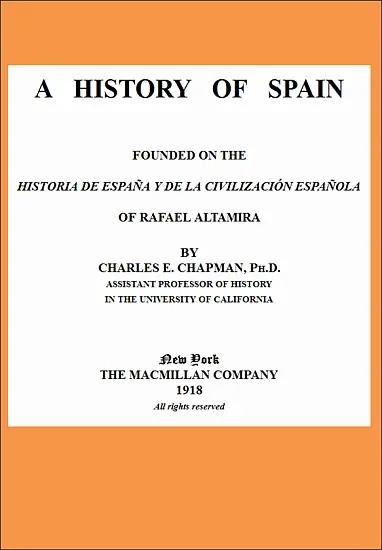
"A History of Spain" by Charles E. Chapman is a comprehensive historical account written in the early 20th century. The work aims to provide an in-depth overview of Spanish history with a particular focus on its civilization and cultural evolution, especially concerning its transfer to the Americas. It looks at the growth of institutions and societal structures from the beginning of recorded history in Spain, positioning these developments within a broader historical and cultural context." "The opening of the book outlines Chapman's intention to present a concise narrative that reflects the evolution of Spanish civilization from various perspectives, acknowledging both historical continuity and change. The preface discusses the significance of understanding Spanish history in relation to American cultures, which have been influenced by Spanish institutions and civilization. It introduces the book as a selection rather than a summary, indicating that it distills rich historical material into an accessible format designed for both general readers and academic settings. Moreover, it emphasizes the geographic and cultural uniqueness of Spain, setting the stage for a discussion of its early peoples and the historic ramifications of its geographical identity."
Introduction adapted from the source catalogue; source summaries may be automatically generated.
Free to read · English · 201,168 words · No account needed
MAKE TIME FOR A GOOD BOOK
On by default. Untick to stop anonymous reading totals. Each page counts after 10 seconds in view. How this works.
Anonymous counting is on unless you have switched it off.
The greatest reformers, however, belonged to the reign of Charles III and the early years of Charles IV. Earlier ministers had increased the national revenues and cut down expenses, but the deficit had not been wiped out. One of the great names of both of the above-named reigns was that of the Count of Aranda, of a distinguished Aragonese noble family. Aranda was obstinate, brutal in speech, aggressive, and energetic, but a man of vast information and clear foresight,--as witness his prediction, in 1775, of the future greatness of the yet unborn United States. Aside from his connection with Spain’s foreign policies he particularly distinguished himself while president of the Consejo de Castilla by the reforms, already referred to, whereby Madrid became a clean and acceptable city. Yet more famous was José Moñino, son of an ecclesiastical notary of Murcia, who was ennobled as the Count of Floridablanca. An honorable man in every sense of the word, just, intelligent, and solicitous for his friends, he was hot-tempered, and unbending in his hostility to his opponents. His action made itself felt in the improvement of the means of communication in the peninsula and in his economic reforms of a commercial nature, such as the great free trade decree of 1778, which abandoned certain phases of the narrowly monopolistic policy which Spain had always followed in her trade with the colonies. Campomanes was an Asturian and, like Somodevilla, of very humble birth, but he rose to be, many hold, the greatest of the men who labored for the social and economic regeneration of Spain in the eighteenth century. He was also the most representative of his age, for, in addition to his measures to develop a better system of internal communications and to foster industry, commerce, and technical popular education, he was a determined royalist,--the embodiment, therefore, of the ideal of the enlightened despotism. Like Aranda and Floridablanca he served for a time under Charles IV, although his greatest work belonged to the reign of Charles III. Three names deserve mention for the reign of Charles IV. Jovellanos was an Asturian of an illustrious family. He distinguished himself by his reforms in finance in conjunction with one Saavedra, but both were early deprived of their posts, as a result of the hostility of Godoy. The third name is that of Godoy, who introduced notable reforms in public instruction and in the organization of the army and navy,--whatever may be the judgment with regard to his foreign policy. The names of some of the great ministers of the Indies are also worthy of record. In addition to Patiño and Ensenada the most noteworthy were Julián de Arriaga (1750 or 1751-1776) and José de Gálvez (1776-1787), especially the former. The results, in terms of revenue, of the activities of the great ministers may serve to give some indication of the effectiveness of their work. In 1766, receipts exceeded expenditures by about 133,000,000 reales ($8,312,500). In 1778 revenues amounted to 630,000,000 ($39,375,000); in 1784 to 685,000,000 ($42,812,500); and in 1787 to 616,000,000 ($38,500,000). Though annual expenditures were much less, the government was never able to overcome the deficit, although the national debt reached its lowest point in the reign of Charles III. In 1791 revenues were some 800,000,000 ($50,000,000), but they fell to a general level of about 600,000,000 ($37,500,000) in the years 1793 to 1795, while expenditures, which had reached 708,000,000 ($44,250,000) in 1793, were 1,030,000,000 ($64,375,000) in 1795. Thus the deficit began to increase again, and in 1808 it was over 7,200,000,000 reales ($450,000,000), an enormous sum as national indebtedness went then.
Your reading position is saved on this browser. Take it to another device with a library code. Reading pages adapt to text, rather than matching a printed edition.
BEHIND THE BOOK
This eBook is for the use of anyone anywhere in the United States and most other parts of the world at no cost and with almost no restrictions whatsoever. You may copy it, give it away or re-use it under the terms of the Project Gutenberg License included with this eBook or online at www.gutenberg.org. If you are not located in the United States, you will have to check the laws of the country where you are located before using this eBook. Read the source licence.
The original source file, including credits and licence, is retained by this library. Request an original-format copy at no charge. Please include the book title and Project Gutenberg identifier #40646.
KEEP YOUR CURIOSITY GOING
Cécile Tormay

Moritz Busch
John L. Ransom
Frances Wright
Cécile Tormay

Mabel Potter Daggett