THE CLASSIC COLLECTION✦An outlaw’s diary: the CommuneCLASSIC FREE BOOKS
An outlaw’s diary: the Commune
Cécile Tormay
THE CLASSIC COLLECTION · 1918
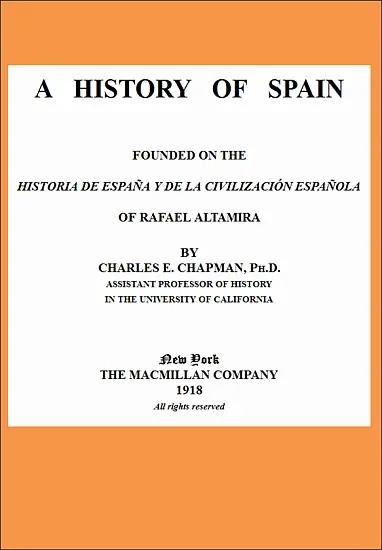
"A History of Spain" by Charles E. Chapman is a comprehensive historical account written in the early 20th century. The work aims to provide an in-depth overview of Spanish history with a particular focus on its civilization and cultural evolution, especially concerning its transfer to the Americas. It looks at the growth of institutions and societal structures from the beginning of recorded history in Spain, positioning these developments within a broader historical and cultural context." "The opening of the book outlines Chapman's intention to present a concise narrative that reflects the evolution of Spanish civilization from various perspectives, acknowledging both historical continuity and change. The preface discusses the significance of understanding Spanish history in relation to American cultures, which have been influenced by Spanish institutions and civilization. It introduces the book as a selection rather than a summary, indicating that it distills rich historical material into an accessible format designed for both general readers and academic settings. Moreover, it emphasizes the geographic and cultural uniqueness of Spain, setting the stage for a discussion of its early peoples and the historic ramifications of its geographical identity."
Introduction adapted from the source catalogue; source summaries may be automatically generated.
Free to read · English · 201,168 words · No account needed
MAKE TIME FOR A GOOD BOOK
On by default. Untick to stop anonymous reading totals. Each page counts after 10 seconds in view. How this works.
Anonymous counting is on unless you have switched it off.
[Sidenote: Tightening of the bonds of family.]
[Sidenote: Influence of the physiocratic school on legislation affecting
property.]
Legislation affecting the family aimed to tighten the bonds between parents and children, which had become loosened as a result of the increasing spirit of individualism. Thus a law of 1766 ordered that the prior consent of parents should be obtained before children could marry, although a remedy was provided for an unreasonable withholding of consent; in the preamble it was stated that the law was due to the frequent occurrence of “unequal marriages.” Several later laws upheld the same principle. Legislation concerning property was characterized by the ideas of the physiocratic school of thinkers, who referred all social and economic problems to the land as the fundamental basis. Among the Spanish physiocrats (for the physiocratic ideal was widespread in western Europe) were Campomanes, Floridablanca, and Jovellanos, who were among the greatest of Spanish reformers in the reign of Charles III and the early years of Charles IV. In keeping with physiocratic views the laws tended to the release of realty from incumbrances and to the distribution of lands among many persons. The practice of entailing estates in primogeniture was one of the institutions attacked by the physiocrats. It was admitted that it was necessary in the case of the great nobles, in order to maintain the prestige of the family name, but it was held to be desirable to check the extension of the institution in other cases and to facilitate the extinction of entails. Thus a law of 1749 permitted of the sale of entailed estates for an annuity in the case of financially ruined houses; a law of 1789 prohibited the founding of new entails, and facilitated the sale of realty already so held; a law of 1795 imposed heavy taxes on existing entails; and a law of 1798 authorized the sale of entailed estates, provided the funds should be invested in a certain loan announced at that time. Still other laws were passed in this period, with the result that many entails disappeared and others were diminished in size. The nobles resisted the change, and the greater number of the entails remained in existence, although reduced in income. In the same way municipal and ecclesiastical holdings were attacked. In the case of the former (propios), laws were passed repeatedly--for example in 1761, 1766, 1767, 1768, and especially in 1770--for the partition of the cultivable and pastoral lands and for their assignment to a number of individuals. Nevertheless, the majority of this type of municipal lands continued in the possession of the towns, for the laws were not fully executed. As concerns lands utilized for the promotion of religious objects, pious foundations were attacked, and either compelled or else permitted to sell their real property, but there was considerable hesitancy about applying the same practice to lands held in mortmain by the regular and secular clergy, although the prevailing opinion of jurisconsults was opposed to these holdings. Some steps were taken, however, to free these lands, as well as other measures to hinder the giving of realty in mortmain. In the various colonization schemes of the century it was customary to forbid the transfer of lands to ecclesiastical institutions. A law of 1763 prohibited further conveyances to the church, and a law of 1798 called for the alienation of lands owned by charitable institutions, even though they might belong to the church, and some estates accordingly were sold. The resistance of the clergy, together with a certain repugnance to laying hands on the property of the church except in case of extreme necessity, operated to prevent these laws from having their full effect. It will be noticed that all of these measures were markedly individualistic, in accord with Roman principles as opposed to those of medieval society, and favorable to the change in ownership of landed estates and to their division into small holdings. This spirit was manifested even more insistently in attacking titles of a medieval character. Thus the right of farmers to fence lands for their own use was sustained, serving as a check upon the abuses of the Mesta, and the various methods of tribute from vassals to a lord (censos, foros, etc.) were the subject of legislation tending to relieve the former from their burdens. To this epoch, also, belong laws requiring the registry of titles to land. Nevertheless, the spirit of collectivism was still alive, as expressed in doctrines favoring the condemnation of individual property and the establishment of communal inclosures with the drawing of lots for land, but the followers of Roman principles were victorious in the controversy.
Your reading position is saved on this browser. Take it to another device with a library code. Reading pages adapt to text, rather than matching a printed edition.
BEHIND THE BOOK
This eBook is for the use of anyone anywhere in the United States and most other parts of the world at no cost and with almost no restrictions whatsoever. You may copy it, give it away or re-use it under the terms of the Project Gutenberg License included with this eBook or online at www.gutenberg.org. If you are not located in the United States, you will have to check the laws of the country where you are located before using this eBook. Read the source licence.
The original source file, including credits and licence, is retained by this library. Request an original-format copy at no charge. Please include the book title and Project Gutenberg identifier #40646.
KEEP YOUR CURIOSITY GOING
Cécile Tormay

Moritz Busch
John L. Ransom
Frances Wright
Cécile Tormay

Mabel Potter Daggett