THE CLASSIC COLLECTION✦An outlaw’s diary: the CommuneCLASSIC FREE BOOKS
An outlaw’s diary: the Commune
Cécile Tormay
THE CLASSIC COLLECTION · 1918
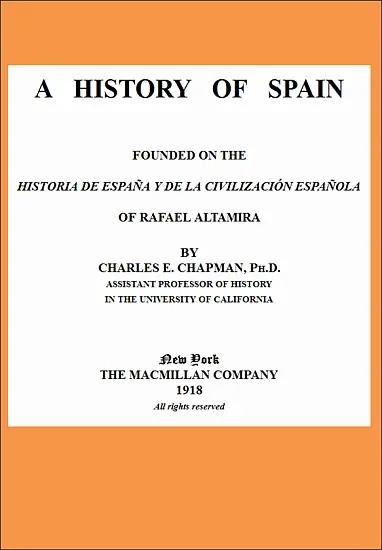
"A History of Spain" by Charles E. Chapman is a comprehensive historical account written in the early 20th century. The work aims to provide an in-depth overview of Spanish history with a particular focus on its civilization and cultural evolution, especially concerning its transfer to the Americas. It looks at the growth of institutions and societal structures from the beginning of recorded history in Spain, positioning these developments within a broader historical and cultural context." "The opening of the book outlines Chapman's intention to present a concise narrative that reflects the evolution of Spanish civilization from various perspectives, acknowledging both historical continuity and change. The preface discusses the significance of understanding Spanish history in relation to American cultures, which have been influenced by Spanish institutions and civilization. It introduces the book as a selection rather than a summary, indicating that it distills rich historical material into an accessible format designed for both general readers and academic settings. Moreover, it emphasizes the geographic and cultural uniqueness of Spain, setting the stage for a discussion of its early peoples and the historic ramifications of its geographical identity."
Introduction adapted from the source catalogue; source summaries may be automatically generated.
Free to read · English · 201,168 words · No account needed
MAKE TIME FOR A GOOD BOOK
On by default. Untick to stop anonymous reading totals. Each page counts after 10 seconds in view. How this works.
Anonymous counting is on unless you have switched it off.
Spain’s experience as an ally of France was not more happy than her previous union with England. France excluded her from representation at several conferences looking to treaties of peace between France and her enemies, and made slight efforts to secure the interests of Spain, going so far as to refuse her sanction to many of the pretensions of her Bourbon ally. Most annoying of all was the dispossession of the Duke of Parma, a relative of Charles IV by descent from Isabel Farnesio. The French government endeavored to calm Spanish feelings on this point by offering to make Godoy the Grand Master of the Knights of Malta,--an honor he was disposed to accept, subject to certain conditions, one of which was that he be absolved from the vow of chastity. In fact, however, the French authorities were suspicious of Godoy, believing that he was secretly plotting with England, because he did not insist on Portugal’s refusing to allow the English fleets to remain in Portuguese ports. A French representative was sent to Spain in 1797, and the dismissal of Godoy was procured from Charles IV. Nevertheless, Godoy continued to be the principal force at the Spanish court, backed as he was by the powerful influence of the queen. The policy of truculence to France went on, however, due in part perhaps to Charles’ continued hopes of acquiring the Bourbon crown, but even more, very likely, to his pusillanimity in the face of the threats of the French Directory. In 1799 his hopes were dashed when Napoleon Bonaparte overthrew the Directory and became first consul of France, a title which a few years later he converted into that of emperor.
[Sidenote: Early relations with Napoleon and the war with Portugal.]
The change of government in France was welcomed at the Spanish court, for it was believed that Spain would receive more consideration at the hands of Napoleon than she had obtained from the Directory. Events proved that Spain was to be even more an instrument in French hands than formerly, and that Napoleon was to be more powerful and despotic and less courteous and faithful in international affairs than the French rulers who had preceded him. One of his earliest acts was an attempt to employ the Spanish fleet to conserve French ends. When the Spanish admiral refused to carry out the wishes of Napoleon, a matter in which he was sustained by his government, the French ruler brought about the dismissal of Urquijo, at that time first minister of state in Spain, and shortly afterward the offending admiral was relieved from his command. Meanwhile, a treaty had been arranged in 1800 whereby Napoleon agreed to enlarge the dominions of the Duke of Parma (who had regained his duchy) in exchange for the recession of Louisiana to France and the gift of six ships of war. By a treaty of 1801 Tuscany was granted to the family of the Duke of Parma, whose whole domains were now called the kingdom of Etruria. It was provided that in case of a lack of succession of the reigning house a Spanish prince of the royal family should inherit the Etrurian throne, and this was to be the rule forever. Another treaty of 1801 required Spain to issue an ultimatum to Portugal demanding an abandonment of the English alliance. The name of Godoy was signed to the later treaties in the series of which the above have been mentioned. He had not ceased to be influential during his absence from power, but henceforth until 1808 he was definitely in the saddle. Though his military experience was slight he was appointed general of the Spanish army which was to invade Portugal, and when war was presently declared he entered that country. The campaign, although comparatively insignificant, resulted in victory. Portugal agreed to close her ports in return for the Spanish king’s guarantee of the territorial integrity of Portugal. A celebration was held at Badajoz, at which the soldiers presented the queen with branches of orange trees taken from Portuguese groves, resulting in the application of the name “war of the oranges,”--which fittingly described its inconsequential character. Napoleon was furious over such a termination of the war, and went so far as to threaten the end of the Spanish monarchy unless the campaign were pursued. At length he decided to accept the result, after Portugal had consented to increase the indemnity which she had originally agreed to pay to France. This marked a beginning, however, of the French ruler’s distrust of Godoy. Shortly afterward it suited Napoleon’s purposes to make peace. In 1802 a treaty was signed with England, and, naturally, Spain too made peace. Minorca, which had been occupied by the English, was restored to Spain, but the island of Trinidad was surrendered to England,--another bit chipped off Spain’s colonial empire.
Your reading position is saved on this browser. Take it to another device with a library code. Reading pages adapt to text, rather than matching a printed edition.
BEHIND THE BOOK
This eBook is for the use of anyone anywhere in the United States and most other parts of the world at no cost and with almost no restrictions whatsoever. You may copy it, give it away or re-use it under the terms of the Project Gutenberg License included with this eBook or online at www.gutenberg.org. If you are not located in the United States, you will have to check the laws of the country where you are located before using this eBook. Read the source licence.
The original source file, including credits and licence, is retained by this library. Request an original-format copy at no charge. Please include the book title and Project Gutenberg identifier #40646.
KEEP YOUR CURIOSITY GOING
Cécile Tormay

Moritz Busch
John L. Ransom
Frances Wright
Cécile Tormay

Mabel Potter Daggett