THE CLASSIC COLLECTION✦An outlaw’s diary: the CommuneCLASSIC FREE BOOKS
An outlaw’s diary: the Commune
Cécile Tormay
THE CLASSIC COLLECTION · 1918
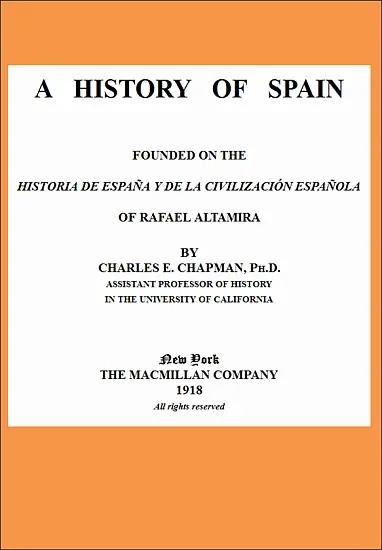
"A History of Spain" by Charles E. Chapman is a comprehensive historical account written in the early 20th century. The work aims to provide an in-depth overview of Spanish history with a particular focus on its civilization and cultural evolution, especially concerning its transfer to the Americas. It looks at the growth of institutions and societal structures from the beginning of recorded history in Spain, positioning these developments within a broader historical and cultural context." "The opening of the book outlines Chapman's intention to present a concise narrative that reflects the evolution of Spanish civilization from various perspectives, acknowledging both historical continuity and change. The preface discusses the significance of understanding Spanish history in relation to American cultures, which have been influenced by Spanish institutions and civilization. It introduces the book as a selection rather than a summary, indicating that it distills rich historical material into an accessible format designed for both general readers and academic settings. Moreover, it emphasizes the geographic and cultural uniqueness of Spain, setting the stage for a discussion of its early peoples and the historic ramifications of its geographical identity."
Introduction adapted from the source catalogue; source summaries may be automatically generated.
Free to read · English · 201,168 words · No account needed
MAKE TIME FOR A GOOD BOOK
On by default. Untick to stop anonymous reading totals. Each page counts after 10 seconds in view. How this works.
Anonymous counting is on unless you have switched it off.
[Sidenote: The French influence in Spain during the War of the Spanish
Succession.]
[Sidenote: Madame des Ursins.]
[Sidenote: Instances of resistance by Philip V to domination by Louis
XIV.]
One of the interesting factors of the era of the war was that of the French influence in Spain, which was to have a pronounced effect on the internal development of the country, and, by extension, on that of the colonies. Philip V was seventeen years of age when he ascended the throne, but, though he many times proved his valor in battle, he was in other respects a weak and irresolute character, without striking virtues or defects, fond of hunting, and exceedingly devout,--in fine, of a type such that he was inevitably bound to be led by others. These traits fitted in with the policies of Louis XIV, who fully intended to direct the affairs of Spain in his own interest. He charged Philip V never to forget that he was a Frenchman, and, indeed, with the exceptions presently to be noted, Philip was quite ready to submit to the will of his grandfather. From the first, Louis XIV surrounded the Spanish king with French councillors, some of whom occupied honorary positions only, while others filled important posts in the government of Spain, and still others, notably the French ambassadors and French generals, exercised actual authority without having any official connection with the country. One of the most important of all was Madame des Ursins, maid of honor to the queen, sent to Spain by Louis XIV because as the widow of the Duke of Braciano, a Spanish grandee, she was familiar with the customs of the country. This lady won the complete confidence of the queen, who in turn was able to dominate her husband. It may be said for Madame des Ursins that she was faithful to the interests of the Spanish monarchs, though promoting the entry of French influences, at that time much to be desired in Spain. Indeed, she not infrequently sided with Philip V against the wishes of Louis XIV, which on one occasion led to her recall by the French monarch. Finding, however, that he could not control Spanish affairs without her aid, Louis allowed her to return to Spain. Despite the enormous pressure exercised against him in favor of France, Philip V occasionally rebelled. One instance of his obstinacy has already been cited respecting the case of the Catalan fueros. A more important issue arose out of the presumptions of Louis XIV to dispose of Philip’s crown, as an avenue of escape for himself. In every year from 1706 to 1712 Louis XIV endeavored to sacrifice the interests of Spain or of Philip V in order to propitiate the allies into a grant of peace. In particular he was desirous of procuring the resignation of Philip from the throne of Spain in favor of the House of Austria, saving to Philip the Spanish dominions in Italy. Philip was obdurate when suggestions were made of his abandoning Spain, and more than once, even when the situation looked hopeless, declared his intention of dying at the head of his troops, rather than abdicate the throne to which he felt divinely entitled. Louis XIV was even disposed to compel him by force of arms to acquiesce, and several times withdrew his military support, but the Spanish king would not yield. Fortunately for Philip the allies played into his hands by demanding too much, with the result that Louis XIV on such occasions would renew his support of Philip. Nevertheless, it was the urgings of Louis XIV which prevailed upon Philip to surrender the Spanish dominions in Italy and the Low Countries as well as to renounce his claim to the throne of France. In all of these tribulations of the Spanish king credit should be given to María Luisa of Savoy, the spirited young queen of Spain. Not yet fourteen at the time of her marriage, in 1701, she at all times displayed a courage and ability which endeared her to the Spanish people. Though her father, the Duke of Savoy, joined the allies against France and Spain, she did not waver in her attachment to the land of her adoption. Inspired by her the Spanish people (except the Catalans) displayed an ardent spirit of nationalism for the first time in history, and were loyally devoted to the king and queen. Nevertheless, despite Spanish patriotism and Philip’s obdurate resistance to Louis XIV’s plans concerning the peninsula, there was the underlying truth of a profound French influence over Spain. This was best represented by men who, like Orry and Amelot, were responsible for far-reaching reforms, the effects of which will be discussed in the chapters on institutions.
Your reading position is saved on this browser. Take it to another device with a library code. Reading pages adapt to text, rather than matching a printed edition.
BEHIND THE BOOK
This eBook is for the use of anyone anywhere in the United States and most other parts of the world at no cost and with almost no restrictions whatsoever. You may copy it, give it away or re-use it under the terms of the Project Gutenberg License included with this eBook or online at www.gutenberg.org. If you are not located in the United States, you will have to check the laws of the country where you are located before using this eBook. Read the source licence.
The original source file, including credits and licence, is retained by this library. Request an original-format copy at no charge. Please include the book title and Project Gutenberg identifier #40646.
KEEP YOUR CURIOSITY GOING
Cécile Tormay

Moritz Busch
John L. Ransom
Frances Wright
Cécile Tormay

Mabel Potter Daggett