THE CLASSIC COLLECTION✦An outlaw’s diary: the CommuneCLASSIC FREE BOOKS
An outlaw’s diary: the Commune
Cécile Tormay
THE CLASSIC COLLECTION · 1918
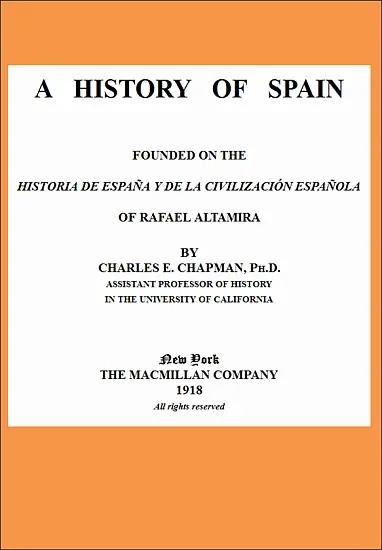
"A History of Spain" by Charles E. Chapman is a comprehensive historical account written in the early 20th century. The work aims to provide an in-depth overview of Spanish history with a particular focus on its civilization and cultural evolution, especially concerning its transfer to the Americas. It looks at the growth of institutions and societal structures from the beginning of recorded history in Spain, positioning these developments within a broader historical and cultural context." "The opening of the book outlines Chapman's intention to present a concise narrative that reflects the evolution of Spanish civilization from various perspectives, acknowledging both historical continuity and change. The preface discusses the significance of understanding Spanish history in relation to American cultures, which have been influenced by Spanish institutions and civilization. It introduces the book as a selection rather than a summary, indicating that it distills rich historical material into an accessible format designed for both general readers and academic settings. Moreover, it emphasizes the geographic and cultural uniqueness of Spain, setting the stage for a discussion of its early peoples and the historic ramifications of its geographical identity."
Introduction adapted from the source catalogue; source summaries may be automatically generated.
Free to read · English · 201,168 words · No account needed
MAKE TIME FOR A GOOD BOOK
On by default. Untick to stop anonymous reading totals. Each page counts after 10 seconds in view. How this works.
Anonymous counting is on unless you have switched it off.
The aristocratic character of intellectual attainments in the siglo de oro was reflected in that of the institutions of learning which were founded. In addition to the eight universities existing in 1516, twenty-one were added in the sixteenth century, and five in the seventeenth, making a total of thirty-four in all. Salamanca and Alcalá stood forth as the leading universities, although outranked in legal studies by Valladolid. Salamanca had the more ample curriculum, with some sixty professorships, but Alcalá, with forty-two professorial chairs, was distinguished for the scientific labors of its faculty. Salamanca was more largely attended, having 6778 students in 1584, a number which had declined to 1955 in 1682, while Alcalá had 1949 in 1547, 2061 in 1650, and 1637 in 1700. The medieval type of internal management remained as the essential basis of university administration, characterized by the close connection between the university and the civil authorities (to which latter the former were in a measure subjected), by an intimate relationship with the cathedral or other local churches, and by the ecclesiastical origin of many of the university rents. The universities did not become religious establishments, however, even though churchmen founded the greater number of them. As time went on, the kings displayed a tendency to intervene in university life, as by the sending of visitadores, or by imposing their candidates for professorships upon the universities, but they did not go so far as to deprive the universities of their economic, legal, and scientific independence.
[Sidenote: Jesuit colleges.]
[Sidenote: Other schools of higher education.]
[Sidenote: The Casa de Contratación as a maritime university.]
There were also various other institutions of higher education. One of them, the Estudios Reales de San Isidro of Madrid, founded early in the reign of Philip IV for the education of the sons of the greater nobility, ranked with the universities. Jesuit teachers were installed. This was not the first instance of Jesuit instruction in the peninsula. By their vows the Jesuits were obliged to found “colleges,” but this term meant houses for study, only in that the members of the order living in these institutions pursued investigations there. Gradually, outside pupils began to be accepted by the Jesuits, who soon won a great reputation for their efficiency as teachers. Their teaching was markedly influenced by Renaissance ideals, for the study of classical authors formed one of the principal elements in their curriculum. They devoted themselves to the education of the wealthy classes, leaving the field of vocational preparation to the universities. Apart from the Jesuit colleges there were various schools, both religious and secular, primarily for the study of Latin. They were in essence schools of literature, at which students were given practice in the writing of poetry and the reciting of verses, both Latin and Castilian. It is said that there were more than four thousand of these institutions in 1619, although their numbers declined greatly with the advance of the century. In addition there were many schools of a purely professional character, such as those for the study of religion, war, medicine, and nautical science. The school of nautical science of the Casa de Contratación of Seville merits special attention. Among the manifold functions of the Casa in its relation to the Americas was that of the pursuit of scientific studies to facilitate overseas communication, and this was carried out to such an extent that the Casa was a veritable maritime university. Mathematics, cosmography, geography, cartography, navigation, the construction and use of nautical instruments, and military science (in so far as it related to artillery) were taught at the Casa, and in nearly all of these respects that institution not only outranked the others in Spain but was able also to add materially to the sum total of world knowledge. Primary education continued to be neglected. The current belief was that it was unnecessary unless one intended to pursue a professional career. The education of the masses for the sake of raising the general level of culture, or even for technical advancement, was a problem which was not as yet comprehended. Such primary schools as there were, were usually ecclesiastical or private foundations. Reading, writing, arithmetic, and Christian doctrine were the subjects taught. Taken as a whole it will be seen that the number of teaching establishments had vastly increased over that of the preceding eras. An understanding of the superior facilities available for the upper classes would not be complete without a reference to the extraordinary diffusion of printing in this era. Although the publication of works was subject to various conditions, printed books fairly came into their own, for the first time in the history of the peninsula. A number of great libraries were formed. It is worthy of mention, too, that it was at this time that care began to be taken in the accumulation of public documents in archives. In 1558 Philip II founded an archive at Rome, and in 1563 made a beginning of the famous state archive at Simancas.
Your reading position is saved on this browser. Take it to another device with a library code. Reading pages adapt to text, rather than matching a printed edition.
BEHIND THE BOOK
This eBook is for the use of anyone anywhere in the United States and most other parts of the world at no cost and with almost no restrictions whatsoever. You may copy it, give it away or re-use it under the terms of the Project Gutenberg License included with this eBook or online at www.gutenberg.org. If you are not located in the United States, you will have to check the laws of the country where you are located before using this eBook. Read the source licence.
The original source file, including credits and licence, is retained by this library. Request an original-format copy at no charge. Please include the book title and Project Gutenberg identifier #40646.
KEEP YOUR CURIOSITY GOING
Cécile Tormay

Moritz Busch
John L. Ransom
Frances Wright
Cécile Tormay

Mabel Potter Daggett