THE CLASSIC COLLECTION✦An outlaw’s diary: the CommuneCLASSIC FREE BOOKS
An outlaw’s diary: the Commune
Cécile Tormay
THE CLASSIC COLLECTION · 1918
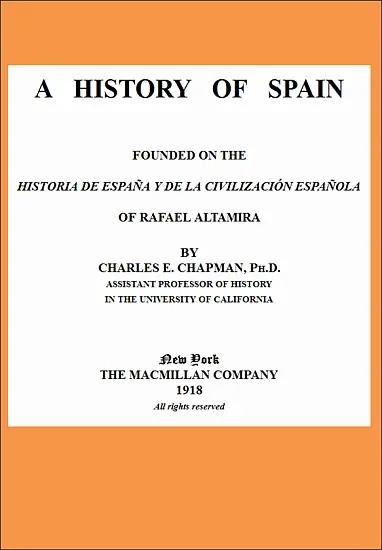
"A History of Spain" by Charles E. Chapman is a comprehensive historical account written in the early 20th century. The work aims to provide an in-depth overview of Spanish history with a particular focus on its civilization and cultural evolution, especially concerning its transfer to the Americas. It looks at the growth of institutions and societal structures from the beginning of recorded history in Spain, positioning these developments within a broader historical and cultural context." "The opening of the book outlines Chapman's intention to present a concise narrative that reflects the evolution of Spanish civilization from various perspectives, acknowledging both historical continuity and change. The preface discusses the significance of understanding Spanish history in relation to American cultures, which have been influenced by Spanish institutions and civilization. It introduces the book as a selection rather than a summary, indicating that it distills rich historical material into an accessible format designed for both general readers and academic settings. Moreover, it emphasizes the geographic and cultural uniqueness of Spain, setting the stage for a discussion of its early peoples and the historic ramifications of its geographical identity."
Introduction adapted from the source catalogue; source summaries may be automatically generated.
Free to read · English · 201,168 words · No account needed
MAKE TIME FOR A GOOD BOOK
On by default. Untick to stop anonymous reading totals. Each page counts after 10 seconds in view. How this works.
Anonymous counting is on unless you have switched it off.
[Sidenote: Taxes in the other kingdoms.]
The above refers to taxes collected in Castile, but the other dominions of Spain, peninsula and otherwise, produced considerable amounts for the state. Aragon, Catalonia, and Valencia yielded much less than Castile. The Low Countries were profitable for a time; Charles I procured 450,000 ducats a year (nearly $7,000,000) at the outset of his reign. Under Philip II, however, they were the scene of heavy expenditures. The Americas have often been considered as the principal financial resort of the Spanish kings, and although this is not certain and may even be doubtful they did yield vast sums. Prior to the conquest of Mexico the annual revenues were only some 70,000 ducats (about $1,000,000), but the conquests of Cortés, followed soon by those of Pizarro in Peru, resulted in an enormous increase. Under Philip II they amounted annually to about 1,200,000 ($18,000,000) according to some writers, and to as much as 2,000,000 ($30,000,000) in the opinion of others. Castilian taxes were applied in the new world, together with certain others arising out of the special circumstances of colonial affairs, such as the royal fifth on precious metals from the mines and the poll tax collected from the Indians. Data are not at hand for an accurate estimate of the entire revenues of Spain, but it seems clear that they increased enormously in the period. They may have reached their highest point under Philip III, when it was estimated that they were some 24,000,000 ducats ($360,000,000) a year, of which not more than half reached the Spanish treasury. An estimate made toward the close of the century gave the revenues as about 17,750,000 ($270,000,000), of which only a third was actually available.
[Sidenote: Growth of the national debt.]
Despite these relatively great sums the national debt was a constant factor, and advanced greatly in amount under Philip II, who is said to have left a debt of 100,000,000 ducats ($1,500,000,000). This was reduced in later reigns, but was still 70,000,000 (well over $1,000,000,000) in 1690,--a huge sum as national debts went then, even though creditors were frequently scaled down or not paid at all. One of the important elements in the debt was that of the loans made by Flemish, German, and Italian bankers, especially those of Genoa. The frequency with which these loans were sought and the high rate of interest required have caused Spain to be characterized, with accuracy, as a mere bridge over which the wealth of the Americas (and, to be sure, that of the peninsula itself) passed to other nations as interest and part payment of the nation’s debts. In 1539 this form of indebtedness amounted to about 1,000,000 ducats ($15,000,000), and in 1560, some 7,000,000 (over $100,000,000). When the Spanish kings were unable to pay a note that had become due, as much as 33-1/3 per cent might be charged for its renewal; indeed, the ordinary rate of interest ranged from 15 to 30 per cent. The inability of Philip II to meet his obligations caused all but the Genoese bankers to refuse him credit, and they joined with the others when he suspended the payment of interest on their notes. Unable to get funds in any other way, Philip surrendered to the Genoese, who exacted as part payment for fresh loans a share in various revenues of the Spanish state, such as in that of the salt monopoly and in certain of the taxes collected from the church,--thus belying the original object for which the latter had been imposed. The Cortes, though it had declined in other respects, was perhaps the most important organ of public finance. It not only voted subsidies but also collected them, a function which it had exercised in previous eras. It had charge of several other taxes as well, such as the productive alcabala and the millones. For these purposes special committees of the Cortes were formed. Nevertheless, the Consejo de Hacienda, founded in 1593, grew rapidly in functions and in power, and by the close of the seventeenth century is said to have had over 60,000 employes. This vast number was due in part to the variety in the origin and character of the various tributes. Without taking into consideration the inevitable accompaniment of graft, such a horde of officials involved the state in a heavy cost for the collection and administration of the revenues.
Your reading position is saved on this browser. Take it to another device with a library code. Reading pages adapt to text, rather than matching a printed edition.
BEHIND THE BOOK
This eBook is for the use of anyone anywhere in the United States and most other parts of the world at no cost and with almost no restrictions whatsoever. You may copy it, give it away or re-use it under the terms of the Project Gutenberg License included with this eBook or online at www.gutenberg.org. If you are not located in the United States, you will have to check the laws of the country where you are located before using this eBook. Read the source licence.
The original source file, including credits and licence, is retained by this library. Request an original-format copy at no charge. Please include the book title and Project Gutenberg identifier #40646.
KEEP YOUR CURIOSITY GOING
Cécile Tormay

Moritz Busch
John L. Ransom
Frances Wright
Cécile Tormay

Mabel Potter Daggett