THE CLASSIC COLLECTION✦An outlaw’s diary: the CommuneCLASSIC FREE BOOKS
An outlaw’s diary: the Commune
Cécile Tormay
THE CLASSIC COLLECTION · 1918
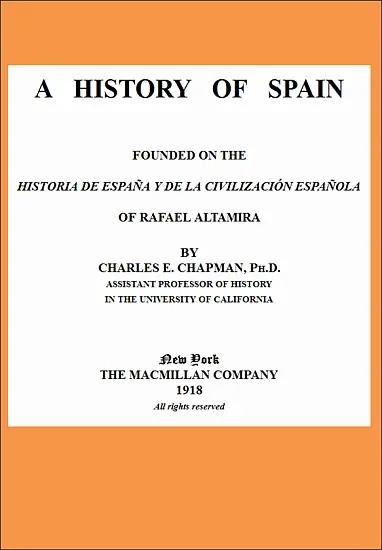
"A History of Spain" by Charles E. Chapman is a comprehensive historical account written in the early 20th century. The work aims to provide an in-depth overview of Spanish history with a particular focus on its civilization and cultural evolution, especially concerning its transfer to the Americas. It looks at the growth of institutions and societal structures from the beginning of recorded history in Spain, positioning these developments within a broader historical and cultural context." "The opening of the book outlines Chapman's intention to present a concise narrative that reflects the evolution of Spanish civilization from various perspectives, acknowledging both historical continuity and change. The preface discusses the significance of understanding Spanish history in relation to American cultures, which have been influenced by Spanish institutions and civilization. It introduces the book as a selection rather than a summary, indicating that it distills rich historical material into an accessible format designed for both general readers and academic settings. Moreover, it emphasizes the geographic and cultural uniqueness of Spain, setting the stage for a discussion of its early peoples and the historic ramifications of its geographical identity."
Introduction adapted from the source catalogue; source summaries may be automatically generated.
Free to read · English · 201,168 words · No account needed
MAKE TIME FOR A GOOD BOOK
On by default. Untick to stop anonymous reading totals. Each page counts after 10 seconds in view. How this works.
Anonymous counting is on unless you have switched it off.
Next to the state the church was the most powerful and influential factor in Castile. This period was one of serious internal disturbance in the Castilian church and of relaxation in discipline. Despite the efforts of the popes and some Castilian prelates, the practice of barraganía continued. There also occurred such incidents as competitions in beauty between the nuns of Seville and Toledo, such instances of lack of discipline as the armed resistance of the dean of Sigüenza to the pope’s appointee as bishop, such turbulent intervention in politics as that of the bishops of Seville and Toledo in the time of Henry IV, and such cases of strife and violence as the attack of the monks of Melón on those of Armenteira, and that of the bishop of Mondoñedo on the Cistercians of Meyra. The disorder was enhanced owing to the appearance of the Great Schism in the church at large, in which Spanish countries were particularly interested, since several of the popes and anti-popes were of Spanish blood. On the other hand, the popes intervened more than ever in the affairs of the Castilian church. The ideas of Gregory VII of the supremacy of the papacy over temporal rulers did not fail to produce results in Castile. In the Partidas of the absolutist Alfonso X it was recognized that one legitimate way of acquiring the crown was by a grant of the pope, and that the latter might also absolve Castilian subjects from obedience to the king in certain cases. The election of bishops, normally the act of the cathedral canons, provoked many disputes between the kings and the popes, for the latter frequently intervened to impose their candidate, or even to make direct appointments, while the former claimed that no election was valid until it had their approval. One of the most unpopular practices of the popes was the appointment of foreigners to Castilian benefices, and frequent protests were made against it, but usually without avail. Although the popes got rather the better of the dispute over appointments to bishoprics, the kings manifested their prerogative in other respects, as by banishing prelates who worked against royal interests, by prohibiting the publication of papal bulls which might do harm to the state, and by employing the already mentioned process of recourse of fuerza in cases of ecclesiastical usurpations of jurisdiction. The Partidas named certain cases where clergymen lost their right of resort to ecclesiastical courts,--for example, suits between clerical and lay individuals over lands and inheritances. Even Alfonso XI, who (though somewhat immoral in private life) was very pious and notably generous with churches and monasteries, was very strict in guarding the rights of the state against the intrusions of the church. On the other hand, he confirmed the jurisdiction of the church courts in spiritual and related matters, including such cases as those arising out of church taxation, marriage, births, divorce, adultery, usury, and robbery in a sacred place, as well as those of a more purely religious or ecclesiastical character. The wealth of the church in lands increased greatly, both as a result of royal donations, and through the gifts of individuals, especially in the fourteenth century when the terror of the plagues which were sweeping Europe caused many to seek divine favor through benefactions to the church. There were a number of protests in the Cortes, especially in the case of the monasteries. The objections were based on social and financial, rather than anti-clerical, grounds, since the accumulation of landed wealth in the hands of the church tended to reduce the agricultural classes to a perpetual condition of mere usufruct or rental of lands, and resulted in vast tracts remaining uncultivated. Furthermore, these lands as a rule became exempted from taxation. The Partidas recognized the right of the church to receive such gifts, and no effectual steps were taken to check them. It may be mentioned here that this was the golden age of pilgrimages to holy places, due to religious devotion, or in fulfilment of vows, or from pure love of travel and adventure. Naturally, Santiago de Compostela was the chief objective of pilgrims in Spain, and to that place went not only Spaniards but also many thousands of persons from all parts of western Europe.
Your reading position is saved on this browser. Take it to another device with a library code. Reading pages adapt to text, rather than matching a printed edition.
BEHIND THE BOOK
This eBook is for the use of anyone anywhere in the United States and most other parts of the world at no cost and with almost no restrictions whatsoever. You may copy it, give it away or re-use it under the terms of the Project Gutenberg License included with this eBook or online at www.gutenberg.org. If you are not located in the United States, you will have to check the laws of the country where you are located before using this eBook. Read the source licence.
The original source file, including credits and licence, is retained by this library. Request an original-format copy at no charge. Please include the book title and Project Gutenberg identifier #40646.
KEEP YOUR CURIOSITY GOING
Cécile Tormay

Moritz Busch
John L. Ransom
Frances Wright
Cécile Tormay

Mabel Potter Daggett