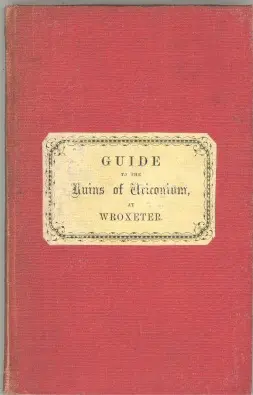
The Ruins of the Roman City of Uriconium, at Wroxeter, near Shrewsbury
Thomas Wright
THE CLASSIC COLLECTION · 1862
"A History of Domestic Manners and Sentiments in England During the Middle Ages" by Thomas Wright is a historical account written in the mid-19th century. The book seeks to provide a comprehensive look at the everyday life, customs, and thoughts of the English people during the Middle Ages, emphasizing their domestic arrangements and practices. The author aims to fill a gap in literature by creating a vivid picture of historical domestic life, juxtaposing it with modern society to illustrate how past customs have shaped contemporary manners and sentiments. At the start of the book, Wright introduces his purpose and methodology, stating that his work focuses on domestic manners and sentiments rather than the traditional histories of rulers and events. He briefly discusses the existing literature on related subjects, emphasizing the need for a cohesive view of domestic life during various historical periods. Wright outlines the structure of his work, which will explore the Anglo-Saxon period through to the Reformation, highlighting the significant transitions in social customs and practices, ultimately aiming to create an engaging narrative that draws from original research rather than previous compilations. The opening chapters promise to examine aspects such as housing, dining customs, and the furnishings of Anglo-Saxon households, setting the stage for a detailed investigation of medieval domestic life.
Introduction adapted from the source catalogue; source summaries may be automatically generated.
Free to read · English · 152,792 words · No account needed
MAKE TIME FOR A GOOD BOOK
On by default. Untick to stop anonymous reading totals. Each page counts after 10 seconds in view. How this works.
Anonymous counting is on unless you have switched it off.
Several circumstances arising out of certain rivalries of social institutions render it somewhat difficult to form an estimate of the moral character of the Anglo-Saxons. In the first place, before the introduction of Christianity, marriage was a mere civil institution, consisted chiefly in a bargain between the father of the lady and the man who sought her, and was completed with few formalities, except those of feasting and rejoicing. After the young lady was out of the control of her parents, the two sexes were on a footing of equality to each other, and the marriage tie was so little binding, that, in case of disagreement, it was at the will of either of the married couple to separate, in which case the relatives or friends of each party interfered, to see that right was done in the proportional repayment of marriage money, dowry, &c., and after the separation each party was at liberty to marry again. This state of things is well illustrated in the Icelandic story of the Burnt Njal, recently translated by Dr. Dasent, and it was not abolished by the secular laws, after the conversion of the Anglo-Saxons to Christianity, marriage still continuing to be, in fact, a civil institution. But the higher clergy, at least, who were those who were most strongly inspired with the Romish sentiments, disapproved entirely of this view of the marriage state, and, although the Saxon priests appear not to have hesitated in being present at the second marriages after such separations, they were apparently forbidden by the ecclesiastical laws from giving their blessing to them.[11] With such views of the conjugal relations, we cannot be surprised if the associating together of a man and woman, without the ceremonies of marriage, was looked upon without disgust; in fact, this was the case throughout western Europe during the middle ages, in spite of the doctrines of the church, and the offspring was hardly considered as dispossessed of legal rights. It would be easy to point out examples illustrating this state of things. Again, the priesthood among the unconverted Saxons was probably, as it appears among the Icelanders in the story of the Burnt Njal just alluded to, a sort of family possession,[12] the priests themselves being what we should call family men; so that when the Anglo-Saxon people were Christians, and no longer pagans, the mass of the clergy, whatever may have been their sincerity as Christians, could not understand, or, at least, were unwilling to accept, the new Romish doctrine which required their celibacy. In both these cases, the Anglo-Saxon ecclesiastical writers, who are our chief authority on this subject, and were the most bigoted of the Romish party, speak in terms of exaggerated virulence, on the score of morality, against practices which the Anglo-Saxon people had not been used to consider as immoral at all. Thus, we should be led to believe, from the accounts of these ecclesiastical moralists, that the Anglo-Saxon clergy were infamous for their incontinence, whereas their declamations probably mean only that the Anglo-Saxon priests persisted in having wives and families. The secular laws contain frequent allusions to the continuance of principles relating to the marriage state, which were derived from the older period of paganism, and some of these are extremely curious. Thus, the laws of king Ethelred provide that a man who seduces another man’s wife, shall make reparation, not only as in modern times, by paying pecuniary damages, but also by procuring him another wife! or, in the words of the original, “If a freeman have been familiar with a freeman’s wife, let him pay for it with his wer-gild (the money compensation for the killing of a man), and provide another wife with his own money, and bring her home to the other.” By a law of king Ine, “if any man buy a wife (that is, if the bargain with her father has been completed), and the marriage take not place,” he was required to pay the money, besides other compensation. And again, by one of Alfred’s laws, it was provided, “If any one deceive an unbetrothed woman, and sleep with her, let him pay for her, and have her afterwards to wife; but if the father of the woman will not give her, let him pay money according to her dowry.” Regulations relating to the buying of a wife, are found in the Anglo-Saxon laws.
Your reading position is saved on this browser. Take it to another device with a library code. Reading pages adapt to text, rather than matching a printed edition.
BEHIND THE BOOK
This eBook is for the use of anyone anywhere in the United States and most other parts of the world at no cost and with almost no restrictions whatsoever. You may copy it, give it away or re-use it under the terms of the Project Gutenberg License included with this eBook or online at www.gutenberg.org. If you are not located in the United States, you will have to check the laws of the country where you are located before using this eBook. Read the source licence.
The original source file, including credits and licence, is retained by this library. Request an original-format copy at no charge. Please include the book title and Project Gutenberg identifier #59351.
KEEP YOUR CURIOSITY GOING
Cécile Tormay

Moritz Busch
John L. Ransom
Frances Wright
Cécile Tormay

Mabel Potter Daggett