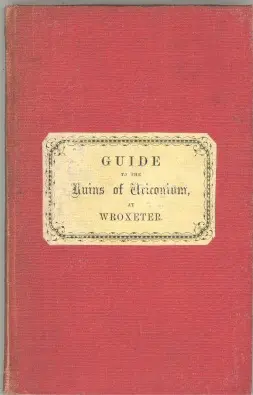
The Ruins of the Roman City of Uriconium, at Wroxeter, near Shrewsbury
Thomas Wright
THE CLASSIC COLLECTION · 1862
"A History of Domestic Manners and Sentiments in England During the Middle Ages" by Thomas Wright is a historical account written in the mid-19th century. The book seeks to provide a comprehensive look at the everyday life, customs, and thoughts of the English people during the Middle Ages, emphasizing their domestic arrangements and practices. The author aims to fill a gap in literature by creating a vivid picture of historical domestic life, juxtaposing it with modern society to illustrate how past customs have shaped contemporary manners and sentiments. At the start of the book, Wright introduces his purpose and methodology, stating that his work focuses on domestic manners and sentiments rather than the traditional histories of rulers and events. He briefly discusses the existing literature on related subjects, emphasizing the need for a cohesive view of domestic life during various historical periods. Wright outlines the structure of his work, which will explore the Anglo-Saxon period through to the Reformation, highlighting the significant transitions in social customs and practices, ultimately aiming to create an engaging narrative that draws from original research rather than previous compilations. The opening chapters promise to examine aspects such as housing, dining customs, and the furnishings of Anglo-Saxon households, setting the stage for a detailed investigation of medieval domestic life.
Introduction adapted from the source catalogue; source summaries may be automatically generated.
Free to read · English · 152,792 words · No account needed
MAKE TIME FOR A GOOD BOOK
On by default. Untick to stop anonymous reading totals. Each page counts after 10 seconds in view. How this works.
Anonymous counting is on unless you have switched it off.
Vessels used at table, 25, 34, 150.
Villains, how regarded by the Normans, 101.
Vine, the, cultivated in England, 33, 99, 296.
Visitors, how received, 141, 142.
Waghe, difference between this word and wall, 12.
Wakes, village, 67.
Walking, rules for behaviour in, 290-293.
Washing, before and after meals, 156, 367, 368,
396, 397.
Weaving, as practised by the ladies, 109, 237, 426, 427, 482, 483.
Well, the, 86, 361.
Whips, 235, 315.
Windows, 83, 121, 134.
Windows, with seats, 373, 374.
Wine, 33, 90.
Woman, her character among the Anglo-Saxons, 52, 53.
Women, their occupations, 52, 53, 108, 109, 237-239;
their want of delicacy in the middle ages, 274;
treated with rudeness, 275;
instructions to them, 275;
acted as doctors, 278, 279;
poisoners, 279, 431;
frequenters of taverns, 282, 420, 437-439;
education and employment of gentlewomen, 383, 384, 419, 426;
their undomestic character, 420;
addicted to gambling and drinking, 483-485;
their manner of riding. See Side-saddle, Pillion.
Writing, implements of, 96, 117, 266, 340, 341, 439.
On the First of every Month, Price 2s. 6d.,
Each Part Illustrated with Splendid Steel Engravings and Woodcuts.
With the year 1862 will be commenced in the “Art-Journal,”
It is designed to succeed the “ROYAL GALLERY” and the “VERNON GALLERY;” and, there can be no doubt, will be superior in interest to either. In the “Vernon Gallery” are many pictures not calculated for engraving; but they were necessarily included in the published work, in order to redeem a pledge given to Mr. Vernon, to publish the whole of his gallery bequeathed to the Nation; while, in engraving the “Royal Gallery” it was considered necessary, in order to represent somewhat duly its varied contents, to introduce examples of some of the old masters, in which the collections are exceedingly rich, although engravings from them were not likely to be as extensively popular as prints from modern works.
In the series now announced, no such restriction or difficulty can arise: the power of selection will be almost unlimited; and the result will depend on the taste and judgment that dictate its contents.
Some of these selections have been made from public galleries, others from large and important collections, but the greater number have been obtained from the comparatively small, though rich and varied, collections of private gentlemen--“the merchant princes” more especially, who have, of late years, been the chief patrons of British Art--whose wealth has been liberally expended in elevating British Art to its present state of high prosperity.
EDITED BY S. C. HALL, ESQ., F.S.A., &c.
Your reading position is saved on this browser. Take it to another device with a library code. Reading pages adapt to text, rather than matching a printed edition.
BEHIND THE BOOK
This eBook is for the use of anyone anywhere in the United States and most other parts of the world at no cost and with almost no restrictions whatsoever. You may copy it, give it away or re-use it under the terms of the Project Gutenberg License included with this eBook or online at www.gutenberg.org. If you are not located in the United States, you will have to check the laws of the country where you are located before using this eBook. Read the source licence.
The original source file, including credits and licence, is retained by this library. Request an original-format copy at no charge. Please include the book title and Project Gutenberg identifier #59351.
KEEP YOUR CURIOSITY GOING
Cécile Tormay

Moritz Busch
John L. Ransom
Frances Wright
Cécile Tormay

Mabel Potter Daggett