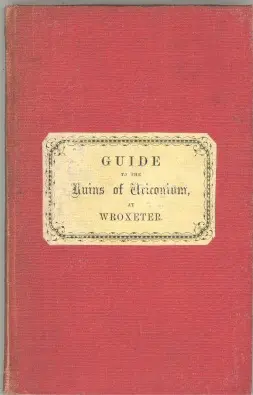
The Ruins of the Roman City of Uriconium, at Wroxeter, near Shrewsbury
Thomas Wright
THE CLASSIC COLLECTION · 1862
"A History of Domestic Manners and Sentiments in England During the Middle Ages" by Thomas Wright is a historical account written in the mid-19th century. The book seeks to provide a comprehensive look at the everyday life, customs, and thoughts of the English people during the Middle Ages, emphasizing their domestic arrangements and practices. The author aims to fill a gap in literature by creating a vivid picture of historical domestic life, juxtaposing it with modern society to illustrate how past customs have shaped contemporary manners and sentiments. At the start of the book, Wright introduces his purpose and methodology, stating that his work focuses on domestic manners and sentiments rather than the traditional histories of rulers and events. He briefly discusses the existing literature on related subjects, emphasizing the need for a cohesive view of domestic life during various historical periods. Wright outlines the structure of his work, which will explore the Anglo-Saxon period through to the Reformation, highlighting the significant transitions in social customs and practices, ultimately aiming to create an engaging narrative that draws from original research rather than previous compilations. The opening chapters promise to examine aspects such as housing, dining customs, and the furnishings of Anglo-Saxon households, setting the stage for a detailed investigation of medieval domestic life.
Introduction adapted from the source catalogue; source summaries may be automatically generated.
Free to read · English · 152,792 words · No account needed
MAKE TIME FOR A GOOD BOOK
On by default. Untick to stop anonymous reading totals. Each page counts after 10 seconds in view. How this works.
Anonymous counting is on unless you have switched it off.
The progress of society from its first formation to the full development of civilization, has been compared not inaptly to the life of man. In the childhood and youth of society, when the population was not numerous, and a servile class performed the chief part of the labour necessary for administering to the wants or luxuries of life, people had a far greater proportion of time on their hands to fill up with amusements than at a later period, and many that are now considered frivolous, or are only indulged in at rare intervals of relaxation, then formed the principal occupations of men’s lives. We have glanced at the in-door amusements of the Anglo-Saxons in a previous chapter; but their out-door recreations, although we have little information respecting them, were certainly much more numerous. The multitude of followers who, in Saxon times, attended on each lord or rich man as their military chief, or as their domestic supporter, had generally no serious occupation during the greater part of the day; and this abundance of unemployed time was not confined to one class of society, for the artisan had to work less to gain his subsistence, and both citizen and peasant were excused from work altogether during the numerous holidays of the year.
That the Anglo-Saxons were universally fond of play (plega) is proved by the frequent use of the word in a metaphorical sense. They even applied it to fighting and battle, which, in the language of the poets, were plega-gares (play of darts), æsc-plega (play of shields), and hand-plega (play of hands).[14] In the glossaries, plegere (a player), and plega-man (a playman), are used to represent the Roman gladiator; and plega-hús (a playhouse), and plega-stow (a play-place), express a theatre, or more probably an amphitheatre. Recent discoveries have shown that there was a theatre of considerable dimensions in the Roman town of Verulamium (near St. Alban’s); and old writers tell us there was one at the Silurian Isca (Caerleon), though these buildings were doubtless of rare occurrence; but every Roman town of any importance in the island had its amphitheatre outside the walls for gladiatorial and other exhibitions. The result of modern researches seems to prove that most of the Roman towns continued to exist after the Saxon settlement of the island, and we can have no doubt that the amphitheatres, at least for awhile, continued to be devoted to their original purposes, although the performances were modified in character. Some of them (like that at Richborough, in Kent, lately examined), were certainly surrounded by walls, while others probably were merely cut in the ground, and surrounded by a low embankment formed of the material thrown out. The first of these, the Saxons would naturally call a play-house, while the other would receive the no less appropriate appellation of a play-stow, or place for playing. Among the illustrations of the Anglo-Saxon manuscript of the Psalms (MS. Harl., No. 603), to which we have so often had occasion to refer, there is a very curious picture, evidently intended to represent an amphitheatre outside a town. It is copied in our cut No. 41. The rude Anglo-Saxon draughtsman has evidently intended to represent an embankment, occupied by the spectators, around the spot where the performances take place. The spectator to the left is expressing his approbation by clapping with his hands. The performances themselves are singular: we have a party of minstrels, one of them playing on the Roman double pipes, so often represented in Anglo-Saxon manuscripts, while another is dancing to him, and the third is performing with a tame bear, which is at the moment of the representation simulating sleep. Games of this kind with animals, succeeded no doubt among the Saxons to the Roman gladiatorial fights, but few have imagined that the popular English exhibition of the dancing bear dated from so remote a period. The manuscripts show that the double pipe was in use among the Anglo-Saxons; with a little modification, and a bag or bellows to supply the place of the human lungs, this instrument was transformed into a bagpipe.
Your reading position is saved on this browser. Take it to another device with a library code. Reading pages adapt to text, rather than matching a printed edition.
BEHIND THE BOOK
This eBook is for the use of anyone anywhere in the United States and most other parts of the world at no cost and with almost no restrictions whatsoever. You may copy it, give it away or re-use it under the terms of the Project Gutenberg License included with this eBook or online at www.gutenberg.org. If you are not located in the United States, you will have to check the laws of the country where you are located before using this eBook. Read the source licence.
The original source file, including credits and licence, is retained by this library. Request an original-format copy at no charge. Please include the book title and Project Gutenberg identifier #59351.
KEEP YOUR CURIOSITY GOING
Cécile Tormay

Moritz Busch
John L. Ransom
Frances Wright
Cécile Tormay

Mabel Potter Daggett