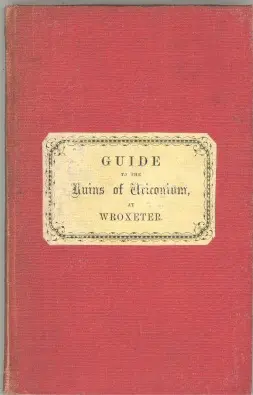
The Ruins of the Roman City of Uriconium, at Wroxeter, near Shrewsbury
Thomas Wright
THE CLASSIC COLLECTION · 1862
"A History of Domestic Manners and Sentiments in England During the Middle Ages" by Thomas Wright is a historical account written in the mid-19th century. The book seeks to provide a comprehensive look at the everyday life, customs, and thoughts of the English people during the Middle Ages, emphasizing their domestic arrangements and practices. The author aims to fill a gap in literature by creating a vivid picture of historical domestic life, juxtaposing it with modern society to illustrate how past customs have shaped contemporary manners and sentiments. At the start of the book, Wright introduces his purpose and methodology, stating that his work focuses on domestic manners and sentiments rather than the traditional histories of rulers and events. He briefly discusses the existing literature on related subjects, emphasizing the need for a cohesive view of domestic life during various historical periods. Wright outlines the structure of his work, which will explore the Anglo-Saxon period through to the Reformation, highlighting the significant transitions in social customs and practices, ultimately aiming to create an engaging narrative that draws from original research rather than previous compilations. The opening chapters promise to examine aspects such as housing, dining customs, and the furnishings of Anglo-Saxon households, setting the stage for a detailed investigation of medieval domestic life.
Introduction adapted from the source catalogue; source summaries may be automatically generated.
Free to read · English · 152,792 words · No account needed
MAKE TIME FOR A GOOD BOOK
On by default. Untick to stop anonymous reading totals. Each page counts after 10 seconds in view. How this works.
Anonymous counting is on unless you have switched it off.
It is very rare that we can catch in history a glimpse of the internal economy of the Anglo-Saxon household. Enough, however, is told to show us that the Saxon woman in every class of society possessed those characteristics which are still considered to be the best traits of the character of Englishwomen; she was the attentive housewife, the tender companion, the comforter and consoler of her husband and family, the virtuous and noble matron. Home was her especial place; for we are told in a poem in the Exeter Book (p. 337) that, “It beseems a damsel to be at her board (table); a rambling woman scatters words, she is often charged with faults, a man thinks of her with contempt, oft her cheek smites.” In all ranks, from the queen to the peasant, we find the lady of the household attending to her domestic duties. In 686, John of Beverley performed a supposed miraculous cure on the lady of a Yorkshire earl; and the man who narrated the miracle to Bede the historian, and who dined with John of Beverley at the earl’s house after the cure, said, “She presented the cup to the bishop (John) and to me, and continued serving us with drink as she had begun, till dinner was over.” Domestic duties of this kind were never considered as degrading, and they were performed with a simplicity peculiarly characteristic of the age. Bede relates another story of a miraculous cure performed on an earl’s wife by St. Cuthbert, in the sequel of which we find the lady going forth from her house to meet her husband’s visitor, holding the reins while he dismounts, and conducting him in. The wicked and ambitious queen Elfthrida, when her step-son king Edward approached her residence, went out in person to attend upon him, and invite him to enter, and, on his refusal, she served him with the cup herself, and it was while stooping to take it that he was treacherously stabbed by one of her attendants. In their chamber, besides spinning and weaving, the ladies were employed in needlework and embroidery, and the Saxon ladies were so skilful in this art, that their work, under the name of English work (opus Anglicum), was celebrated on the continent. We read of a Saxon lady, named Ethelswitha, who retired with her maidens to a house near Ely, where her mother was buried, and employed herself and them in making a rich chasuble for the monks. The four princesses, the sisters of king Ethelstan, were celebrated for their skill in spinning, weaving, and embroidering; William of Malmesbury tells us that their father, king Edward, had educated them “in such wise, that in childhood they gave their whole attention to letters, and afterwards employed themselves in the labours of the distaff and the needle.” The reader will remember in the story of the Saxon queen Osburgha, the mother of the great Alfred, how she sat in her chamber, surrounded by her children, and encouraging them in a taste for literature. The ladies, when thus occupied, were not inaccessible to their friends of either sex. When Dunstan was a youth, he appears to have been always a welcome visitor to the ladies in their “bowers,” on account of his skill in music and in the arts. His contemporary biographer tells us of a noble lady, named Ethelwynn, who, knowing his skill in drawing and designs, obtained his assistance for the ornaments of a handsome stole which she and her women were embroidering. Dunstan is represented as bringing his harp with him into the apartment of the ladies, and hanging it up against the wall, that he might have it ready to play to them in the intervals of their work. Editha, the queen of Edward the Confessor, was well-known as a skilful needle-woman, and as extensively versed in literature. Ingulf’s story of his schoolboy-days, if it be true (for there is considerable doubt of the authenticity of Ingulf’s “History”), and of his interviews with queen Edith, gives us a curious picture of the simplicity of an Anglo-Saxon court, even at the latest period of their monarchy. “I often met her,” he says, “as I came from school, and then she questioned me about my studies and my verses; and willingly passing from grammar to logic, she would catch me in the subtleties of argument. She always gave me two or three pieces of money, which were counted to me by her handmaiden, and then sent me to the royal larder to refresh myself.”
Your reading position is saved on this browser. Take it to another device with a library code. Reading pages adapt to text, rather than matching a printed edition.
BEHIND THE BOOK
This eBook is for the use of anyone anywhere in the United States and most other parts of the world at no cost and with almost no restrictions whatsoever. You may copy it, give it away or re-use it under the terms of the Project Gutenberg License included with this eBook or online at www.gutenberg.org. If you are not located in the United States, you will have to check the laws of the country where you are located before using this eBook. Read the source licence.
The original source file, including credits and licence, is retained by this library. Request an original-format copy at no charge. Please include the book title and Project Gutenberg identifier #59351.
KEEP YOUR CURIOSITY GOING
Cécile Tormay

Moritz Busch
John L. Ransom
Frances Wright
Cécile Tormay

Mabel Potter Daggett