THE CLASSIC COLLECTION✦A Christmas Carol The original manuscriptCLASSIC FREE BOOKS
A Christmas Carol The original manuscript
Charles Dickens
THE CLASSIC COLLECTION · 1895
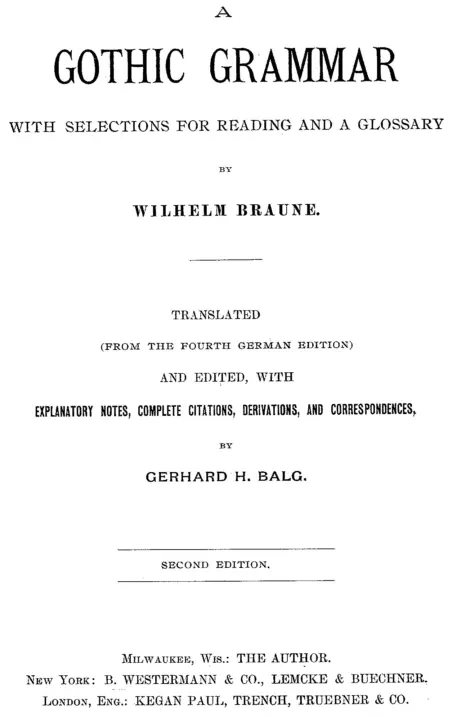
"A Gothic Grammar" by Wilhelm Braune is an academic textbook written in the late 19th century. The work serves as both a comprehensive introduction and an instructional guide for students seeking to learn the Gothic language, emphasizing phonology and inflectional grammar while providing reading selections and a glossary for practical application. The opening of this grammar provides insight into its structure and intended use in an academic context. It first outlines the purpose of the book, which is to aid students in gaining a practical understanding of Gothic, enabling them to follow lectures on historical and comparative grammar. Braune emphasizes that the focus will be on phonology and inflection without relying heavily on comparative grammar. Additionally, it advises beginners on how to approach the chapters, indicating that initial focus should be on phonology before progressing to inflections and reading texts, along with guidance on supplemental resources for deeper study. This sets the stage for a systematic exploration of the intricacies of the Gothic language.
Introduction adapted from the source catalogue; source summaries may be automatically generated.
Free to read · English · 99,757 words · No account needed
MAKE TIME FOR A GOOD BOOK
On by default. Untick to stop anonymous reading totals. Each page counts after 10 seconds in view. How this works.
Anonymous counting is on unless you have switched it off.
NOTE. Sum instances of gemination as wel as of simplified gemination in the MSS. ar merely orthografic errors; as, =allh= for =alh=; Lu. II, 46; =wisêdun= (=s= for =ss=); =inbranjada= (=nj= for =nnj=); Jo. XV, 6; =swam= for =swamm=; Mk. XV, 36.--Such errors ar mostly corrected by the editors. Cp. Bernhardt, 'Vulfila', p. LVII.
§ 81. The changes of consonants before dentals may, as far as the Gothic is concernd, be embraced in the following rule:
Before the dentals, =d=, =þ=, =t=, all labial stops and spirants ar changed into =f=, all gutturals into =h=, all dentals into =s=, the second dental appearing always as =t=. E. g.
=skapjan=, =gaskafts= (§ 51, n. 2); =þaúrban= (=*þaúrbda=), =þaúrfta=; =giban=, =gifts= (§ 56, n. 4); --=siuks=, =saúhts=; =þagkjan=, =þâhta= (§ 58, n. 2); =magan=, =mahta= (§ 66, n. 1); --=wait=, =waist= (§ 69, n. 2); =waírþan=, =warst= (§ 71, n. 3); =biudan=, =baust= (§ 75, n. 1).
NOTE 1. Exceptions ar =magt= (2nd pers. sg.; 1st =mag=, § 201) and
=gahugds=, mind.
NOTE 2. =st= often becums =ss= by assimilation; as, =wissa=, prt. of =witan= (§ 76, n. 1). Cp. Beitr., 7, 171 et seq.; 9, 150 et seq.; IF., 4, 341 et seq.
NOTE 3. The rule givn abuv from a practical standpoint of the Gothic grammar must be formulated differently from a comparativ-historical standpoint, because the discust sound-shiftings hav not originated in the Gothic language, but ar reflections of proethnic Germanic and Indo-Germanic relations of sounds. S. Brgm., I, 381 et seq.; 403 et seq.
§ 82. Assimilations occur only in combination with =h= (s. § 62, n. 3)
and =us= (§ 78, n. 4).
(a) On declension in general.
§ 83. The Gothic declension, like that of the remaining Old-Germanic
dialects, comprises three genders: the +masculin+, +neuter+ and
+feminin+.
NOTE 1. The neuter of all declensions resembls in form very closely the masculin; a distinction occurs in the nom. and acc. sg. and pl. only.
NOTE 2. A distinction of gender is wanting only with the personal prn. of the 1st and 2nd persons, with the reflexiv prn. (§ 150), and with the numeral adjectivs 4-19 (§ 141).
§ 84. The Goth. declension has +two+ numbers: +singular+ and +plural+.
NOTE. The +dual+ which originally existed in all Indg. languages, is preservd in the Goth. decl. in the 1st and 2nd pers. of the personal prn. only (§ 150).
§ 85. The Goth. declension has four complete cases: +nominativ+, +genitiv+, +dativ+, +accusativ+. The +vocativ+ is mostly identical with the nominativ, only in the singular of sum classes of declension the vocativ is different from the nominativ, but then it is always identical with the accusativ.
NOTE. The Goth. dativ represents several Indg. cases (dativ, locativ, ablativ, instrumental). Relics of the neuter instrumental ar stil present in the pronominal declension: =þê= (§ 153), =ƕê= (§ 159).
(b) On the declension of substantivs.
Your reading position is saved on this browser. Take it to another device with a library code. Reading pages adapt to text, rather than matching a printed edition.
BEHIND THE BOOK
This eBook is for the use of anyone anywhere in the United States and most other parts of the world at no cost and with almost no restrictions whatsoever. You may copy it, give it away or re-use it under the terms of the Project Gutenberg License included with this eBook or online at www.gutenberg.org. If you are not located in the United States, you will have to check the laws of the country where you are located before using this eBook. Read the source licence.
The original source file, including credits and licence, is retained by this library. Request an original-format copy at no charge. Please include the book title and Project Gutenberg identifier #50336.
KEEP YOUR CURIOSITY GOING
Charles Dickens
Violet Hunt
Marjorie Bowen

Edward Lucas White
James Mooney
May Agnes Fleming