THE CLASSIC COLLECTION✦A Christmas Carol The original manuscriptCLASSIC FREE BOOKS
A Christmas Carol The original manuscript
Charles Dickens
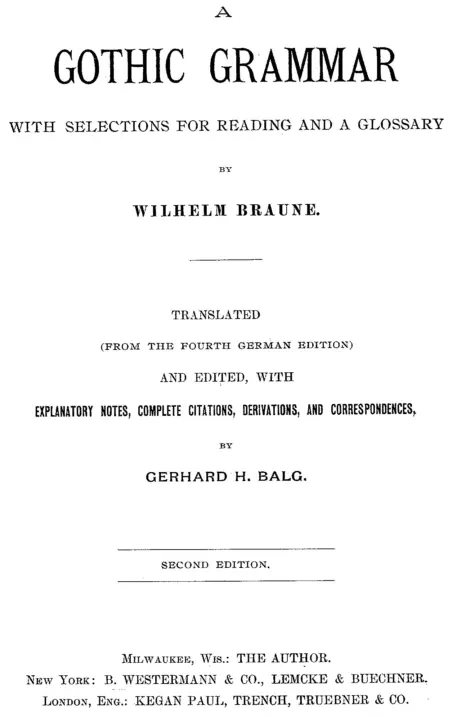
THE CLASSIC COLLECTION · 1895
"A Gothic Grammar" by Wilhelm Braune is an academic textbook written in the late 19th century. The work serves as both a comprehensive introduction and an instructional guide for students seeking to learn the Gothic language, emphasizing phonology and inflectional grammar while providing reading selections and a glossary for practical application. The opening of this grammar provides insight into its structure and intended use in an academic context. It first outlines the purpose of the book, which is to aid students in gaining a practical understanding of Gothic, enabling them to follow lectures on historical and comparative grammar. Braune emphasizes that the focus will be on phonology and inflection without relying heavily on comparative grammar. Additionally, it advises beginners on how to approach the chapters, indicating that initial focus should be on phonology before progressing to inflections and reading texts, along with guidance on supplemental resources for deeper study. This sets the stage for a systematic exploration of the intricacies of the Gothic language.
Introduction adapted from the source catalogue; source summaries may be automatically generated.
Free to read · English · 99,757 words · No account needed
MAKE TIME FOR A GOOD BOOK
On by default. Untick to stop anonymous reading totals. Each page counts after 10 seconds in view. How this works.
Anonymous counting is on unless you have switched it off.
NOTE 1. =au= often interchanges with =aw= (cp. § 42); e. g., =taujan=, prt. =tawida=, to do; =mawi=, gen. =maujôs=, girl; =sniwan=, prt. =snau=, to hasten.
NOTE 2. Latin writers express Goth. =au= by au; as, =Ausila=, =Austrovaldus=, =Audericus=. Cp. Wrede, 'Wand.', 96 et seq. Concerning East Gothic monofthongizations, s. Wrede, 'Ostg.', 165 et seq. (Zs. fda., 36, 273²).
NOTE 3. In the =u=-declension =u= is often found for =áu=; cp. §
24, n. 4; § 105, n. 2.
§ 26. Another =au=, historically, and probably also fonetically, different from the preceding ones occurs before vowels.
(a) For original =ô=: =stauida=, prt. of =stôjan=, to judge; =staua=, f., judgment; =staua=, m., judge; =taui=, n., gen. =tôjis=, deed (cp. also =ubiltôjis=, evil-doer; =taujan=, to do, prt. =tawida=); =afmauidai= and =afdauidai=, pps. of =*afmôjan=, and =*afdôjan=, to tire out, weary; =sauil=, n., sun.
(b) For û in the other Germanic languages: =trauan= (OHG. trûên), to trust; =bauan= (OHG. bûan), to dwel; =bnauan=, to rub (to pieces or powder. ON. (g)núa, OHG. nûan). Cp. also § 179, n. 2.
Sinse this =au= does not change into =aw= before vowels, it must denote a monofthong which is likely to be the long of =aú=, hense a long open =o= (= a in E. fall), while long close =o= (shading very much to =û=, like ô in E. home) is denoted by =ô=. Accordingly, Goth. antevocalic =ô=, =û= past into =au=. Cp. Brgm., I, 156. For the extensiv literature on this question, s. Noreen's 'Urgerm. Lautlehre', p. 34; also Beitr., 17, 563-567.
NOTE 1. Also Gr. ω before a vowel, which is represented as a rule by =ô=, is renderd by =au=: =Trauada=, Τρῳάς; =Nauêl=, Νωέ; =Lauidja=, Λωίς.
NOTE 2. =ô= before =u= occurs, however, in the preterit forms =waiwôun= (inf. =waian=, § 182), =lailôun= (inf. =*lauan=, § 179, 4). Cp. Beitr., 11, 74².
§ 27. Beside the vowel-signs discust in the foregoing paragrafs, a few consonant-signs may likewise discharge the function of vowels, for the Gothic liquids =l=, =r= and the nasals =m=, =n= ar very often vocalic (i. e. syllabic) at the end of a word after a consonant. Here an original suffixal vowel was lost in most cases, and in its place the following liquid or nasal became the bearer of the accent. Thus the Gothic has dissyllabic words with vocalic liquids or vocalic nasals (sonant liquids or sonant nasals); as, =ak~r~s=, field; =fug~l~s=, bird; =taik~n~s=, token; =maiþ~m~s=, present.
NOTE In the West Germanic languages a new vowel (OHG. a) has developt from these vocalic liquids and nasals; e. g., OHG. akkar, fogal, zeihhan, OS. mêþom. Cp. ahd. gr., § 65, and Brgm., I, 190. 237.
[1] For the values of this sign according to 'Amended Spelling', s. 'Standard Dictionary', p. 568.
Your reading position is saved on this browser. Take it to another device with a library code. Reading pages adapt to text, rather than matching a printed edition.
BEHIND THE BOOK
This eBook is for the use of anyone anywhere in the United States and most other parts of the world at no cost and with almost no restrictions whatsoever. You may copy it, give it away or re-use it under the terms of the Project Gutenberg License included with this eBook or online at www.gutenberg.org. If you are not located in the United States, you will have to check the laws of the country where you are located before using this eBook. Read the source licence.
The original source file, including credits and licence, is retained by this library. Request an original-format copy at no charge. Please include the book title and Project Gutenberg identifier #50336.
KEEP YOUR CURIOSITY GOING
Charles Dickens
Violet Hunt
Marjorie Bowen
Edward Lucas White
James Mooney
May Agnes Fleming