THE CLASSIC COLLECTION✦A Christmas Carol The original manuscriptCLASSIC FREE BOOKS
A Christmas Carol The original manuscript
Charles Dickens
THE CLASSIC COLLECTION · 1895
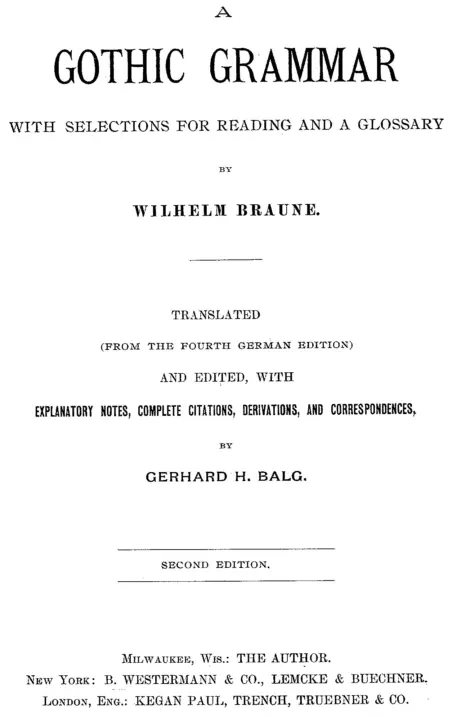
"A Gothic Grammar" by Wilhelm Braune is an academic textbook written in the late 19th century. The work serves as both a comprehensive introduction and an instructional guide for students seeking to learn the Gothic language, emphasizing phonology and inflectional grammar while providing reading selections and a glossary for practical application. The opening of this grammar provides insight into its structure and intended use in an academic context. It first outlines the purpose of the book, which is to aid students in gaining a practical understanding of Gothic, enabling them to follow lectures on historical and comparative grammar. Braune emphasizes that the focus will be on phonology and inflection without relying heavily on comparative grammar. Additionally, it advises beginners on how to approach the chapters, indicating that initial focus should be on phonology before progressing to inflections and reading texts, along with guidance on supplemental resources for deeper study. This sets the stage for a systematic exploration of the intricacies of the Gothic language.
Introduction adapted from the source catalogue; source summaries may be automatically generated.
Free to read · English · 99,757 words · No account needed
MAKE TIME FOR A GOOD BOOK
On by default. Untick to stop anonymous reading totals. Each page counts after 10 seconds in view. How this works.
Anonymous counting is on unless you have switched it off.
Chap. II. 1. =gastauida=; prt. of =gastôjan= (Gr., 186).--=at=, with.--=qimau=; opt. in an obj. clause expressing possibility (S., 92).--=at=, to. 2. =gailjai=; opt. in a rel. clause expressing result (S., 99, a).--=sa=; art.--=gáurida=; nom. sg. m. of the weak pp. (Gr., 134).--=us=, by. 3. =jaþ=; for =jah= (Gr., 62, n. 3).--=izwis=; dat. of the indir. obj. after =gamêlida= (S., 37).--=habau=; prs. opt. in a final clause after a prt. in the leading proposition (S., 96, a, β).--=fram þaimei= (its antecedent being omitted. S., 70, n. 1; and 72); loc. dat. guvernd by =faginôn= (S., 53, 1, b).--=allaizê= (uzed substantivly) =izwara= (pers. prn. in the gen. pl. Gr., 150); sc. =fahêþs=, the joy of all of you (S., 82). 4. =aþþan= (γάρ; so in the epistls only), for.--=þaírh=, with; expresses the situation of the subj.--=ni þêei= (prop. instr. of the rel. prn. Gr., 157, n. 1); conj. not that.--=ufarassau=; see I, 8. 5. =ƕas=; indef. prn. (Gr., 162, n. 2).--=bi sumata, ei ni anakaúrjau, allans izwis=, in sum mezure, that I may not overcharge (him) you all. 6. =þamma swaleikamma= (the dat. being guvernd by =ganah=, which uzually takes the acc. S., 42, n.); uzed substantivly (S., 68, (1), a, α).--=andabêt= (=ê= for =ei=. Gr., 17, n. 1).--=managizam=; compar. (Gr., 132, n. 4; 135; 136), where we uze the positiv: many. 7. =swaei..izwis..fragiban jag= (=g= for =h=. Gr., 62, n. 3) =gaþláihan=; acc. with the inf. introduced by =swaei= to express result (S., 115; cp. Mk. IV, 1).--=þata andaneiþô=; adverbial acc. (S., 15, (2), n. 2): contrariwise.--=managizein= (weak compar. adj. fem. Gr., 132, n. 4) =saúrgai=; instr. dat. of cause (S., 52, 5; cp. also 53, n. 1).--=sa swaleiks= (for its strong inflection, see Gr., 161), such a one. 8. =inuþ= (for =in-uh=, i. e. =-uh= attacht to the prep. =in=, which is here uzed with the gen.: because of. The prep. =inuh= or =inu= means without) =þis=, on this account, therefore.--=in imma=; for εὶς αὐτόν. 9. =sijaidu= (for =sijaiþ-u=. Gr., 74, n. 1); opt. in an indir. question depending on =ufkunnau=, and introduced by the interr. particl =-u= (S., 95, a, β). 10. =aþþan=; here for δέ; cp. 4.--=ƕa=; here indef. prn.; see Mt. V, 23.--=jah ik=, [to him] I [forgiv] also.--=jah þan ik ...fragaf= (in both cases for the Grk. perf.), for I hav alredy forgivn.--=jabai ƕa= (indef.) =fragaf=, if I hav forgivn anything. 11. =gaáiginôndau=; 1st pers. pl. prs. opt. (in a final clause. S., 96, a, α) pass. (Gr., 189, d).--=munins=; gen. after =unwitandans= (S., 23).--=is=; pers. prn. for the poss. prn. (S., 62). 12. =aþþan=; for δέ.--=qimands in Trauadai=; see Mt. V, 20.--=at haúrdai uslukanai=; dat. abs. with =at= (S., 120).--=mis=; dat. of interest (S., 47). 13. =ahmin meinamma=; loc. dat. (S., 53, (1), c).--=in þammei= (for =þamma ei=. Gr., 4, n.), in that (Gr., 157), because.--=im=; abl. dat., guvernd by =twisstandands= (S., 54). 15. =dauns wôþi=; for εὐωδία. 16. =us=, of.--=jad=; for =jah= (Gr., 62, n. 3). 17. =sium=; for =sijum= (Gr., 10, n. 4; 204, n. 1).
Your reading position is saved on this browser. Take it to another device with a library code. Reading pages adapt to text, rather than matching a printed edition.
BEHIND THE BOOK
This eBook is for the use of anyone anywhere in the United States and most other parts of the world at no cost and with almost no restrictions whatsoever. You may copy it, give it away or re-use it under the terms of the Project Gutenberg License included with this eBook or online at www.gutenberg.org. If you are not located in the United States, you will have to check the laws of the country where you are located before using this eBook. Read the source licence.
The original source file, including credits and licence, is retained by this library. Request an original-format copy at no charge. Please include the book title and Project Gutenberg identifier #50336.
KEEP YOUR CURIOSITY GOING
Charles Dickens
Violet Hunt
Marjorie Bowen

Edward Lucas White
James Mooney
May Agnes Fleming