THE CLASSIC COLLECTION✦A Christmas Carol The original manuscriptCLASSIC FREE BOOKS
A Christmas Carol The original manuscript
Charles Dickens
THE CLASSIC COLLECTION · 1895
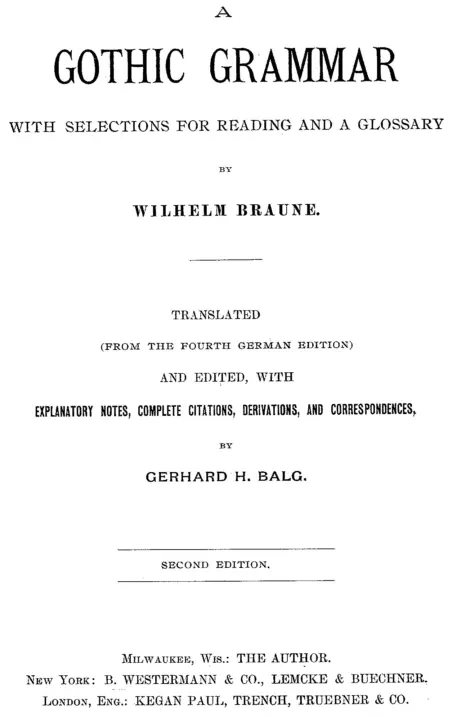
"A Gothic Grammar" by Wilhelm Braune is an academic textbook written in the late 19th century. The work serves as both a comprehensive introduction and an instructional guide for students seeking to learn the Gothic language, emphasizing phonology and inflectional grammar while providing reading selections and a glossary for practical application. The opening of this grammar provides insight into its structure and intended use in an academic context. It first outlines the purpose of the book, which is to aid students in gaining a practical understanding of Gothic, enabling them to follow lectures on historical and comparative grammar. Braune emphasizes that the focus will be on phonology and inflection without relying heavily on comparative grammar. Additionally, it advises beginners on how to approach the chapters, indicating that initial focus should be on phonology before progressing to inflections and reading texts, along with guidance on supplemental resources for deeper study. This sets the stage for a systematic exploration of the intricacies of the Gothic language.
Introduction adapted from the source catalogue; source summaries may be automatically generated.
Free to read · English · 99,757 words · No account needed
MAKE TIME FOR A GOOD BOOK
On by default. Untick to stop anonymous reading totals. Each page counts after 10 seconds in view. How this works.
Anonymous counting is on unless you have switched it off.
Codex E. Eight leavs three of which ar in the Vatican library at Rome, and contain the fragments of an interpretation of the gospel of St. John. They wer calld by their editor (Massmann): =Skeireins aíwaggêljôns þaírh Jôhannên=, and are therefore stil cited as =Skeireins= (concerning which cp. Zs. fda., 37, 320; Anz. fda., 20, 148 et seq.).
4. 'Codex Taurinensis', four considerably damaged leavs with scanty fragments of the epistls to the Galatians and Colossians, which remain to be deciferd.
NOTE 1. Concerning Wulfila, cp. Waitz, 'Ueber das leben und die Lehre des Ulfila' (Hannover 1840); Bessell, 'Ueber das leben des Ulfilas' (Göttingen 1860); G. Kaufmann, 'Kritische untersuchung der quellen zur geschichte Ulfilas', in Zs. fda., 27, 193 et seq.; Grundr. II, 68; Kögel, 'Gesch. der dtsch. Litt.', I, 1, 182.
NOTE 2. For more on the Gothic manuscripts, s. Bernhardt's 'Vulfila', Introduction, p. XXXIX et seq.; for the history of the 'Codex Argenteus', cp. also the recent articls by Schulte, 'Gotthica minora', in Zs. fda., 23, 51. 318 and 24, 324 et seq.: lastly, J. Peters, 'Germania', 30, 314 et seq.
NOTE 3. Beside the translation of the Bible (and the =Skeireins=) there ar no Gothic literary monuments of great moment. The most important ones ar two Latin title deeds with Gothic signatures at Naples and Arezzo, and the abuv (with Codex A) mentiond fragment of a Gothic calendar. The editions of Wulfila contain these remains also. Concerning the Gothic words and alfabets in the Salzburg-Vienna manuscript (§ 1, n. 5; § 2, n. 2) and other remains of the Gothic language, cp. Massmann's articl 'Gotthica minora', in Zs. fda., 1, 294-393.--Concerning Gothic runic inscriptions, s. Wimmer, 'Die runenschrift' (1887), p. 62 et seq.; R. Henning, 'Die deutschen runendenkmäler', Strassburg 1889 (and Zs. fdph., 23, 354 et seq.; Wimmer, 'de tyske runemindesmærker, Aarb. f. nord. oldk. og hist.', 1894, 1 et seq.). The most important inscription is that of the Bukarest ring ('gold-ring of Pietroassa', Henning, 27 et seq.): =gutaniowi hailag=.
NOTE 4. The numerous proper nouns in Gothic, which ar containd in Greek and stil more so in Latin sources, hav been utilized by Dietrich ('Ausspr.') and by Bezzenberger, 'Ueber die A-reihe der got. sprache', Göttingen 1874, p. 7 et seq. A monografic treatment of the East Gothic names has been givn us by F. Wrede, 'Ueber die sprache der Ostgoten in Italien', Strassburg 1891 (OF., 68); cp. review of this book in Litbl. 1891, p. 333; Anz. fda., 18, 43 et seq., 309 et seq.
Your reading position is saved on this browser. Take it to another device with a library code. Reading pages adapt to text, rather than matching a printed edition.
BEHIND THE BOOK
This eBook is for the use of anyone anywhere in the United States and most other parts of the world at no cost and with almost no restrictions whatsoever. You may copy it, give it away or re-use it under the terms of the Project Gutenberg License included with this eBook or online at www.gutenberg.org. If you are not located in the United States, you will have to check the laws of the country where you are located before using this eBook. Read the source licence.
The original source file, including credits and licence, is retained by this library. Request an original-format copy at no charge. Please include the book title and Project Gutenberg identifier #50336.
KEEP YOUR CURIOSITY GOING
Charles Dickens
Violet Hunt
Marjorie Bowen
Edward Lucas White
James Mooney
May Agnes Fleming