THE CLASSIC COLLECTION✦An outlaw’s diary: the CommuneCLASSIC FREE BOOKS
An outlaw’s diary: the Commune
Cécile Tormay
THE CLASSIC COLLECTION · 1911
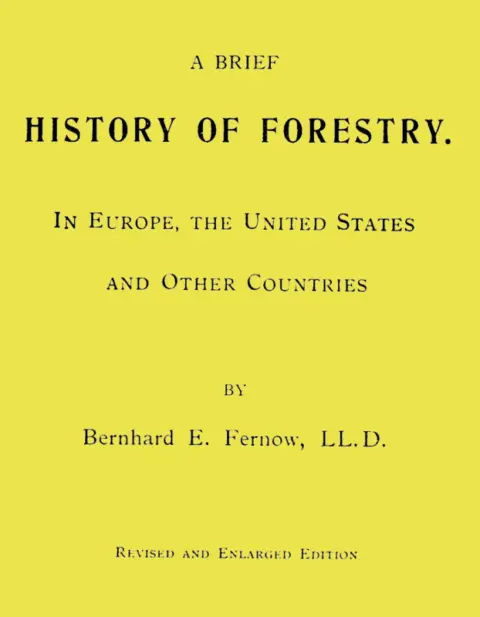
"A Brief History of Forestry" by B. E. Fernow is a historical account written in the early 20th century. The book provides a comprehensive overview of the development of forestry practices and policies across various regions, including Europe and the United States. It likely examines how historical, political, and economic factors have influenced forest management and conservation efforts throughout time. The opening of the text introduces the author’s motivation for compiling this information based on a series of lectures given at Yale University. It emphasizes the importance of understanding the historical context of forestry, as this enables readers to analyze the development of current practices and avoid past mistakes. Fernow highlights how forestry as a discipline has evolved, often dictated by necessity and the pressures of human expansion on natural resources. He sets the stage for a discussion that will span ancient practices to modern conservation measures, revealing how deeply intertwined forestry is with civilization's growth and industrial progress.
Introduction adapted from the source catalogue; source summaries may be automatically generated.
Free to read · English · 128,661 words · No account needed
MAKE TIME FOR A GOOD BOOK
On by default. Untick to stop anonymous reading totals. Each page counts after 10 seconds in view. How this works.
Anonymous counting is on unless you have switched it off.
Three extensive mountain systems, running north and south, give rise to at least eight topographic subdivisions of the country, going from east to west.
1. The narrow belt of level coast and hill country along the Atlantic shore, from 100 to 200 miles in width with elevations up to 1,000 feet, but especially low along the seacoast from Virginia south; drained by short rivers navigable only for short distances from the mouth; a farming country, with the soils varying from the richest to the poorest; some 300,000 square miles.
2. The Appalachian mountain country, nearly of the same width as the first section, with elevations up to 5,000 feet; the watershed of all the rivers to the Atlantic, of several rivers to the Gulf, and of the eastern affluents of the Mississippi; a mountain country, of about 360,000 square miles extent, rich in coal, iron and other minerals, except in its northern extension formed of archean rock.
3. The great river basin of the Mississippi, a Central plain of glacial and river deposit, rising gradually from the Gulf to the headwaters for more than 1200 miles, and nowhere over 1,000 feet above sea level; the richest agricultural section, 700,000 square miles, more or less, in extent.
4. The plateau, rising towards the Rocky Mountains from 1,000 to 5,000 feet above sea level, some 870,000 square miles in extent, a region of scanty rainfall, hence of prairie and plain, but mostly rich soil of undetermined depth, capable of prolific production where sufficient water supply is available.
5. The Rocky Mountain region, rising from 5,000 to near 10,000 feet (except some higher peaks), an arid to semi-arid district of rugged ranges, covered mostly with forest growth, often open and of inferior kind, with tillable soils in the narrow valleys, requiring irrigation for farm use; a mining country, rich in gold and silver, extending over 150,000 square miles.
6. The Sierra Nevada Mountain Range, including the Coast Range, rarely over 7,000 feet elevation, arid to semi-arid on the Eastern slopes; humid, and supporting magnificent forest growth on the Western slopes; some 190,000 square miles.
7. The Interior Basin, lying between the two preceding mountain ranges, some 400,000 square miles; for the most part a desert, although in parts supporting a stunted growth of pinon and juniper, and, where irrigation is possible, productive.
8. The interior valleys of the Sierra, comprising about 30,000 square miles, which, under irrigation, have become the garden spots of the Pacific.
To these topographic subdivisions correspond in part the climatic and the forest conditions, although variation of soil, and of northern and southern climate produce further differentiation in types, and in distribution of field and forest.
Your reading position is saved on this browser. Take it to another device with a library code. Reading pages adapt to text, rather than matching a printed edition.
BEHIND THE BOOK
This eBook is for the use of anyone anywhere in the United States and most other parts of the world at no cost and with almost no restrictions whatsoever. You may copy it, give it away or re-use it under the terms of the Project Gutenberg License included with this eBook or online at www.gutenberg.org. If you are not located in the United States, you will have to check the laws of the country where you are located before using this eBook. Read the source licence.
The original source file, including credits and licence, is retained by this library. Request an original-format copy at no charge. Please include the book title and Project Gutenberg identifier #48874.
KEEP YOUR CURIOSITY GOING
Cécile Tormay

Moritz Busch
John L. Ransom
Frances Wright
Cécile Tormay

Mabel Potter Daggett